
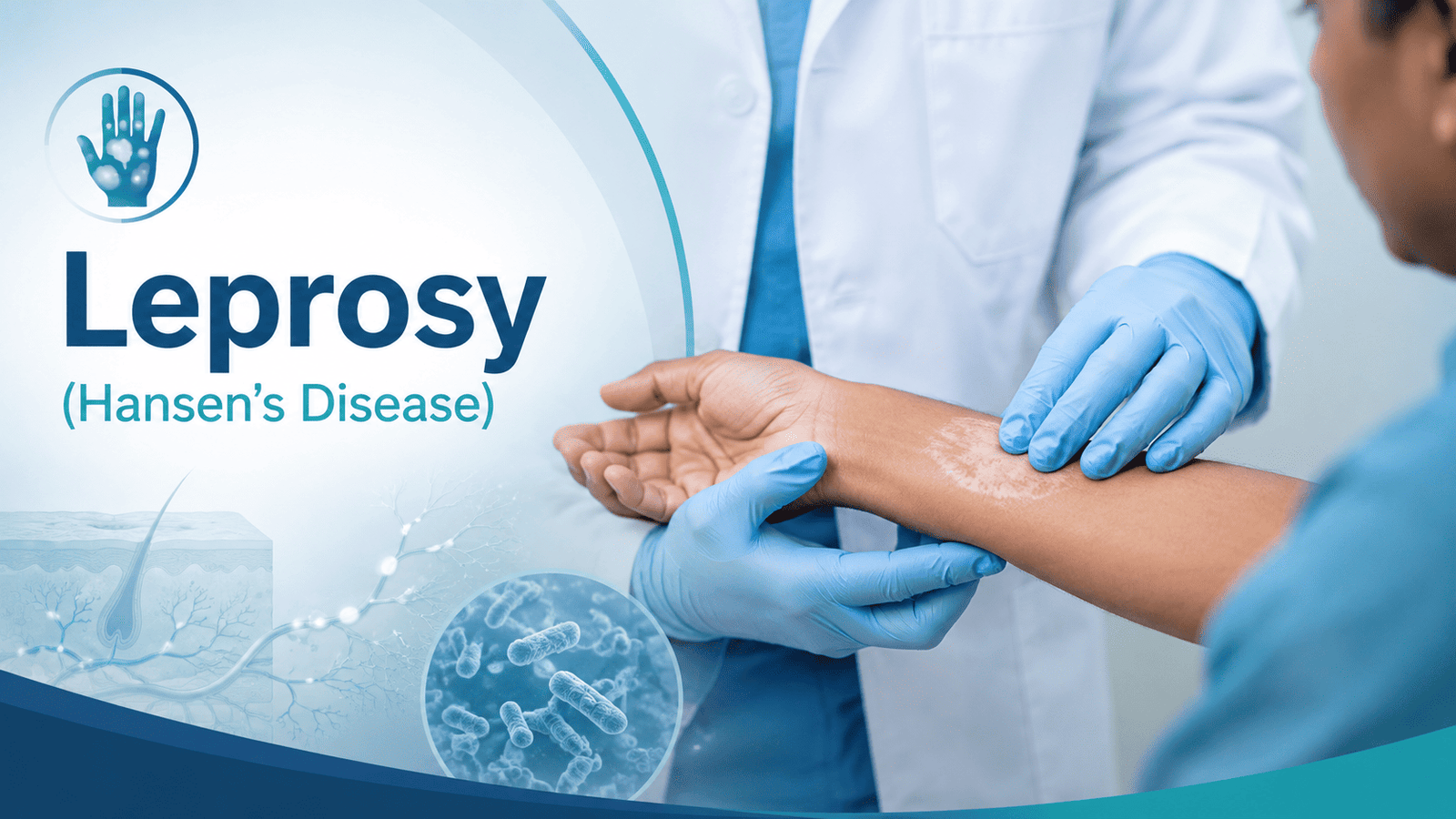
Leprosy (Hansen’s Disease) is a chronic, curable infectious disease caused mainly by Mycobacterium leprae, affecting skin, peripheral nerves, mucosa of the upper respiratory tract, and eyes; early diagnosis and multidrug therapy (MDT) prevent disability and stop transmission.
📌 Key Takeaways: Leprosy (Hansen’s Disease)
- Causative Agent: Chronic granulomatous infection caused primarily by Mycobacterium leprae, affecting the skin, peripheral nerves, and mucosal surfaces.
- Transmission: Transmitted via respiratory droplets during prolonged, close contact with untreated multibacillary cases; non-infectious shortly after starting treatment.
- Cardinal Diagnostic Signs: Loss of sensation in skin patches, enlarged/thickened peripheral nerves, or positive acid-fast bacilli on slit-skin smear.
- WHO Treatment: Curable with Multidrug Therapy (MDT)—PB cases receive Rifampicin + Dapsone (6 months); MB cases receive Rifampicin + Dapsone + Clofazimine (12 months).
Definition:
- Leprosy is a chronic granulomatous infection caused by Mycobacterium leprae (and rarely M. lepromatosis), primarily involving skin and peripheral nerves, with potential involvement of eyes, nasal mucosa, and other organs.
- It is classified as a neglected tropical disease (NTD) and remains endemic in over 120 countries, with India, Brazil, and Indonesia accounting for the majority of new cases.
Causative Agents and Transmission:
1. Causative agent
- Mycobacterium leprae: slow-growing, acid-fast, obligate intracellular bacillus; cannot be cultured in artificial media.
2. Mode of Transmission:
- Primarily via respiratory droplets from untreated multibacillary (MB) cases during prolonged, close contact.
- Not spread through casual contact (handshakes, sharing food, sitting together).
- Patient becomes non-infectious soon after starting MDT.
Reservoirs:
- Humans are the main reservoir: armadillos and some environmental sources implicated in specific regions.
Classification and Types:
Leprosy presents along an immunological spectrum (Ridley-Jopling classification):
| Type | Immune response | Bacillary load | Lessons | Nerve involvement | Infectivity |
|---|---|---|---|---|---|
| Indeterminate | Early, unstable | Very low | 1-few hypopigmented macules | Minimal | Low |
| Tuberculoid (TT) | Strong cell-mediated | Paucibacillary (PB) | A few, well-demarcated hypopigmented/erythematous plaques with loss of sensation | Asymmetric, thickened nerves | Low |
| Borderline Tuberculoid (BT) | Moderate | PB | More lesions than TT, satellite lesions | Moderate | Moderate |
| Borderline Borderline (BB) | Unstable | Intermediate | Annular plaques, “inverted saucer” appearance | Multiple nerves | Moderate-high |
| Borderline Lepromatous (BL) | Weak | Multibacillary (MB) | Numerous, poorly defined lesions and nodules. | Symmetric, widespread | High |
| Lepromatous (LL) | Very weak/absent | MB | Diffuse infiltration, nodules (leonine facies), symmetric nerve damage. | Severe, symmetric | High |
For treatment purposes, the WHO simplifies it to the following:
- Paucibacillary (PB): 1 to 5 skin lesions, no bacilli on smear.
- Multibacillary (MB): more than 5 lesions, nerve involvement, or smear-positive.
Clinical features and symptoms:
1. Early signs:
- Hypopigmented or reddish skin patches with loss of sensation (touch, pain, and temperature).
- Thickened peripheral nerves, e.g., ulnar, median, lateral popliteal, and posterior tibial.
2. Common symptoms:
- Skin lesions that do not heal for weeks or months.
- Numbness/tingling in hands, feet, arms, and legs.
- Muscle weakness, wasting, claw hand, and foot drop.
- Nasal stuffiness, epistaxis, septal perforation.
- Eye involvement: lagophthalmos, iritis, blindness.
- Deformities: contractures, trophic ulcers, and auto-amputation of digits.
Leprosy reactions (acute episodes):
- Type I (reversal) reaction: Type IV hypersensitivity, sudden inflammation of existing lesions, nerve pain, and risk of permanent nerve damage.
- Type II (Erythema Nodosum Leprosum, ENL): Immune complex-mediated; fever, tender nodules, neuritis, arthritis, and orchitis.
Diagnosis:
Cardinal signs (any one sufficient for diagnosis):
- Definite loss of sensation in a hypopigmented/reddish skin patch.
- Thickened/enlarged peripheral nerve with sensory/motor loss.
- Slit-skin smear positive for acid-fast bacilli.
Clinical Diagnosis:
Primarily clinical, based on history and examination by trained health workers.
Diagnostic methods:
- Skin examination: distribution, number, type of lesions; sensory testing with cotton/touch.
- Nerve examination: palpation for thickening, tenderness, and motor/sensory function.
- Slit-skin smear: bacterial index (BI) and morphological index (MI); more useful in MB cases.
- Skin biopsy: histopathology (granulomas, bacilli); used in atypical cases.
- Molecular tests: PCR for M. leprae DNA (research/reference labs).
- Serology: anti-PGL-1 antibodies (supportive, not diagnostic alone).
Treatment:
Multidrug Therapy (MDT)—WHO regimen:
- PB leprosy: Rifampicin + Dapsone for 6 months.
- MB leprosy: Rifampicin + Dapsone + Clofazimine for 12 months.
MDT is free under the National Leprosy Eradication Programme (NLEP) in India.
Management of reactions and complications:
- Type I: Oral corticosteroids (prednisolone) to prevent nerve damage.
- Type II (ENL): Corticosteroids; thalidomide (where approved, with strict controls).
- Nerve function impairment: Physiotherapy, protective care, splints, and reconstructive surgery if needed.
- Ulcer care: wound management, footwear, and infection control.
- Follow-up: Monthly drug refills, adherence counseling, monitoring for reactions, and disability.
Prevention and Control Measures:
1. Primary prevention:
- Early case detection and prompt MDT to interrupt transmission.
- Post -exposure prophylaxis (PEP): Single-dose rifampicin (SDR) for eligible contacts after ruling out active leprosy and TB.
- BCG vaccination: provides partial protection; included in many national schedules.
2. Secondary prevention:
- Regular contact screening (household, neighborhood, and social contacts)
- Surveillance of high-risk groups (slums, tribal areas, migrants).
- Disability prevention and rehabilitation services.
3. Tertiary prevention:
- Reconstructive surgery, physiotherapy, and occupational therapy.
- Socioeconomic rehabilitation, microcredit, and livelihood support.
Environmental & health system measures:
- Integration into general health services.
- Training of ASHAs, ANMs, and medical officers.
- Strengthening referral systems and drug supply chains.
Magnitude and Epidemiology:
1. Global:
- ~ 200,000 new cases reported annually worldwide; > 120 countries still report cases.
- The Southeast Asia region accounts for the majority of global new case detections.
- Elimination at a global level (prevalence < 1/10,000) was achieved in 2000; the focus now is on zero transmission, zero disability, and zero discrimination.
2. India:
- India contributes the highest number of new cases globally, along with Brazil and Indonesia.
- The prevalence rate declined from 57.2/10,000 (1981) to 0.57/10,000 (2025).
- Proportion of child cases (indicator of recent transmission) fell from 9.04% (2014-15) to 4.68% (2024-25).
- Endemic pockets persist in states like Uttar Pradesh, Bihar, Jharkhand, Chhattisgarh, Odisha, Maharashtra, and some northeastern states.
3. Global risk:
- Continued transmission in high-burden countries poses the risk of importation to low-endemic areas.
- Drug-resistant strains and delayed diagnosis increase the risk of disability and onward transmission.
Public Awareness, Community Engagement & IEC Materials:
Objectives:
- Promote early recognition of symptoms and help-seeking.
- Reduce stigma and discrimination.
- Encourage contact screening and treatment adherence.
IEC/BCC strategies (as per WHO & NLEP):
- Posters, leaflets, and flip charts showing early signs (insensitive patches, nerve thickening)
- School programs: Leaflets and pictograms for school medical inspection.
- Street plays (Nukkad Natak), cultural programs, and testimonials from cured persons.
- Self-examination for minors, interactive quizzes, and pledge campaigns against discrimination.
- Radio/TV spots, social media campaigns around National Leprosy Day (30 January)
Evidence shows focused IEC with community volunteers sustains knowledge and improves early detection.
Role of Public Health Department:
At the national/state level, e.g., NLEP, India:
- Policy formulation, planning, and resource allocation.
- Procurement and distribution of MDT drugs and diagnostic kits.
- Training of health personnel and supervision of districts.
- Monitoring and evaluation: case detection rates, treatment completion, and disability grades.
- Coordination with NGOs and international partners (WHO, global partnership for zero leprosy).
At the district/PHC levels:
- Active case finding through surveys, camps, and outreach.
- Ensuring contact tracing and SDR-PEP implementation.
- Maintaining leprosy registers and reporting to state / national dashboards.
- Organizing IEC activities, school health programs, and community meetings.
- Referral for reactions, disability management, and reconstructive surgery.
- Integration with general health services, TB programs, and NCD clinics.
Key Challenges and Priorities:
- Hidden cases due to stigma and low awareness in marginalized communities.
- Diagnostic delays leading to grade 2 disabilities at presentation.
- Need for simplified field-friendly diagnostics, e.g., rapid tests.
- Strengthening contact management and PEP coverage.
- Sustaining political commitment and funding as prevalence declines.