
A snakebite is a medical emergency because venom can damage tissues, cause blood clotting, and damage nerves and the heart, and it can become fatal without prompt treatment.
Globally, snakebites affect nearly 5 million people each year, with about 94,000 to 125,000 deaths and many more disabilities.
A snakebite is an injury caused by snake fangs piercing the skin; some bites are “dry” and do not inject venom, but every bite should be treated seriously. Venom can act in different ways: it may cause local swelling and tissue injury, bleeding problems, paralysis, or cardiac effects.
1. Introduction and History:
Snakes are elongated reptiles in the order Squamata and suborder Serpentes. Fossil evidence indicates that snakes had already diversified by the jurassic period; some of the oldest known snake fossils are approximately 167 to 143 million years old. Their ancestors were probably lizard-like animals, although the precise evolutionary pathway—burrowing, aquatic, or terrestrial—remains debated. Early snakes possessed small hind limbs, which were gradually lost during evolution.
Snakes are important predators. They control populations of rodents, frogs, insects, birds, and other animals and therefore help protect crops and maintain ecological balance. Most snakes are non-venomous or harmless to humans; only a minority are medically important.
Terminology: “Venomous” is the correct scientific term for snakes that inject toxins through fangs.”Poisonous” usually refers to organisms that cause harm when eaten or touched.
2. Spiritual and cultural importance:
Snakes have had religious and symbolic importance in many societies:
- India: The cobra is associated with Lord Shiva, Lord Vishnu’s serpent Ananta/Shesha, and the festival of Nag Panchami. Snakes may symbolize fertility, protection, regeneration, rain, and spiritual power.
- Ancient Egypt: The cobra, or uraeus, represented royal authority, protection, and divine power.
- Ancient Greece: The serpent was associated with Asclepius, the god of healing; the Rod of Asclepius remains a medical symbol.
- Judaism and Christianity: The serpent has a different meaning, including temptation, danger, healing, and transformation.
- Mesoamerican cultures: The feathered serpent, such as Quetzalcatl, represented creation, knowledge, wind, and renewal.
- Buddhist and Southeast Asian Traditions: Naga serpents are connected with water, fertility, guardianship, and protection.
These beliefs are culturally significant, but people should not handle workship closely or attempt to capture live snakes. Respect for cultural traditions must be combined with safety and conservation.
C) Major venomous snakes of the world:
Venomous snakes occur mainly in two medically important families:
- Elapidae: cobras, kraits, mambas, coral snakes, taipans, death adders, and sea snakes. Their venom is often neurotoxic, although some species also cause tissue injury or bleeding.
- Viperidae: vipers and pit vipers, including rattlesnakes, adders, lanceheads, and saw-scaled vipers. Their venom commonly causes bleeding, clotting disorders, swelling, tissue destruction, and kidney injury.
Examples of important venomous snakes include:
| Region | Examples |
|---|---|
| Africa | Black mamba (Dendroaspis polylepis), puff adder (Bitis arietans), Gaboon viper (Bitis gabonica), Egyptian cobra (Naja haje) |
| Australasia and New Guinea | Inland taipan (Oxyuranus microlepidotus), coastal taipan (Oxyuranus scutellantus), eastern brown snake (Pseudonaja textilis), death adder (Acanthophis species) |
| Asia | King cobra (Ophiophagus santoniae), monocled cobra (Naja kaouthia), common krait (Bungarus caeruleus), and Russell’s viper (Daboia russelii) |
| North and South America | Eastern diamondback rattlesnake (Crotalus adamanteus), fer-de-lance (Bothrops asper), bushmaster (Lachesis muta), coral snakes (Micrurus species) |
| Oceans and coastal waters | Yellow-bellied sea snake (Hydrophis platurus), beaked sea snake (Hydrophis schistosus) |
The “most dangerous” snake depends not only on venom potency but also on its abundance, behavior, contact with humans, amount of venom delivered, and availability of treatment.
D) Important venomous snakes in India:
India has more than 310 snake species, of which approximately 60 are venomous. The traditional medically important group is the Big Four.
- Indian or spectacled cobra – Naja naja
- Common krait – Bungarus caeruleus
- Russell’s viper—Daboia russelii
- Indian saw-scaled viper—Echis carinatus
Other medically important Indian snakes include:
- King cobra—Ophiophagus hannah
- Monocled cobra—Naja kaouthia
- Many banded or wall’s krait—Bungarus walli
- Hump-nosed pit vipers—Hypnale species
- Malabar pit viper – Craspedocephalus malabaricus
- Bamboo pit viper – Craspedocephalus gramineus
- Green pit vipers—Trimeresurus and related species
- Levantine or mountain vipers in parts of northern and western India
- Andaman cobra and other regional species
The Big Four cause many serious bites, but the species responsible varies geographically. Commercial antivenom may not neutralize every regional venom equally well because venom composition differs between species and even between populations of the same species.
E) How venom affects the human body:
Snake venom is a mixture of enzymes, proteins, peptides, and toxins. Its effects depend on the species, bite location, amount of venom, and the victim’s age and health.
| Venom effect | Main body systems affected | Typical effects |
|---|---|---|
| Neurotoxic | Nerves, neuromuscular junction, respiratory muscles | Drooping eyelids, double vision, difficulty speaking or swallowing, weakness, paralysis, respiratory failure |
| Hemotoxic and procoagulant | Blood vessels, platelets, clotting system | Persistent bleeding, bruising, blood in urine, abnormal clotting, shock, internal bleeding |
| Cytotoxic | Skin, muscle, connective tissue | Pain, swelling, blisters, bruising, tissue death, secondary infection, and possible amputation. |
| Myotoxic | Skeletal muscle and kidneys | Severe muscle pain, muscle breakdown, dark urine, kidney failure |
| Nephrotoxic or systemic | Kidneys and circulation | Reduced urine, acute kidney injury, low blood pressure, shock |
| Cardiotoxic or autonomic | Heart and autonomic nervous system | Abnormal heart rhythm, sweating, vomiting, blood pressure changes |
Some bites produce little pain or swelling initially, especially certain krait bites. Therefore, the absence of dramatic local symptoms does not prove that a bite is harmless.
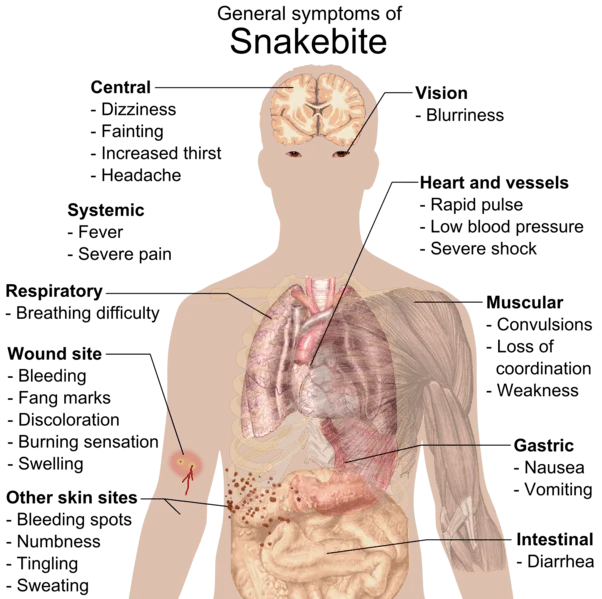
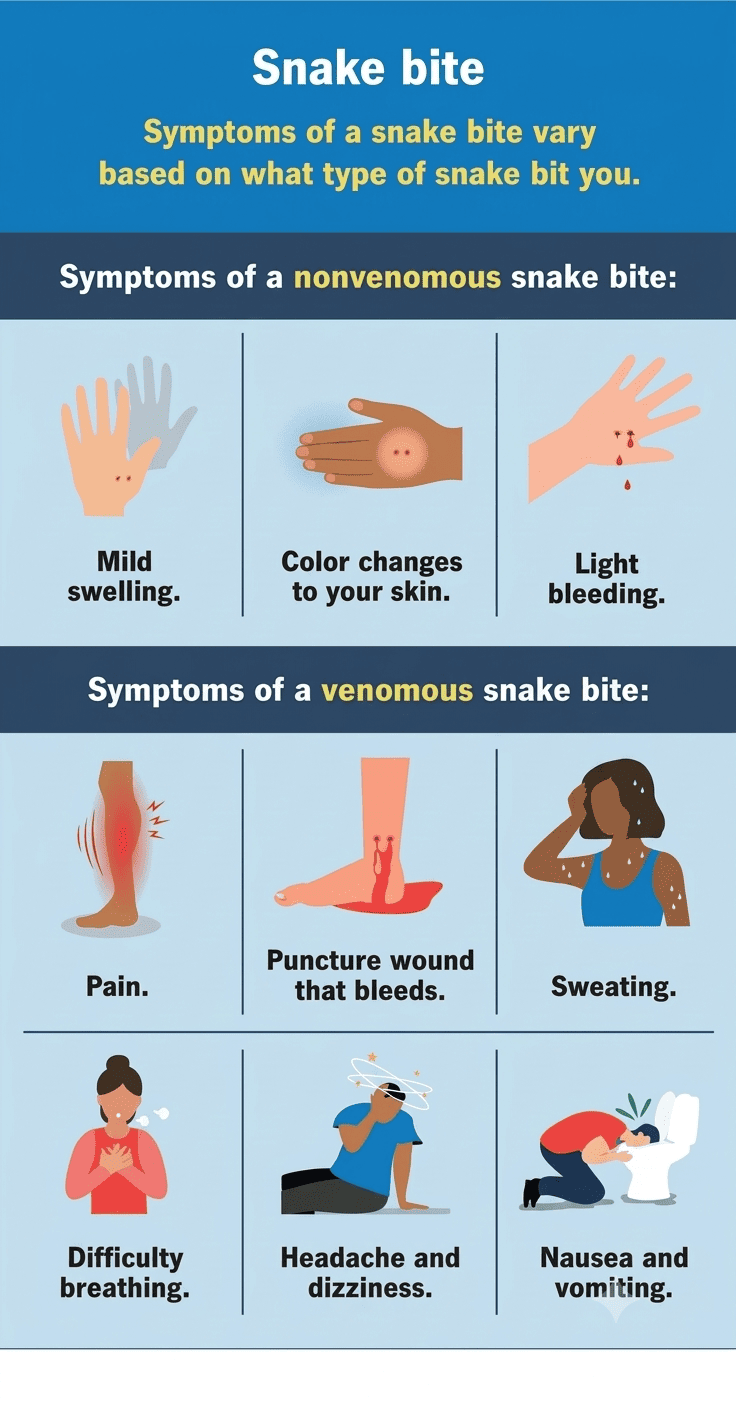
F) Symptoms and warning signs:
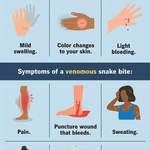
Symptoms may appear within minutes or may be delayed for several hours. Warning signs include:
1. Local symptoms:
- Fang marks or scratches, although marks may be absent.
- Pain or burning
- Incresing swelling.
- Redness, bruising, blistering, or bleeding.
- Numbness or tingling.
- Tissue discolouration or necrosis.
2. Neurological symptoms:
- Drooping eyelids.
- Blurred or double vision.
- Difficulty speaking, swallowing, or controlling saliva,
- Weakness of the face, neck, arms, or legs.
- Increasing sleepiness or paralysis.
- Shallow or difficult breathing.
3. Bleeding and circulatory symptoms:
- Bleeding from the bite, gums, nose, or injection sites.
- Blood in urine or vomit.
- Large bruises or spontaneous bleeding.
- Severe weakness, fainting, cold clammy skin, or shock.
4. Other symptoms:
- Nausea and vomiting.
- Abdominal pain.
- Sweating or dizziness.
- Muscle pain and dark urine.
- Reduced urine output.
- Confusion, seizures, coma, or collapse.
A suspected venomous bite is a medical emergency even when symptoms are initially mild.