
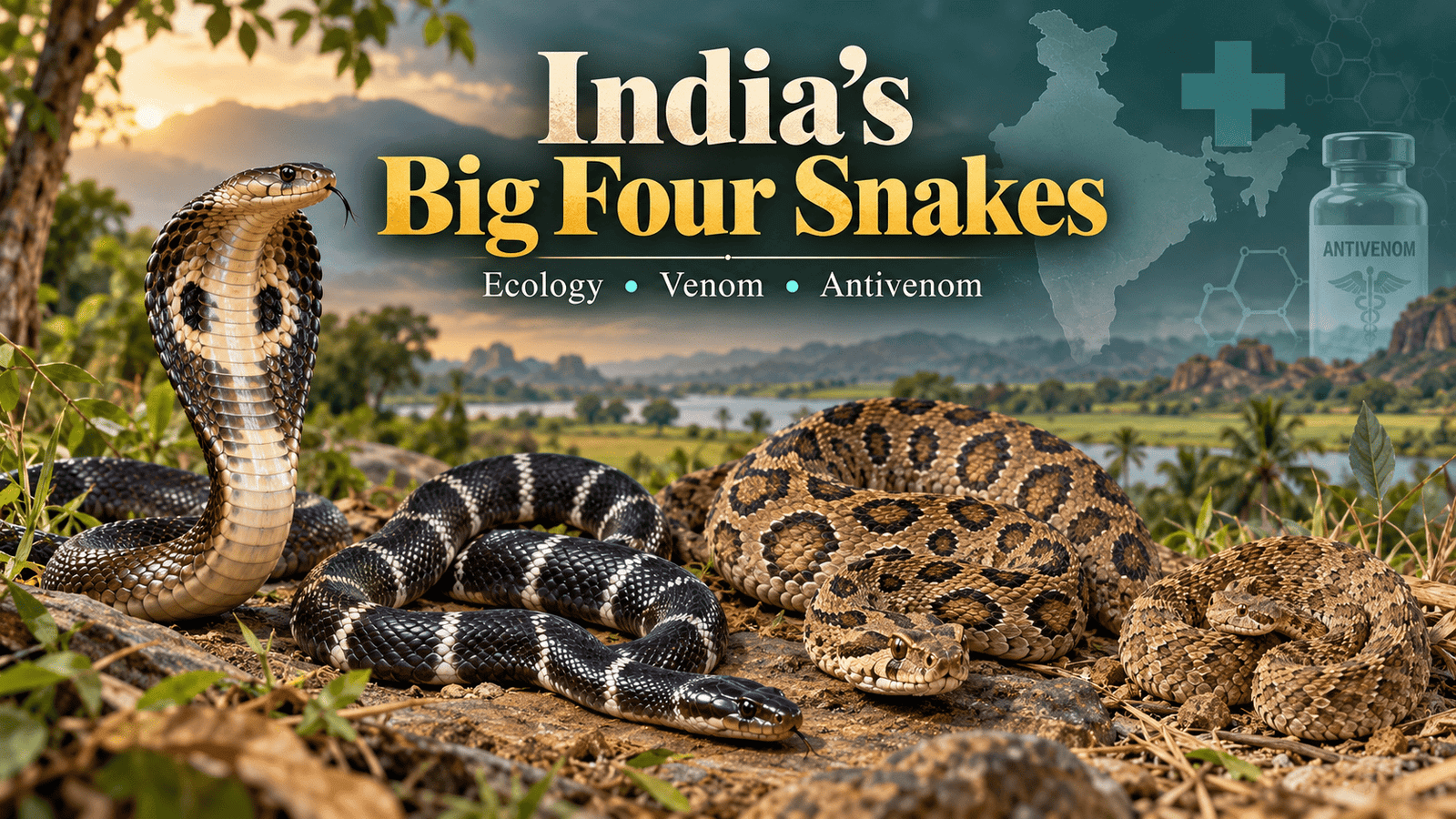
The phrase “Big Four snakes” refers to the four venomous species responsible for the majority of serious snakebite cases in India. Their “function” is primarily medical and public health significance, not an ecological role. They are the main drivers of snakebite morbidity and mortality, and they shape India’s antivenom production and treatment protocols.
Which are the 4 Most Venomous Snakes in India?
Spectacled cobra (Naja naja)
Common krait (Bungarus caeruleus)
Russell’s viper (Daboia russelii)
Saw-scaled viper (Echis carinatus)
These species are widespread, often live near human settlements, and are responsible for an estimated ~ 90% of significant snakebite envenomings in India.
Why are they called the “Big Four”?
The label was created for public health and pharmaceutical reasons, not because they are the largest snakes.
- Historically, epidemiological data showed these four species accounted for most fatal and severe bites.
- India’s polyvalent antivenom (the standard “ASV” used in hospitals) was formulated specifically to neutralize the venoms of these four species.
- This focus allowed manufacturers to standardize production and clinicians to use a single antivenom for most serious cases.
Why Are They Important?
- Medical impact: These four species cause most life-threatening snakebites and deaths in India.
- Antivenom production: Indian polyvalent antivenom is specifically made to neutralize the venoms of these four snakes.
- Treatment guidelines: Hospital protocols for snakebite are largely built around envenoming by these species.
Limitations of the “Big Four”:
Recent research highlights that focusing only on these four can miss other dangerous species, e.g., hump-nosed pit vipers, some sea snakes, and regional kraits.
- Some areas have significant bites from non-Big Four snakes whose venoms are not well neutralized by the standard antivenom.
- This has led to calls to expand antivenom coverage and improve species-specific diagnosis.
- Even so, the Big Four remain the core framework for snakebite management in India.
The Big Four and Their Functions:
| Snake | Scientific Name | Main ecological function | Main medical effect |
|---|---|---|---|
| Spectacled Cobra | Naja naja | Control rats, mice, frogs, lizards, and other small animals | Mainly neurotoxic: may also cause local tissue damage. |
| Common Krait | Bungarus caeruleus | Control rodents and other snakes, especially in agricultural areas | Powerful neurotoxic venom causing paralysis and respiratory failure |
| Russell’s viper | Daboia russelli | Helps regulate rodent populations in fields and grasslands | Causes clotting failure, bleeding, tissue injury, shock, and kidney damage |
| Swa-scaled viper | Echis carinatus | Control rodents, lizards, insects, and other small prey in dry regions | Causes severe bleeding, abnormal clotting, swelling, and tissue injury |
1. Ecological functions:
a) Rodent and pest control:
All four species eat animals such as rats, mice, frogs, lizards, and other small vertebrates. By reducing rodent numbers, they can help:
- Protect stored grain and standing crops.
- Reduce crop damage.
- Limit the spread of some rodent-associated diseases.
- Maintain balance in agricultural and grassland ecosystems.
This is particularly important in rural India, where rodents can cause significant agricultural losses.
b) Maintaining food webs:
The Big Four are both predators and prey. They:
- Control populations of smaller animals.
- Provide food for predators such as birds of prey, mongooses, and larger mammals.
- Help maintain biodiversity and natural food-chain relationships.
The common krait also eats other snakes, while the cobra consumes reptiles, amphibians, birds, and small mammals.
c) Natural selection and ecosystem health:
As predators, these snakes influence the abundance and behavior of the prey. Their presence is an indicator of the functioning habitats, such as farms, scrublands, grasslands, forests, and village edges. They should therefore be conserved rather than indiscriminately killed.
2. Medical significance:
Their major “function” from a public health perspective is that their venom can cause severe human envenoming:
- Cobra: nerve paralysis and sometimes local tissue destruction.
- Common Krait: Progressive muscle paralysis, often with little pain or swelling at first.
- Russell’s viper: Bleeding, clotting failure, shock, kidney injury, and tissue damage.
- Swa-scaled viper: severe clotting abnormalities, bleeding, swelling, and local tissue injury.
These species are medically important because they are relatively common in areas where people work and live, and the Indian polyvalent antivenom is primarily designed against the venoms.
The Big Four are not the only dangerous snakes in India. Species such as the king cobra, the monocled cobra, the hump-nosed pit viper, and several regional pit vipers can also cause serious or fatal bites. The Big Four classification is a public health and antivenom category, not a complete list of all venomous Indian snakes.
In short, the Big Four perform valuable ecological services—especially rodent control and foodweb regulation—but their venom makes them a major medical concern. The safest approach is habitat conservation, avoidance, and immediate hospital treatment after any suspected bite, never attempting to catch or kill them.
Why Are Only Four Species Used to Produce Indian Antivenom?
India uses venom from the Big Four—spectacled cobra, common krait, Russell’s viper, and swa-scaled viper—because they historically caused a large proportion of serious and fatal snakebites, and using four venoms makes one polyvalent antivenom practical to manufacture and distribute. WHO India states that these four are associated with about 90% of reported snakebites, although the proportion varies by region.
How Polyvalent Antivenom is Produced from Snake Venom
- Venom is collected from the four selected species.
- The venoms are pooled and injected in small, controlled amounts into horses.
- The horses produced antibodies against venom toxins.
- Antibody-rich plasma is collected, purified, tested, and formulated as polyvalent anti-snake venom.
Thus, the antivenom is not made from the snakes, bodies. It is made from purified antibodies produced by immunized horses. Indian polyvalent antivenom is produced using venom from the Big Four species.
Why not include every venomous snake?
1. The Big Four cause many severe bites:
Including the most frequently encountered medically important species, it provides the greatest public health benefit with one product. Producing a separate antivenom for every venomous species would require more venom collection, animal immunization, testing, manufacturing, storage, and expense.
2. Antivenom production is technically difficult:
Antivenom manufacturing requires:
- Reliable collection of correctly identified venom.
- Safe and standardized venom doses.
- Suitable donor animals.
- Extensive quality and safety testing.
- Adequate production capacity and cold-chain distribution.
Adding many species would make the product more expensive and difficult to supply, especially in rural hospitals.
3. A practical “polyvalent” product is easier to use:
In many emergencies, the snake is not identified. A polyvalent antivenom covering several common species allows doctors to begin treatment based on clinical signs and laboratory findings rather than waiting for exact identification.
4. Important limitation:
The Big Four antivenom is not a universal antidote for every Indian snake. India has many other medically important snakes, including monocled cobras, king cobras, hump-nosed pit vipers, and several regional pit vipers. The standard product may not adequately neutralize all of their venoms. There is also a major geographic problem: commercial venom is predominantly collected from limited areas of southern India, while venom compositions can vary considerably between populations of the same species. Consequently, an antivenom made from southern populations may be less effective against some Big Four snakes from northern, eastern, or western India.
Why this matters clinically:
A patient should not be denied urgent hospital care because the snake is unknown or appears not to be one of the Big Four. Doctors determine whether antivenom is needed from:
- Progressive paralysis
- Abnormal blood clotting or bleeding.
- Rapidly increasing swelling or tissue injury.
- Shock or systemic symptoms.
- Laboratory findings and repeated clinical examination.
Increasingly, experts recommend region-specific antivenoms, improved venom surveillance, better diagnostic tests, and antivenoms that cover a wider range of medically important Indian snakes.
How Researchers Extract and Process Venom from the Big Four Snakes:
Researchers do this work only in licensed venom laboratories or snake farms, using trained herpetologists, veterinarians, protective equipment, and strict biosafety procedures. It should never be attempted by the public.
1. Selecting the snakes:
For Indian polyvalent antivenom, venom is collected from the four traditional medically important species:
- Spectacled cobra (Naja naja)
- Common krait (Bungarus caeruleus)
- Russell’s viper (Daboia russelii)
- Saw-scaled viper (Echis carinatus)
Researchers first confirm the species and record the snake’s location, sex, size, health, and collection date. This matters because venom composition can vary between regions and even between individuals of the same species. WHO recommends using well-identified, healthy snakes and representative venom samples from the region where the antivenom will be used.
2) Venom “extraction”—milking:
A trained handler restrains the snake’s head using specialized equipment. The snake is encouraged to bite through a sterile collection membrane or container so that venom from the venom glands is released into the container.
The handler must prevent:
- A bite to the handler
- Contamination of the venom.
- Injury to the snake.
- Mixing venom from incorrectly identified species.
Sick, injured, or gravid snakes are generally excluded from collection. Detailed records, and, where appropriate, photographic or voucher records, are kept for traceability. The venom is collected separately from each species. Cobra and krait venoms are not mixed with viper venoms at the collection stage unless a validated manufacturing protocol specifically requires a defined pooled mixture.
3) Initial handling and preservation:
After collection, the venom is
- Labelled with species, locality, date, and batch information.
- Kept cold and protected from contamination.
- Frozen as soon as possible.
- Sometimes centrifuged or filtered under controlled laboratory conditions to remove debris.
- Freeze-dried, or lyophilized, to improve long-term stability.
- Stored under controlled temperature and humidity conditions.
The exact preparation method varies by manufacturer. The important principles are rapid preservation, traceability, sterility, and maintaining the venom’s relevant antigenic components. WHO guidance emphasizes that venom should be frozen promptly after collection.
4) Preparing the immunizing venom mixture:
Laboratories determine the amount of venom from each Big Four species required for the immunization program. The material is carefully standardized and may be pooled to represent several populations rather than a single snake. The mixture is then formulated into an immunogen. It is administered to selected horses in gradually increasing, medically supervised doses. The horses are not meant to become dangerously ill; the goal is to stimulate their immune systems to produce antibodies against the venom toxins. Horses undergo veterinary examination, quarantine, vaccination, parasite control, and continuing health monitoring. WHO stresses that healthy, well-cared-for donor animals are essential to the quality and safety of the final antivenom.
5. Collecting antibody-rich plasma:
After the horses develop a strong antibody response, blood or plasma is collected under veterinary supervision. The plasma contains antibodies that recognize and bind to venom toxins. In modern facilities, plasma collection methods are designed to reduce harm to the horses. Red blood cells may be returned to the animal through plasmapheresis or related procedures, depending on the facility and regulatory system.
The collected plasma is pooled and tested for:
- Antibody activity.
- Contamination.
- Sterility.
- Protein concentration.
- Safety and consistency.
6. Purifying the antivenom:
The antibody-containing plasma is processed to obtain immunoglobulins or antibody fragments. Depending on the manufacturer, processing can include:
- Fractionation of plasma.
- Removal of unwanted proteins.
- Enzyme digestion to produce antibody fragments such as F(ab)₂ or Fab.
- Filtration and concentration.
- Addition of stabilizers.
- Sterile filling into vials.
WHO describes antivenoms as products made by harvesting and purifying antibodies from plasma produced by donor animals.
7. Testing the finished product:
before release, each batch undergoes quality-control testing for:
- Identity and composition.
- Sterility.
- Purity.
- Potency against the relevant venoms.
- Absence of harmful contamination.
- Stability during storage.
- Appropriate labelling and expiry date.
The final product is usually a polyvalent antivenom, meaning it contains antibodies against more than one snake venom. It does not contain venom in a quantity intended to poison the patient; it contains purified antibodies capable of binding and neutralizing venom toxins.
Thus, researchers carefully collect venom from correctly identified Big Four snakes, rapidly preserve and characterize it, use it to immunize healthy horses, harvest antibody-rich plasma, purify the antibodies, and test the final polyvalent antivenom for safety and potency.