
Understanding proper Snake Bite Treatment, including immediate first aid and hospital medical care, is essential for saving lives.
1. Immediate first aid and treatment:
What to do
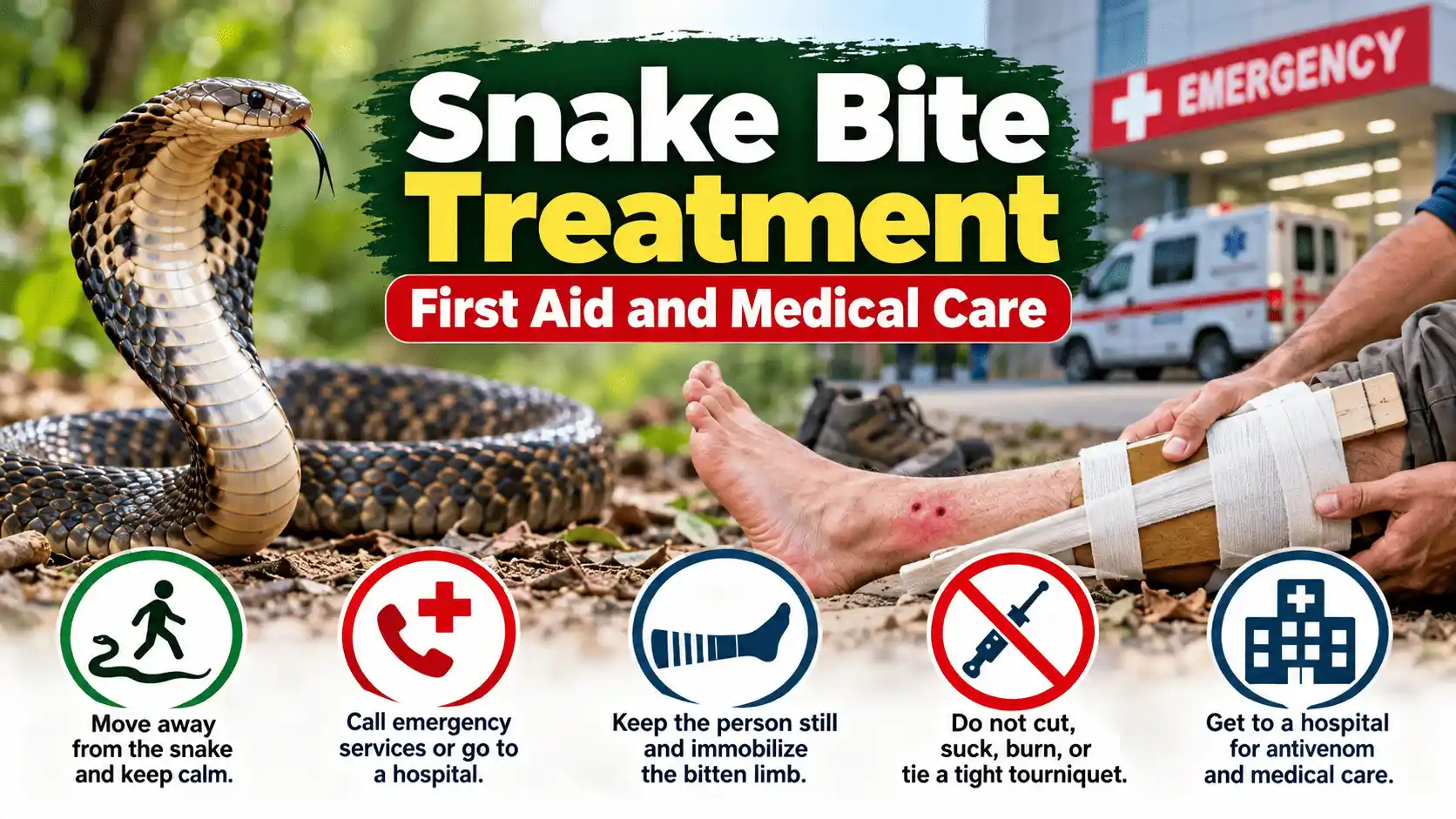
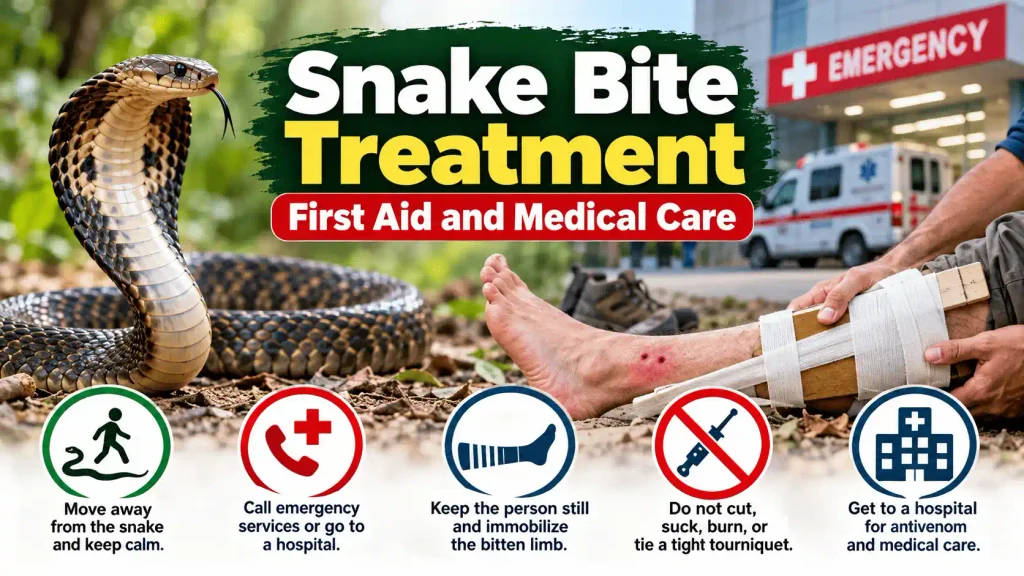
- Move away from the snake and keep the person calm.
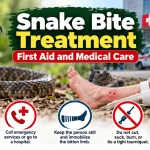
- Call emergency services or arrange immediate transport to a hospital.
- Keep the person still; immobilize the bitten limb with a splint or sling.
- Remove rings, watches, anklets, shoes, and tight clothing before swelling increases.
- Keep the person in a safe position and monitor breathing.
- If vomiting or unconsciousness occurs but breathing continues, place the person in the recovery position.
- If safe, take a photograph of the snake from a distance; do not try to catch or kill it.
- Note the time of the bite and the progression of symptoms.
Hospital snake bite treatment involves clinical evaluation and antivenom administration
WHO recommends reassurance, complete immobilization, rapid transport, airway and breathing monitoring, and avoidance of traditional harmful methods.
What not to do:
- Do not cut, burn, or excise the wound.
- Do not suck or attempt to extract venom.
- Do not apply a tight arterial tourniquet.
- Do not use a “black stone,” herbs, chemicals, ice, or electric shock.
- Do not give alcohol or sedative medicines.
- Do not delay hospital treatment while waiting for symptoms.
- Do not attempt to handle the snake for identification.
Incision, suction, “black stones,” and tight tourniquets can worsen tissue injury, bleeding, ischemia, infection, or disability.
2. Hospital Snake bite treatment:
Treatment may include:
- Assessment of airway, breathing, circulation, consciousness, and swelling.
- Repeated neurological examinations and clotting tests.
- Snake antivenom, when clinical signs indicate significant envenoming.
- Oxygen-assisted ventilation or mechanical ventilation for paralysis.
- Blood products and treatment of severe bleeding or clotting disorders.
- Intravenous fluids and treatment of shock.
- Kidney monitoring, dialysis when required, and management of muscle injury.
- Wound care, antibiotics only when clinically indicated, tetanus protection, and surgery for established tissue damage.
- Rehabilitation for weakness, amputation, scarring, or psychological trauma.
Antivenom is the specific treatment capable of neutralizing venom and is on the WHO list of essential medicines. It must be administered by trained medical personnel because allergic and other serious reactions can occur.
3. Global magnitude and risk:
WHO estimates that approximately 4.5 to 5.4 million people are bitten by snakes each year. About 1.8 to 2.7 million develop clinical envenoming, and approximately 81,000 to 138,000 die. Many more survivors suffer permanent disability, disfigurement, amputations, kidney injury, and psychological or economic harm.
The highest risks occur in:
- Rural and agricultural communities.
- Tropical and subtropical regions.
- Areas with poor housing, inadequate lighting, and limited transport.
- Communities where people walk barefoot or work outdoors.
- Places where hospitals lack antivenom, ventilation, blood products, or trained staff.
- Regions where traditional treatment delays hospital care.
Snake bite is classified by WHO as a neglected tropical disease because it disproportionately affects poorer communities and is often underreported.
4. Snakebite risk in India:
India is one of the countries most affected by snake bite. Estimates differ because many bites occur at home or are treated outside formal health facilities. A nationally representative mortality study estimated approximately 58,000 snake bite deaths per year in India, while older estimates and official records have reported lower figures.
Risk is especially high among:
- Farmers, plantation workers, forest workers, construction workers, and sanitation workers.
- People sleeping on floors.
- Children, older adults, and people living in poorly lit rural homes.
- People walking barefoot at night.
- Communities in monsoon-affected and flood-prone regions.
- People who use traditional healers before reaching a hospital.
Important barriers include long travel distances, lack of transport, antivenom shortages, limited intensive-care capacity, cost of treatment, fear, and belief that a snake must be identified before medical care begins.
5. Prevention and control measures:
Household and personal prevention
- Wear shoes or boots and long trousers outdoors ,especially at night.
- Use a torch or flashlight after dark.
- Avoid putting hands into holes, wood piles, rock crevices, drains, or thick vegetation.
- Use a stick to disturb vegetation or debris before stepping or reaching into it.
- Keep grass, rubbish, firewood, and building materials away from houses.
- Store firewood above ground and away from walls.
- Keep food waste controlled to reduce rodents, which attract snakes.
- Use well-tucked mosquito nets and raised sleeping arrangements where appropriate.
- Keep children away from snakes and teach them not to touch or chase them.
- Do not try to kill or capture a snake.
- Don’t sleep on floors
6. Community control:
- Improve lighting on paths, around homes, schools, farms, and health facilities.
- Maintain clean compounds and safe drainage.
- Establish rapid transport and emergency referral systems.
- Train community health workers in first aid and referral.
- Ensure hospitals have appropriate antivenom and resuscitation equipment.
- Promote humane snake rescue and conservation rather than indiscriminate killing.
- Use local-language education adapted to regional snake species and customs.
Prevention is preferable to snake removal through indiscriminate killing because snakes perform important ecological functions.
7. Public awareness:
Effective awareness messages should be simple and repeated through schools, villages, agricultural programs, radio, television, social media, and health workers:
- “A snakebite is an emergency—go to a hospital immediately.”
- “Keep the patient still and immobilize the limb.”
- “Do not cut, suck, burn, or tie a tight tourniquet.”
- “Do not delay treatment for snake identification.”
- “Do not use traditional remedies in place of antivenom.”
- “Avoid handling dead snakes; reflex bites can occur.”
- “Use footwear, lighting, and mosquito nets.”
- Public awareness about proper snake bite treatment helps prevent delays in care.
Awareness programs should also address myths: not every snake is dangerous, but every suspected venomous bite requires urgent assessment; charms and herbal remedies cannot neutralize venom; and a person should not be forced to walk to the hospital.
8. Role of public health department:
Public health authorities have responsibilities at several levels:
Surveillance and data:
- Make snakebite cases and deaths routinely reportable.
- Collect information on location, occupation, and age. species if known, treatment delay, antivenom use, disability, and outcome.
- Map seasonal and geographic hotspots.
- Include deaths occurring outside hospitals.
WHO recommends stronger community and hospital surveillance because official data often underestimate the true burden.
9. Health-system strengthening:
- Ensure affordable, quality-assured antivenom at appropriate hospitals
- Maintain stock inventories, cold-chain systems where required, and reliable distribution.
- Train doctors, nurses, emergency workers, and community health workers.
- Strengthen airway management, ventilation, dialysis, blood bank, laboratory, and surgical capacity.
- Establish referral pathways and 24-hour emergency transport.
- Monitor antivenom effectiveness, adverse reactions, and regional venom variation.
10) Community engagement:
- Provide culturally appropriate prevention and first-aid education.
- Work with schools, farmer groups, local governments, tribal communities, and traditional systems.
- Establish telephone helplines and emergency guidance.
- Support safe snake rescue and conservation programs.
11) Policy and research:
- Develop regional antivenoms where current products have limited coverage.
- Support research on venom variation, diagnostics, antivenom dosing, disability, rehabilitation, and affordable treatment.
- Include snakebite care in primary health care planning.
- Work toward WHO’s goal of reducing snakebite deaths and disability by 50% by 2030 through community engagement, effective treatment, stronger health systems, and partnerships.
The most important life-saving action is rapid transport to a properly equipped hospital while keeping the patient still and avoiding harmful traditional first aid. Antivenom, respiratory support, treatment of bleeding, kidney care, and timely emergency management can prevent many deaths and long-term disabilities.