

Definition:
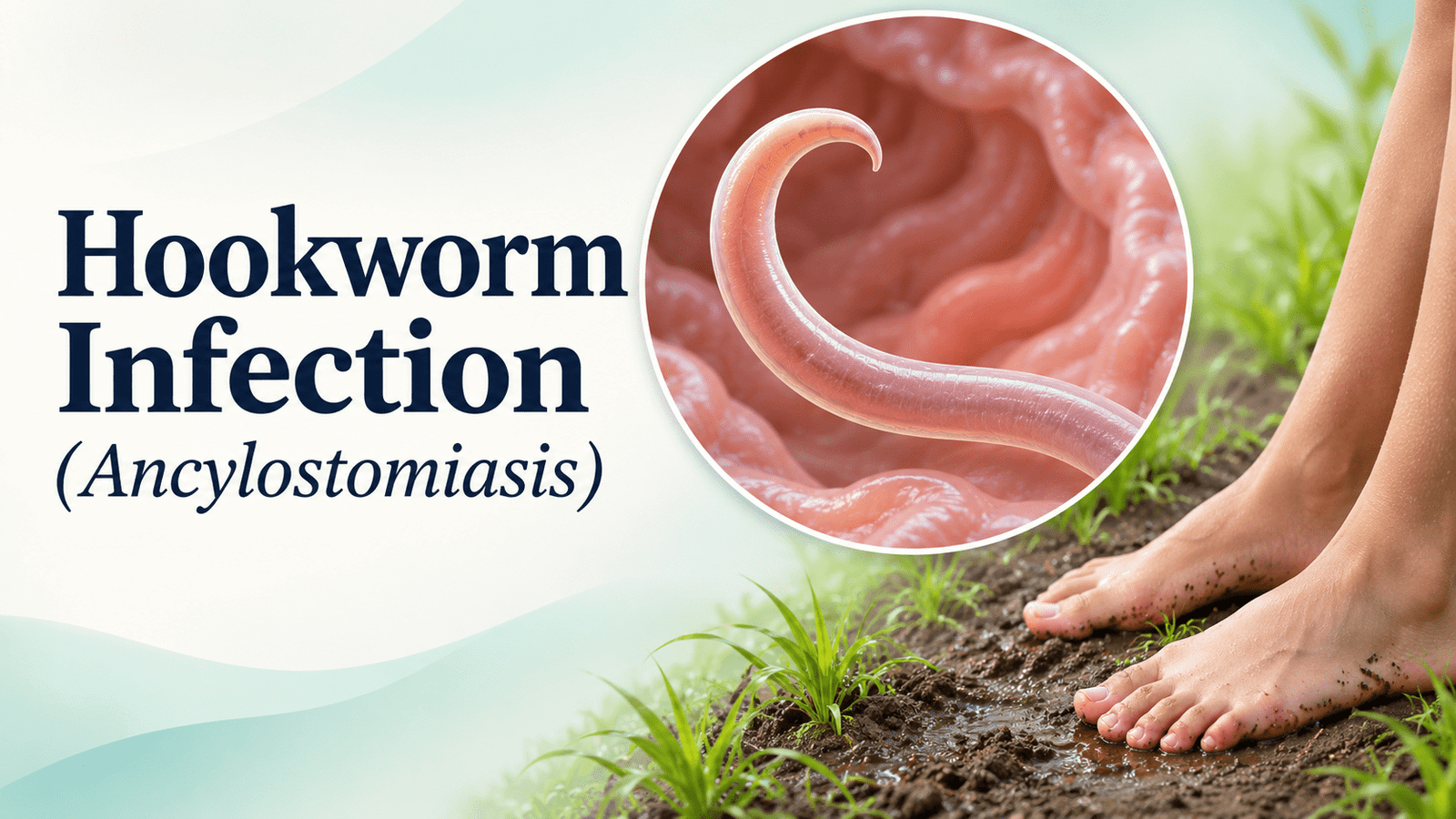
Hookworm is a soil-transmitted intestinal parasitic worm infection caused mainly by Ancylostoma duodenale and Necator americanus. It is important because chronic infection can cause iron-deficiency anemia, poor growth in children, and reduced work capacity in adults.
History:
Hookworm disease was recognized in the 19th century as a major cause of anemia among workers in tropical mining and plantation areas: its transmission through skin contact with contaminated soil was later established. Today it is classified by WHO as one of the major soil-transmitted helminth (STH) infections.
Hookworm infection occurs when infective larvae in warm, moist, shaded soil penetrate human skin, usually bare feet, migrate through the lungs, are swallowed, and mature in the small intestine, where adult worms attach and suck blood.
Types:
Hookworms are classified into the following three types:
| Species | Common regions | Key Feature |
|---|---|---|
| Necator Americanus | Tropical and subtropical areas, including much of India | Most widespread human hookworm; usually transmitted through skin |
| Ancylostoma duodenale | Parts of Asia, the Middle East, and North Africa | Can infect through skin or ingestion; tends to cause greater blood loss. |
| Ancylostoma ceylanicum | Asia-Pacific region | A zoonotic hookworm that can also infect humans. |
Causes and Risk Factors:
Infection is caused by exposure of skin to soil contaminated with human feces containing hookworm eggs. Larvae develop in the soil and become infective.
Major risks include:
- Walking barefoot in contaminated soil.
- Open defecation and poor sanitation.
- Lack of safe water and hygiene facilities.
- Warm, humid climate and shaded, sandy/loamy soil.
- Poverty, overcrowding, and poor waste management.
Symptoms:
Many infections, especially light ones, are asymptomatic. Early infection may cause an itchy local rash (“ground itch”) where it entered the skin.
Heavy or chronic infection can cause:
- Abdominal pain, nausea, diarrhea, and loss of appetite.
- Fatigue, weakness, and weight loss.
- Iron-deficiency anemia due to blood loss from worms attached to the intestine.
- Pallor, breathlessness, and reduced exercise tolerance.
- In children: poor growth, poor school performance, and sometimes pica.
Diagnosis and diagnostic methods:
Diagnosis is confirmed by detecting hookworm eggs in stool under a microscope. Stool should ideally be examined soon after collection because eggs can hatch.
Common diagnostic methods:
- Direct wet-mount stool microscopy.
- Stool concentration techniques, especially formalin-ethyl acetate sedimentation.
- Repeated stool examinations when egg counts are low.
- Harada-Mori fecal culture to identify larvae and differentiate species.
- Complete blood count to detect anemia and eosinophilia; eosinophilia may appear before eggs are detectable.
Treatment:
Treatment uses oral anthelmintic medicines.
- Albendazole or mebendazole are primary treatments.
- Pyrantel pamoate is an alternative.
- Iron and folic acid supplementation is important for anemia, which may require transfusion.
For public health control, WHO recommends preventive chemotherapy with a single dose of albendazole 400 mg or mebandazole 500 mg in high-prevalence settings, including pregnant women after the first trimester where prevalence exceeds 20%.
Prevention and control:
Prevention focuses on breaking transmission from feces to soil to skin:
- Use and maintain toilets; stop open defecation.
- Wear footwear, especially in rural and farming areas.
- Wash hands with soap after defecation and before eating.
- Safe disposal and treatment of exceta; avoid using untreated human faces as fertilizer.
- Provide safe water, sanitation, and hygiene (WASH) facilities.
- Regular deworming of at-risk groups such as school-age children and pregnant women.
Control combines deworming, sanitation improvement, health education, and monitoring. Drugs alone reduce infection temporarily, so sustained control requires environmental and behavioral measures.
Public awareness and IEC materials:
Public awareness should emphasize that hookworm enters through bare skin, not usually through eating contaminated food. Messages should promote footwear use, toilet use, handwashing, and timely deworming.
Useful IEC (Information, Education, Communication) materials include
- Posters and wall paintings at schools, anganwadis, clinics, and community centers.
- Flipbooks and demonstrations for mothers’ groups and self-help groups.
- School lesions, rallies, and National Deworming Day activities.
- Radio, SMS, social media messages, and folk media in local languages.
- Simple visuals showing “wear slippers,” “use toilet,” “wash hands,” and “take deworming tablet.”
Role of the public health department:
The public health department should:
- Map high-risk areas through stool surveys and surveillance.
- Organize mass deworming campaigns, especially through schools and anagwadis.
- Supply albendazole/mebendazole and iron-folic acid tablets.
- Strengthen sanitation, safe water, and waste management with local bodies.
- Train teachers, ASHAs, anganwadi workers, and health staff.
- Conduct IEC campaigns and community mobilization.
- Monitor treatment coverage, adverse events, anemia, and infection trends.
Magnitude and global burden:
Hookworm remains a major neglected tropical disease. WHO estimates that hookworm affected about 173 million people in tropical regions in 2019. Globally, soil-transmitted helminths together infect more than a billion people, and hookworm is a leading cause of iron deficiency anemia in endemic populations.
Burden and Risk in India:
India carries a very high STH burden: WHO estimates about 241 million children aged 1 to 14 years are at risk of STH infection, representing roughly 68% of the world’s children in that age group at risk.
Hookworm is often the predominant STH species in parts of India. In a Deworm 3 trial in southern India, hookworm prevalence was about 21%, although most infections were light-intensity. Risk is higher in areas with warm, humid climates, poor sanitation, open defecation, agricultural work, and barefoot walking; some states, including Bihar, report particularly high hookworm prevalence.