



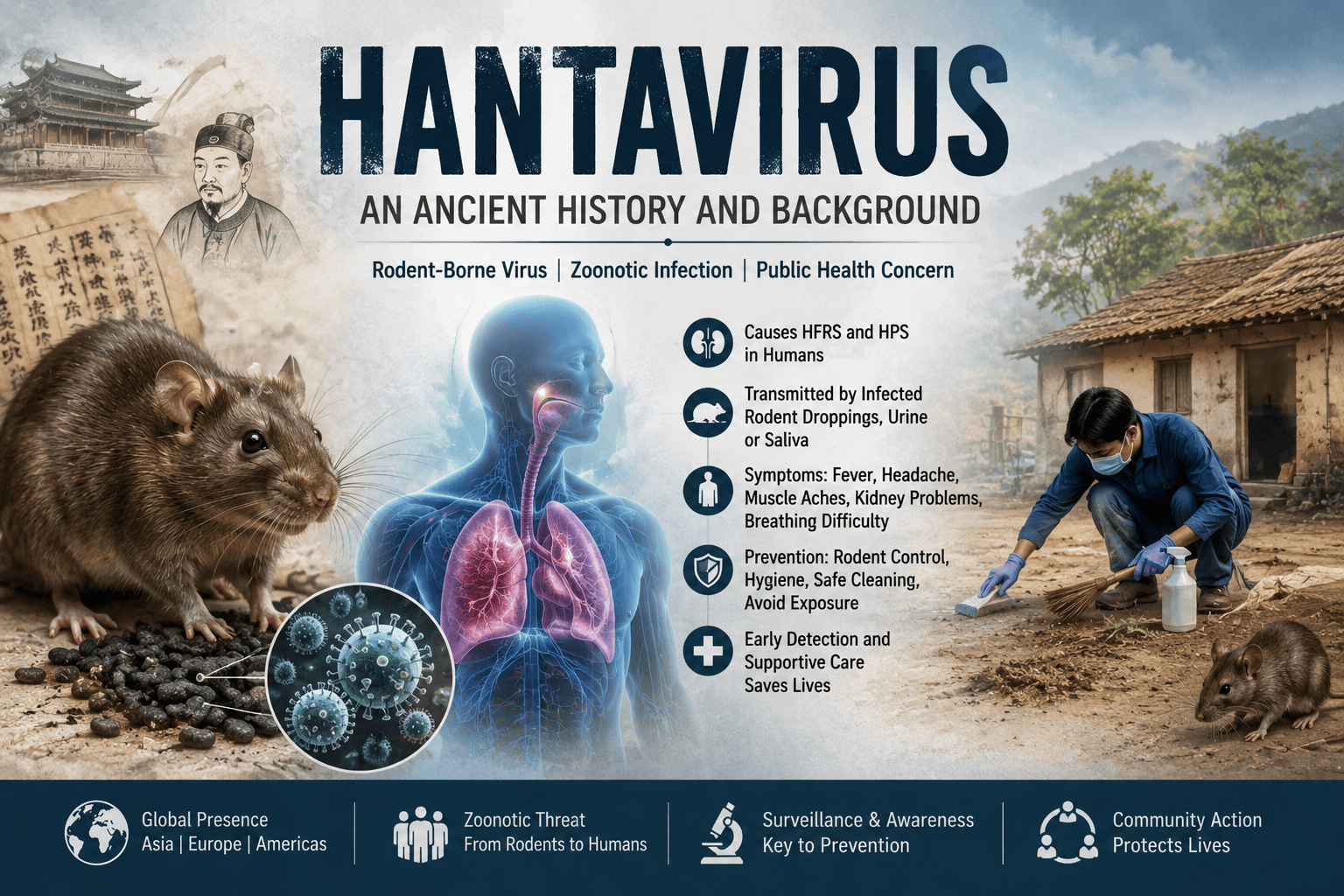


Historical texts from China provide the earliest potential references to the disease. The Huangdi Neijing (Yellow Emperor’s Internal Canon), dating to the Warring States Period (475 to 221 BCE), contains descriptions that some researchers believe correspond to hantavirus-induced hemorrhagic fever. Similar accounts appeared in Chinese medical literature around 960 AD, indicating that the virus was likely endemic to the region for centuries.
In Europe, historians have hypothesized that the “sweating sickness”—a mysterious, often lethal disease that caused five major epidemics in England between 1485 and 1551—may have been caused by a hantavirus. Although evidence remains circumstantial, the symptoms and impact on historical figures, such as Lord Stanley during the Battle of Bosworth Field, are consistent with the pathology of hantavirus infections.
Key Takeaways: 7 Critical Hantavirus Facts
- Ancient Roots: Potential historical accounts date as far back as China’s Warring States Period (475–221 BCE) and Europe’s 15th-century “sweating sickness,” though it was formally isolated in 1978 near the Hantaan River.
- Rodent-Borne Danger: It is a family of zoonotic viruses carried by rodents. Humans contract it primarily by inhaling airborne dust contaminated with infected rodent urine, droppings, or saliva.
- Two Severe Syndromes: Depending on the region, it manifests as HFRS (Hemorrhagic Fever with Renal Syndrome, common in Europe/Asia) affecting the kidneys, or HPS (Hantavirus Pulmonary Syndrome, common in the Americas) targeting the lungs.
- No Universal Cure: There is no specific antiviral cure or vaccine. Treatment relies heavily on early hospitalization and intensive supportive care (oxygen and fluid management).
- Prevention Over Treatment: Avoid dry-sweeping or vacuuming rodent droppings, as this stirs up dangerous virus particles. Always wet down areas with disinfectant first and focus heavily on household rodent control.
Modern Recognition
The virus remained largely unrecognized by Western medicine until it appeared in a military setting during the 20th century. Doctors noted conditions resembling hantavirus, such as “trench nephritis,” among soldiers during the American Civil War and World War I. A more definitive clinical awareness emerged during the Korean War (1951 to 1954), when approximately 3,200 United Nations soldiers were struck by an unknown hemorrhagic fever. The causative agent, later named the “Hantaan virus” after the “Hantaan River” in South Korea, was finally isolated in 1978. It was not until 1993 that a previously unknown, respiratory-focused strain of the virus was identified in the United States, leading to the classification of hantavirus pulmonary syndrome (HPS).
What Is Hantavirus?
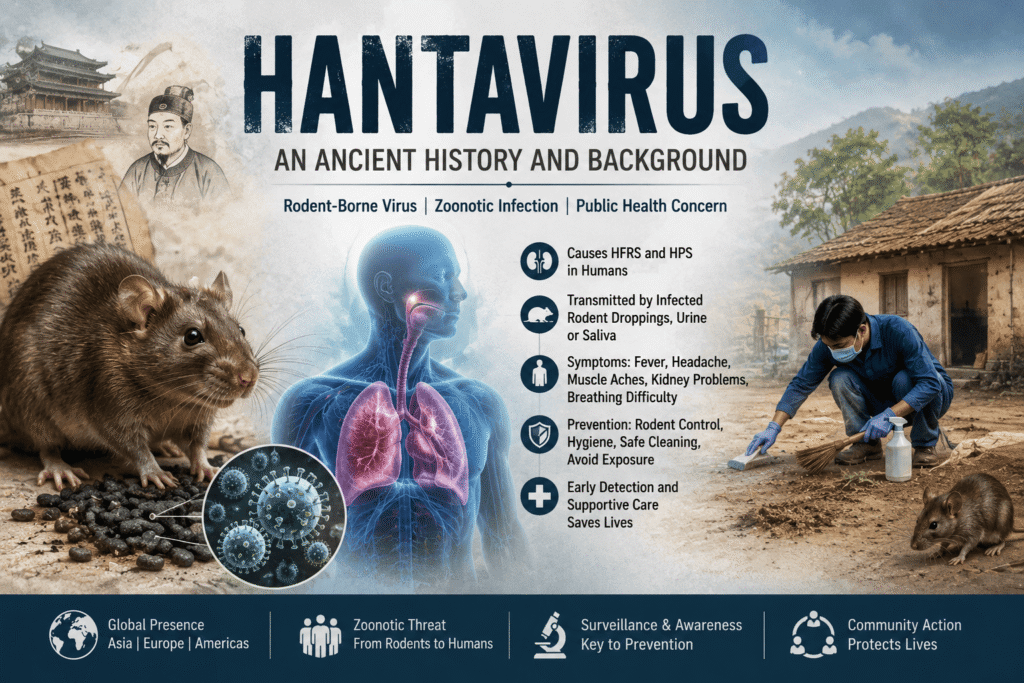
Hantavirus is a group of rodent-borne viruses that can cause serious illness in humans, mainly through exposure to infected rodent urine, droppings, or saliva, especially when contaminated dust is breathed in. In humans, it can cause two major disease patterns: 1) hemorrhagic fever with renal syndrome (HFRS) and 2) hantavirus pulmonary syndrome (HPS).
What It Means
“Hantavirus” does not refer to one single virus only; it refers to a family of related viruses carried by rodents. Hantaviruses are long-known zoonotic viruses associated with rodents, and they have become an important emerging public health concern in different regions of the world. Historically, the best-recognized human diseases linked to them were described in Asia and Europe as HERS and later in the Americas as HPS. Infection usually happens when people inhale particles contaminated by rodent excreta, touch contaminated materials and then touch the face, or, less commonly, are bitten or scratched by rodents.
How Does Hantavirus Spread?
The cause is infection with a hantavirus carried by infected rodents. Risk rises in settings with poor rodent control, contaminated stores, farms, sheds, camps, or enclosed spaces where rodent droppings are disturbed and become airborne.
What Are the Symptoms of Hantavirus?
Early symptoms can be nonspecific and flu-like, including fever, fatigue, muscle aches, headache, nausea, vomiting, diarrhea, abdominal pain, and dizziness.
In HFRS, kidney-related problems, low blood pressure, blurred vision, and sometimes a rash can occur. In HPS, breathing difficulty, cough, and severe respiratory distress can develop after the initial flu-like phase.
What Are the Different Types of Hantavirus Disease?
The two main clinical syndromes are
HFRS, seen mainly with Old World hantaviruses in Europe, Asia, and Africa.
HPS, seen mainly with New World hantaviruses in the Americas.
How Is a Hantavirus Infection Diagnosed?
A diagnosis is suspected from the history of rodent exposure plus compatible symptoms such as fever with kidney involvement or breathing problems. Confirmatory methods commonly include serology for hantavirus antibodies and molecular testing such as PCR, along with routine clinical tests that show organ involvement, especially kidney function tests, blood counts, and oxygen assessment. Because early symptoms can resemble many other infections, exposure history is very important.
Is There a Cure or Treatment for Hantavirus?
There is no specific antiviral cure universally established for routine clinical use, so treatment is mainly supportive. Severe cases may need hospital care or ICU support, including oxygen, fluids managed carefully, blood pressure support, and kidney or respiratory support depending on the syndrome
How Can We Prevent and Control Hantavirus?
Prevention focuses on rodent control, safe cleaning, and avoiding exposure to droppings or urine. Key measures include sealing holes, storing food securely, reducing rodent nesting sites, using gloves and disinfectants during cleanup, and never sweeping or vacuuming dry droppings because that can aerosolize the virus. particles. Community-level control also includes sanitation, waste management, and rodent surveillance.
What Is the Role of the Public Health Department?
The public health department should lead surveillance, outbreak investigation, risk communication, rodent control coordination, and health education. IEC materials should focus on simple massage, how hantavirus spreads, early warning signs, when to seek care, how to clean safely, and how to reduce rodent exposure at home and work. Community engagement works best through local leaders, schools, workplaces, farmers, sanitation workers, and media campaigns that reinforce practical prevention behaviors.
What Is the Global Burden of Hantavirus?
Globally, hantavirus infections are uncommon but can be severe, and the reported burden is highest in parts of Asia, Europe, and the Americas, depending on the virus type. One recent summary reported that the WHO estimates around 10,000 to over 100,000 infections occur worldwide each year, with a substantial disease burden in Asia and Europe.
What Is the Hantavirus Burden in India?
In India, only sporadic reports have been described, linked mainly to rural rodent exposure, and major outbreaks have not been established. For India, the main concern is not mass spread but missed recognition in people with fever, kidney symptoms, or breathing difficulties after rodent exposure. Early medical evaluation is important because severe disease can progress quickly, and prevention depends much more on rodent control and hygiene than on treatment after infection.

1 Comment
Key Structure of Hantavirus: 3 Critical Components Explored
May 19, 2026[…] Communicable Diseases […]