





Sexual literacy in a healthy society means giving people the knowledge, skill, and confidence to understand sexuality, relationships, consent, reproduction, and sexual health and to use that knowledge for safe and responsible decisions. It is an important part of comprehensive sexuality education and public health because it helps prevent STIs, unintended pregnancy, gender-based violence, and misinformation.
Definition: Sexual literacy is the ability to understand and apply correct sexual health information for safe, respectful, and informed living.
OR
It is the ability of individuals to communicate and access, understand, evaluate, and apply sexual health information to make informed, safe, and healthy decisions about sexuality and relationships. It goes beyond basic knowledge to include:
Importance:
- Sexual literacy is the ability to find, understand, evaluate, and use information related to sexual health and relationships.
- It includes correct knowledge about puberty, anatomy, reproduction, contraception, STIs/HIV, consent, and healthy relationships.
- It also includes communication skills, decision-making, help-seeking, and the ability to challenge myths and stigma.
- In a healthy society, sexual literacy supports informed choices, respectful behaviour, gender equality, and better use of health services.
- It should be age-appropriate, scientifically accurate, and culturally sensitive.
- Health workers, teachers, parents, and community organisations all play a role in improving it.
- Sexual literacy helps people protect their health and dignity. It reduces confusion and encourages open discussion and supports healthier relationships and safer behaviour. For young people especially, it improves access to reliable information and youth-friendly services.
- The World Health Organization (WHO) describes sexual health literacy as a key determinant that reduces the risk of STIs/HIV, unintended pregnancies, and sexual violence, while improving overall well-being.
Information: Sexual literacy encompasses several domains:
- Biological knowledge: reproduction, contraception, STIs, HIV, and menstrual health.
- Behavioural skills: condom use, testing, partner communication, consent.
- Psychological aspects: body image, gender roles, power dynamics, pleasure, and intimacy.
- Service navigation: knowing where and how to access youth-friendly or confidential sexual health services.
- Low sexual literacy is linked to delayed care-seeking, misinformation, stigma, and higher-risk behaviours.
Risk Factors for Low Sexual Literacy: Common risk factors include:
- Limited or no formal sexuality education
- Cultural taboos and stigma around discussing sex openly.
- Gender inequality and power imbalances in relationships.
- Early sexual debut, multiple partners, and inconsistent condom use
- Alcohol/substance use before or during sex
- Low education levels, especially among women and rural populations.
- Lack of access to confidential, non-judgemental health services.
In India, NFHS-5 found that only about one-fifth of women and one-third of men have comprehensive knowledge about HIV prevention, indicating widespread gaps in sexual health information.
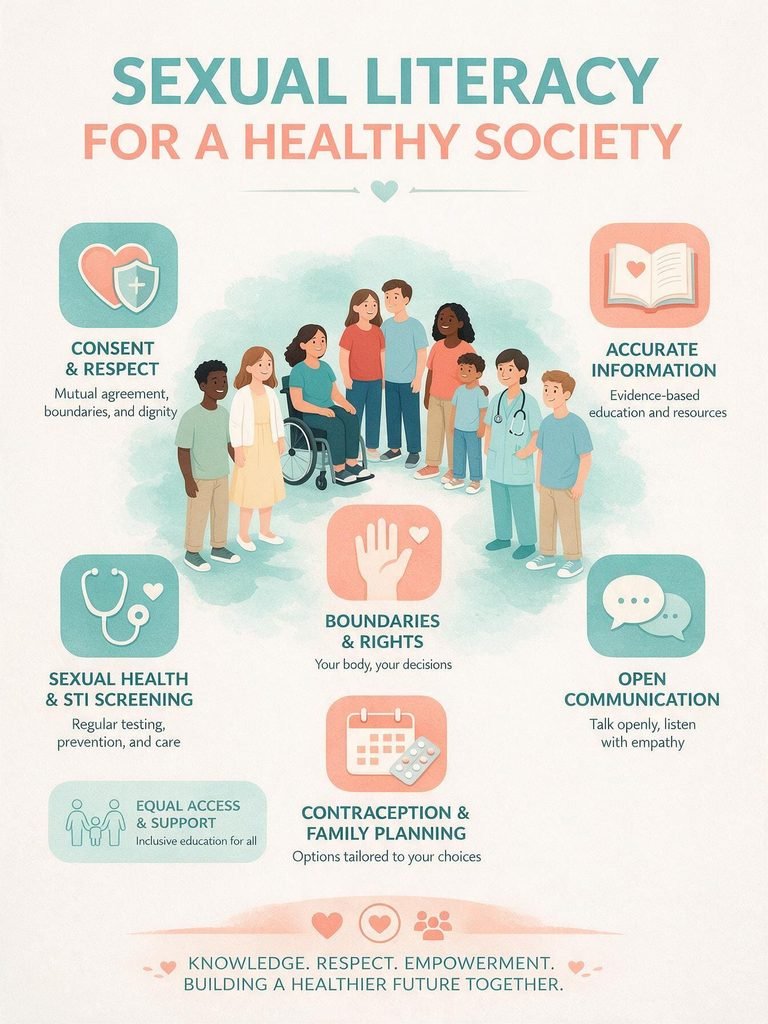
The Role of Parents and Teachers in Promoting Sexual Literacy:
Parents and teachers can promote sexual literacy by giving accurate, age-appropriate, nonjudgmental information and by creating a safe space for questions. They should combine home-based communication with school-based comprehensive sexuality education so children get both values and facts.
- Ways parents can help:
- Start early with simple, age-appropriate talks about body parts, privacy, safety, and consent.
- Use everyday situations as teachable moments, instead of waiting for a “big talk”.
- Answer questions honestly and calmly, and say “I do not know” when needed, then find the correct answer together
- Set clear values and boundaries while avoiding shame, fear, or ridicule.
- Monitor media and online content, because children often learn from social media, movies, and peers.
- Ways teachers can help:
- Provide scientifically accurate, age-appropriate, and culturally sensitive sexual education in school.
- Focus not only on anatomy and reproduction but also on consent, relationships, respect, gender equality, and decision-making skills.
- Encourage discussion, group activities, and anonymous question boxes so students can ask freely.
- Use simple language, visuals, aids, and interactive methods to improve understanding.
- Work with parents so school teaching and home teaching support each other rather than conflict.
A helpful approach is to keep communication open, respectful, and continuous. Parents and teachers should avoid fear-based messaging and instead promote confidence, responsibility, and help-seeking behaviour. Schools can also share reading materials, workshops, and parent sessions to strengthen family involvement.
Why Shame-Free Sexuality Education is More Effective:
Shame-free sexuality education is more effective because it helps learners stay open, ask questions, and remember accurate information instead of reacting with fear or avoidance. High-quality comprehensive sexuality education is associated with better knowledge and safer behaviours and does not increase sexual activity.
Why it works:
- It creates trust, so students are more likely to ask questions and seek help.
- It reduces secrecy and misinformation, which are common when sexuality is treated as “forbidden”.
- It supports healthy decision-making by teaching consent, relationships, contraception, and self-protection in a clear way.
- It improves confidence and self-esteem, which can lead to safer choices and healthier relationships.
- It is more inclusive for survivors of abuse and for young people who feel judged or stigmatised.
Public Health Value:
Shame-based teaching often focuses only on fear, but that does not build skills for real-life situations. Evidence from WHO shows that well-implemented comprehensive sexuality education can delay sexual initiation, increase contraceptive and condom use, and reduce sexual risk-taking. Reviews also show broader benefits such as healthier relationships, better school outcomes, and improved safety.
How Comprehensive Sexuality Education Reduces Misinformation:
Comprehensive sexuality education reduces misinformation by replacing rumors, stigma, and guesswork with age-appropriate, scientifically accurate information about bodies, relationships, consent, and rights. It also gives young people a trusted source, so they are less likely to rely on peers, social media, pornography, or other unreliable sources.
How it helps:
- It corrects myths directly by teaching the facts in a structured way.
- It gives learners a safe place to ask questions, which helps clear confusion early.
- It uses trained teachers and evidence-based content, which improves trust in the information.
- It builds critical thinking, so students can recognise false or harmful messages.
- It reduces shame, making it easier for children and adolescents to seek accurate answers instead of hiding doubts.
Why this matters:
When misinformation is left unchallenged, young people may misunderstand puberty, menstruation, consent, contraception, STI prevention, and abuse warning signs. CSE helps them make informed choices and protect their health. WHO also reports that high-quality CSE improves knowledge and does not increase sexual risk-taking.
What Children Should Learn About Consent at Different Ages:
Children should learn about consent in age-approximate stages, starting with body autonomy and simple permission-taking, then gradually moving to relationships, boundaries, and sexual consent.
- By Age Group:
- Ages 0 to 4 yrs: Teach “my body belongs to me,” ask before hugging or touching, and respect a child’s “no” in everyday situations like ticking or play.
- Ages 5 to 10 yrs: Explain personal boundaries, privacy, and permission in daily life, such as sharing toys, taking turns, and choosing how to greet others.
- Ages 11 to 13 yrs: Introduce consent in friendships and early romantic settings, including asking before physical contact and accepting refusal without pressure.
- Ages 14 to 18 yrs: ITeach verbal and non-verbal consent, coercion, intoxication, peer pressure, and the fact that consent can be withdrawn at any time.
- Core ideas: Children should understand that consent is specific, freely given, reversible, and free from pressure. They should also learn that no one is entitled to their body and that they should tell a trusted adult if they feel unsafe or confused.
Why Consent Education Improves Relationship Safety:
Consent education improves relationship safety because it teaches people to respect boundaries, communicate clearly, and recognise when agreement is not genuine. It also reduces coercion, misunderstanding, and harmful myths about relationships and sex.
How it helps:
- It builds communication so partners can talk openly about comfort, limits, and expectations.
- It strengthens respect for boundaries, which lowers the chance of pressure, manipulation, or unwanted contact.
- It improves recognition of true consent, including the facts that consent must be freely given and can be withdrawn.
- It challenges myths that normalise entitlement, coercion, or silence as permission.
- It creates trust and emotional safety, which are key parts of healthy relationships.
When people understand consent, they are more likely to ask before acting and more likely to pause when the other person is unsure or says no. That reduces conflict and helps prevent sexual violence and other boundary violations. Consent education also encourages empathy, which makes relationships more respectful and stable. It helps partners build trust and maintain healthier, safer relationships.

1 Comment
Sexual Health Challenges in India: 5 Critical Public Health Priorities
September 21, 2026[…] Sexual health problems in India are large, diverse, and substantially undercounted. They include sexually transmitted infections (STIs), HIV, unintended pregnancy, unsafe abortion, infertility, sexual dysfunction, cervical cancer, sexual violence, and limited access to confidential, non-judgemental services. India lacks a comprehensive population-based STI surveillance system, so available figures should be interpreted as estimates rather than a complete national count. […]