



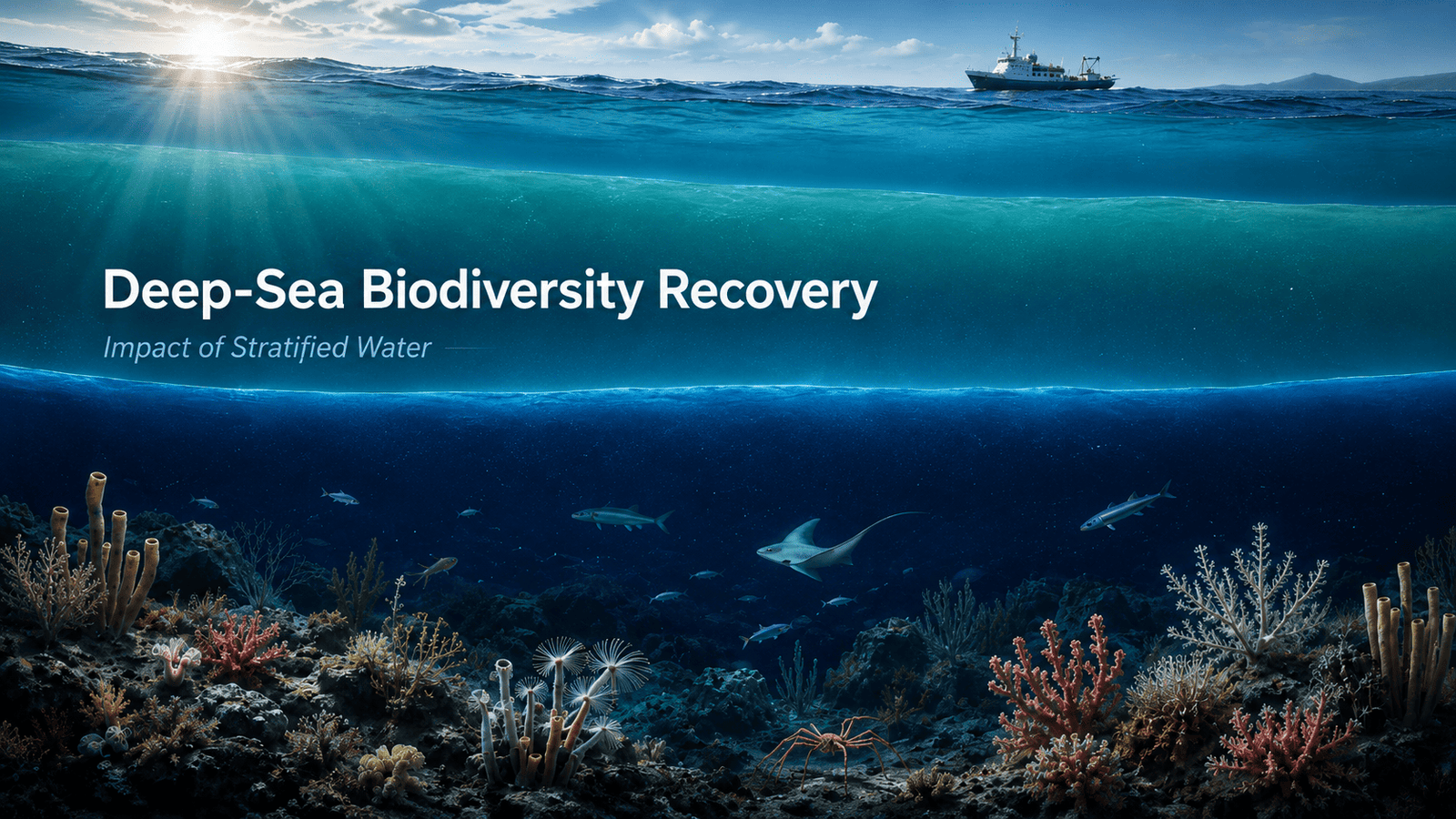
Stratified water columns strongly constrain deep-sea biodiversity recovery by limiting the supply of oxygen and organic matter to the seafloor, slowing recolonization after disturbances such as trawling, mining, or oxygen depletion events.
How stratification affects deep-sea ecosystems
Water column stratification creates stable layers (thermocline, pycnocline) that inhibit vertical mixing between surface and deep waters. This has three key consequences for deep-sea biodiversity.
Reduced oxygen supply
- Stratification limits the downward transport of oxygen-rich surface water, contributing to expansion of oxygen minimum zones (OMZs), especially at bathyal depths (200 to 600m)
- Low-oxygen conditions compress habitable depth ranges for mobile organisms, e.g., tuna and billfish, and reduce survival of benthic fauna, delaying post-disturbance recovery.
Decline in food flux
- Surface warming and stronger stratification reduce nutrient upwelling, lowering primary productivity and the export of particulate organic carbon to the deep sea.
- IPCC projections indicate that by 2081-2100, abyssal meio- and macrofauna biomass could decline carbon flux under high-emission scenarios.
- Less food means slower growth, reproduction, and recolonization rates for deep-sea communities already characterized by low metabolic rates and long generation times.
Altered disturbance-recovery dynamics
- In stratified basins,( e.g., Baltic sea, Mediterranean), hypoxia and reduced mixing create self-reinforcing feedbacks: legacy nutrients and internal loading sustain low-oxygen conditions even after external stressors are reduced
- Recovery times lengthen because benthic communities depend on episodic mixing events (e.g., dense water cascades and benthic storms) to restore oxygen and deliver fresh organic matter.
- In the Mediterranean, dense winter water formation can rapidly re-oxygenate deep basins and boost organic matter flux, temporarily enhancing benthic biomass and diversity—but such events are becoming less frequent with climate-driven stratification.
Impacts on biodiversity recovery trajectories
- Slower recolonization: Low oxygen and food scarcity reduce larval settlement, survival, and growth, extending recovery from decades to centuries in some deep-sea habitats.
- Community shifts: Recovery favors opportunistic, hypoxia-tolerant taxa (e.g., certain nematodes, polychaetes) over sensitive, slow-growing species (e.g., sponges, corals), leading to long-term biodiversity loss and simplified food webs.
- Reduced ecosystem resilience: Stratification-induced stress lowers functional redundancy, making deep-sea ecosystems more vulnerable to future disturbances, e.g., mining and climate extremes.
Regional examples
- Mediterranean Sea: Enhanced summer stratification is projected to reduce benthic biomass by > 35%, with cascading effects on biodiversity and ecosystem function.
- Baltic and semi-enclosed seas: Persistent stratification and hypoxia have caused benthic die-offs and trophic shifts (e.g., jellyfish dominance), with recovery hindered by internal nutrient cycling and weak mixing.
- Global bathyal zones: Expanding OMZs compress vertical habitat for zooplankton and fish, altering predator-prey dynamics and reducing connectivity essential for recolonization.
Implications for conservation and restoration
- Deep-sea restoration efforts must account for physical drivers (stratification, oxygen dynamics) alongside biological interventions.
- Mitigating climate change to reduce surface warming and stratification is critical for maintaining deep-sea oxygen and carbon flux.
- In semi-enclosed basins, active management (e.g., artificial mixing, nutrient load reduction) may be needed to break feedback loops and support recovery.
In short, stratified water columns act as a biogeochemical bottleneck, starving deep-sea ecosystems of oxygen and energy and thereby slowing—and in some cases preventing—biodiversity recovery after anthropogenic or natural disturbances.
Mechanisms Behind Self-Reinforcing Hypoxia in Enclosed Sea Basins:
Self-reinforcing (or “positive feedback”) hypoxia in enclosed sea basins arises from tightly coupled physical, biogeochemical, and ecological mechanisms that, once triggered, sustain low-oxygen conditions even after initial drivers (e.g., nutrient loading) are reduced. When low oxygen triggers processes that make oxygen loss worse, creating a feedback loop. In poorly ventilated basins, strong stratification limits mixing, organic matter decomposition consumes oxygen, and the resulting oxygen depletion further reduces the basin’s ability to recover.
Mechanism
- Enclosed basins have weak water exchange with the open ocean, so oxygen-rich water is renewed slowly.
- Temperature and salinity differences create stratification, which blocks vertical mixing and traps low-oxygen bottom water below the surface layer.
- Nutrient enrichment boosts algal growth; when the algae die, bacterial decomposition uses up dissolved oxygen
- As oxygen falls, sediments release more nutrients and can consume less oxygen through altered biogeochemistry, which weakens the system’s buffer capacity and promotes even more hypoxia.
- In severe cases, the basin can shift toward conditions that are harder to reverse, especially when ventilation events are rare or weak.
Physical preconditioning:
Stratification and restricted exchange
- Strong stratification (thermal, saline, or both) isolates deep waters from atmospheric oxygen and surface photosynthesis.
- Silled or narrow outlets limit lateral inflow of oxygenated water, increasing water residence time and allowing oxygen demand to outpace supply.
- In basins like the Baltic, century-scale deoxygenation is driven by the interplay of thermohaline stratification and weak deep-water renewal.
Internal nutrient recycling (the “phosphorus trap”)
- Under anoxia, iron-bound phosphorus in sediments is released as soluble reactive phosphorus (SRP) due to reductive dissolution of Fe (III) oxides.
- This internal P loading fuels surface algal blooms—especially nitrogen-fixing cyanobacteria—bypassing nitrogen limitation and perpetuating eutrophication despite external nutrient reductions.
- In the Baltic Sea, this feedback sustains high primary production, which exports organic matter to depth, fueling further oxygen consumption—a classic self-reinforcing loop.
Loss of bioturbation and sediment ventilation
- Hypoxia eliminates macrofauna (e.g., polychates, bivalves) that normally bioturbate and irrigate sediments, enhancing oxygen penetration and coupled nitrification-denitrification.
- Their loss reduces sediment oxygenation and impairs nitrogen removal (denitrification), shifting sediments from N sinks to N sources (ammonium release).
- This weakens the system’s capacity to export nitrogen, reinforcing eutrophication and oxygen demand.
Microbial community restructuring and functional hysteresis
- Prolonged hypoxia selects for anaerobic microbial taxa (e.g. ,sulphate reducers, methanogens) and suppresses aerobic carbon processors.
- Even upon experimental reoxygenation, microbial communities retain impaired carbon-processing capacity, slowing recovery of organic matter degradation and oxygen balance.
- This functional hysteresis means the system does not revert linearly when oxygen is restored.
Sulphade accumulation and methane feedbacks
- Sulphate reduction in anoxic sediments produces toxic hydrogen sulphate (H₂S), which inhibits aerobic metabolism and further excludes macrofauna.
- Sulphate also suppresses anaerobic oxidation of methane (AOM), collapsing the sediment “methane biofilter” and increasing greenhouse gas emissions—a secondary feedback with climate implications.
Density-driven nutrient plumes
- Nutrient-rich pore waters released from sediments can form density-driven plumes that flow along slopes, actively redistributing phosphorus and organic matter throughout the basin—not just vertically.
- This expands the spatial footprint of internal loading, making localized remediation less effective.
System-level behavior: regime shifts and recovery asymmetry
These feedbacks interact to create nonlinear dynamics
- Small increases in nutrient loading or warming can push the system past a critical threshold, triggering a shift to chronic hypoxia.
- Recovery requires larger reductions in nutrients (and often longer timeframes) than the increases that caused degradation—a phenomenon known as hysteresis.
- Cross-system analysis shows only ~ 50% of remediated coastal systems achieve clear oxygen recovery, with stratified, diffuse-source basins (like the Baltic) recovering far less readily.
Implications for management:
- Dual-nutrient control (N and P) is essential in systems where internal P loading sustains cyanobacterial blooms.
- Climate mitigation is critical: warming strengthens stratification and exacerbates oxygen solubility loss, raising the bar for recovery.
- Active interventions (e.g., artificial mixing, sediment capping, targeted dredging) may be needed to break feedback loops in severely degraded basins.
Thus, self-reinforcing hypoxia emerges when physical isolation enables biogeochemicals and ecological feedbacks to lock the system into a low-oxygen state—making prevention far more effective than a cure.