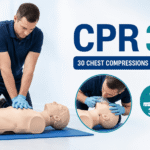




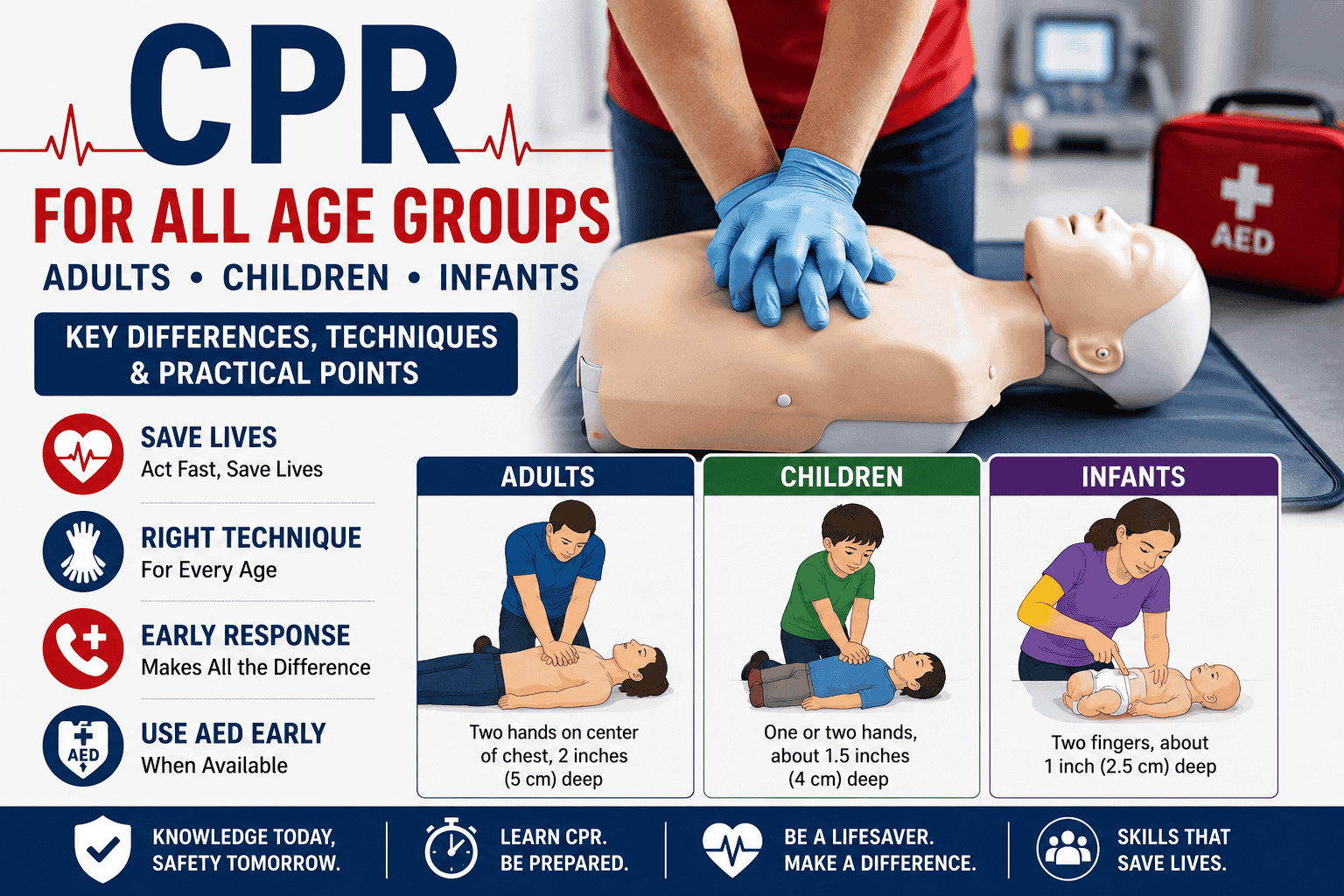
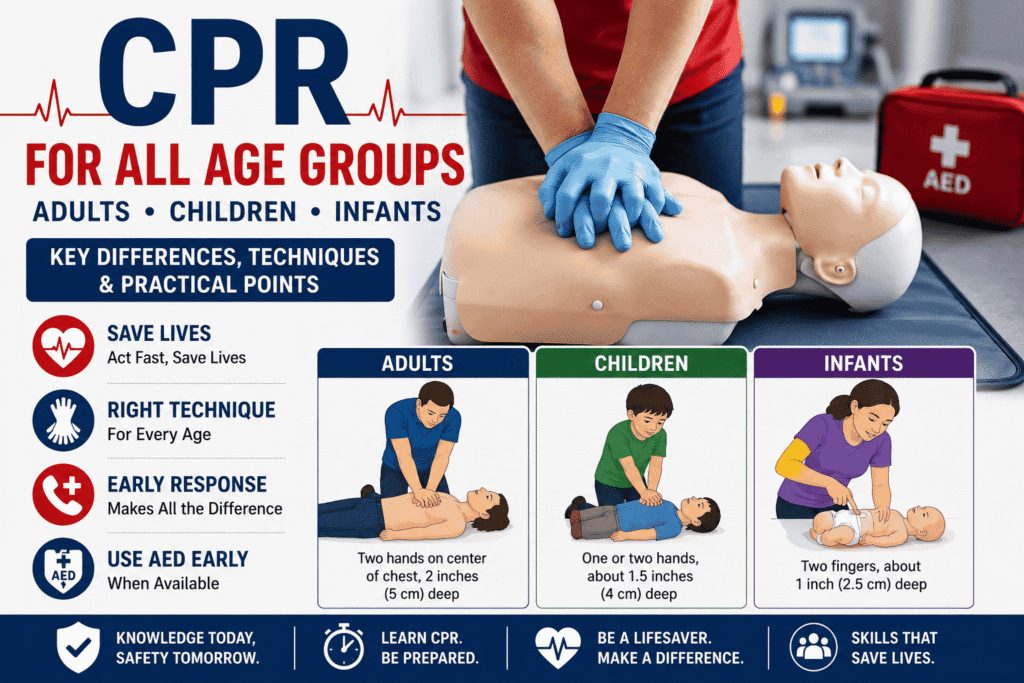
The core goal of CPR is the same for all ages—maintain circulation and oxygenation until advanced help arrives—but techniques differ by hand/finger placement, compression depth, compression technique, compression-to-ventilation ratio, and when to call for help.
📌 Key Takeaways: CPR Across Age Groups
- Compression Rates: The standard compression rate remains 100–120 compressions/min across all age categories.
- Depth Variations: Compress about 5 cm (~2 inches) for adults, ~5 cm (1/3 chest depth) for children, and ~4 cm (1/3 chest depth) for infants.
- Hand Placement: Use two hands for adults, 1 or 2 hands for children (depending on size), and 2 fingers (or the 2-thumb encircling method) for infants.
- Resuscitation Ratios: Single rescuers use a 30:2 ratio for all ages. Two-rescuer CPR drops to a 15:2 ratio for children and infants.
Key differences (concise comparison)
Hand/finger placement and technique
Adults—heel of one hand over the center of the chest with the other hand on top. Children (1 year to puberty)— one or two hands (depending on size) on the lower half of the sternum: Infants (under 1 year) — two fingers in the center of the chest or the two-thumb-encircling-hands technique for two rescuers.
Compression depth
Adults—> about 5 cm (~2 inches)
Children—> about ⅓ of chest depth (~5 cm for many children, but less for smaller ones);
Infants —> about ⅓ of the chest depth (~4 cm or ~1.5 inches).
Compression rate
All ages—> Aim for about 100 to 120 compressions per minute.
Compression-to-ventilation ratio (single rescuer)
Adults—> 30 compressions: 2 breath
Children—> 30:2 (single rescuer) but 15:2 when two rescuers are available.
Infants—> 30:2 (single rescuer) and 15:2 for two rescuers (the two-rescuer infant technique often uses two-thumb encircling compressions).
Emphasis on ventilation
Children and infants more often have cardiac arrest secondary to respiratory problems, so providing effective ventilations (rescue breaths) is relatively more important in pediatric/infant CPR than in adult sudden cardiac arrest, where immediate high-quality compressions are prioritized.
When to call emergency services
Adults → if you find an unresponsive adult who is not breathing normally, call for help/EMS right away and start CPR
Children/Infants: If you are alone and the collapse was unwitnessed, many pediatric guidance protocols recommend giving about 2 minutes of CPR first (because respiratory causes are common) before leaving to call EMS, but if others are present, have someone call immediately.
Use of AED
AED use is recommended for all ages when pediatric pads or pediatric settings are available for children. For infants, follow device guidance or use adult pads if pediatric pads are unavailable, placing pads so they do not touch. Early defibrillation is especially important if the arrest is cardia in origin (more typical in adults).
Technique adjustment to protect fragile anatomy
Infants’ ribs and airways are delicate, so compressions and ventilations must be gentler, and head positioning must be neutral (avoid overextension).
For children, use smaller force and appropriate hand choice to avoid injury.
Two-rescuer coordination
With two rescuers, switch roles (compressor/ventilator) every ~2 minutes to avoid fatigue; two rescuers allow the 15:2 ratio for children/infants and generally produce better-quality compressions and ventilation (two-thumb encircling for infants gives more consistent depth).
Quick practical points (what to remember)
Rate: 100 to 120 compressions/min for all ages.
Depth: Adults~5 cm
Children: ~⅓ chest depth
Infants: ~⅓ chest depth (~4 cm)
Ratio: single rescuers 30:2 for all ages; two rescuers 15:2 for children and infants.
Hands: Adult = two hands
Children: one or two hands
Infants = two fingers or two thumbs encircling.
If untrained or unwilling to give breaths, perform continuous hands-only CPR for adults; for infants/children, breaths are more important when possible.
Use an AED as soon as available; use pediatric settings/pads if available for children.
Short example to illustrate
Adult collapse: Start compression immediately (hard, fast, center chest); call for help/AED; 30:2 or hands-only if untrained.
Child/infant collapse (alone rescuer, likely respiratory cause): give about 2 minutes of CPR (compressions + breaths) before leaving to call emergency services if no one else can call; use age-appropriate hand technique and depth, then continue until help or an AED arrives.
CPR Checklist for All Agegroups
Here is a simple CPR checklist for adults, children, and infants. It is written as a quick study guide, not a substitute for formal CPR training.
Adult CPR Checklist
- Make the area safe.
- Check if the person responds.
- Call emergency help and get an AED.
- Check breathing; if not breathing normally, start CPR.
- Place the heel of one hand in the center of the chest, the other hand on top.
- Push hard and fast at 100 to 120 compressions per minute.
- Compress about 5 cm (2 inches) deep.
- Let the chest rise fully after each push.
- Give 30 compressions and 2 breaths if trained.
- Use the AED as soon as it arrives and follow its instructions.
- Keep going until help takes over or the person starts moving or breathing normally.
Child CPR Checklist
- Make the area safe.
- Check if the child responds.
- Call emergency help and get an AED.
- Check breathing; if not breathing normally, start CPR.
- Place one or two hands on the center of the chest, depending on the child’s size.
- Push at 100 to 120 compressions per minute.
- Compress about one-third of the chest depth.
- Give 30 compressions and 2 breaths if one rescuer is present.
- If two rescuers are present, use 15 compressions and 2 breaths.
- Use AED as soon as available.
- Continue until help arrives or the child recovers.
Infant CPR Checklist
- Make the area safe.
- Check if the infant responds.
- Call emergency help and get an AED.
- Check breathing; if not breathing normally, start CPR.
- Use two fingers in the center of the chest or the two-thumb encircling method if two rescuers are present.
- Push 100 to 120 compressions per minute.
- Compress about one-third of the chest depth.
- Give 30 compressions and 2 breaths if one rescuer is present.
- If two rescuers are present, use 15 compressions and 2 breaths.
- Give gentle breaths—just enough to make the chest rise.
- Keep going until help arrives or the infant starts breathing normally.
Important Reminders
- CPR should be started only when the person is unresponsive and not breathing normally.
- For adults, hands-only CPR is better than doing nothing if you are untrained.
- For children and infants, rescue breaths are especially important.
- Use an AED as early as possible.
- Training from a certified first-aid/CPR course is strongly recommended.
Very Short Memory Aid
Adult: hands on chest, hard and fast.
Child: gentler, same rhythm.
Infant: two fingers, very gentle.
Comparison Table for CPR
| Feature | Adult CPR | Child CPR | Infants CPR |
|---|---|---|---|
| Age group | Puberty and older | One year to puberty | Under One year |
| Main hand position | Heel of one hand on the center of the chest, second hand on top | One or two hands, depending on the child’s size, on the center of the chest | Two fingers on the center of the chest or the two-thumb encircling method with two rescuers |
| Compression depth | About 5 cm (2 inches) | About ⅓ of chest depth | About ⅓ of chest depth, about 4 cm (1.5 inches) |
| Compression rate | 100 to 120 per minute | 100 to 120 per minute | 100 to 120 per minute |
| Rescue breaths | 30 compressions: 2 breaths if trained | 30:2 for one rescuer, 15:2 for two rescuers | 30:2 for one rescuer, 15:2 for two rescuers |
| Breathing emphasis | Hands-only CPR is acceptable if untrained | Breaths are important | Breaths are very important |
| AED use | Use as soon as available | Use as soon as available, with pediatric pads if available | Use as soon as available; follow device guidance |
| Common cause of arrest | Often sudden cardiac cause | Often breathing-related | Often breathing-related |
| Best calling approach | Call emergency help immediately | If alone and unwitnessed, give about 2 minutes of CPR before leaving to call | If alone and unwitnessed, give about 2 minutes of CPR before leaving to call |
Simple Memory Guide
Adult: hard and fast compressions, hands only if needed.
Child: Same rhythm, gentler force, and breaths matter more.
Infant: two fingers, very gentle compressions, and breaths are crucial.
Automated External Defibrillator (AED) Use During CPR
Use an AED as soon as it is available on someone who is unresponsive and not breathing normally, while CPR is already in progress or immediately after starting CPR.
When to Use It
Use the AED for sudden cardiac arrest, which is when the person collapses, is unresponsive, and is not breathing normally.
Do not wait for CPR to “finish”; start CPR right away and bring the AED to the person as quickly as possible.
If another person is there, one person should call emergency help and another should get AED while CPR continues.
How It Fits with CPR
When the AED arrives, turn it on, attach the pads to bare chest skin, and follow the voice prompts.
Stop CPR only when the AED tells you to analyze the rhythm or deliver a shock, then restart CPR immediately after the shock or if no shock is advised.
The AED should be used repeatedly as instructed until emergency responders take over or the person shows signs of life.
If the AED is nearby, send someone to get it without delaying compressions. If you are alone and the AED is very close, retrieve it only if you can do so quickly and return immediately.
CPR Pocket Reference
If unresponsive and not breathing normally, then call emergency services first and then start CPR.
| Adults | Children (1 to 8 yrs) | Infant (< 1 year) |
|---|---|---|
| 1) Responsiveness: Tap shoulder and shout, “Are you okay?” | 1) Responsiveness: Tap shoulder and shout, “Are you okay?” | 1) Responsiveness: Tap your foot and shout, “Are you okay?” |
| 2) Hand Position: hands centered on chest | 2) Hand Position: 1 or 2 hands on chest | 2) Hand Position: 2 fingers on chest |
| 3) Compression Dept.: 2 in (5 cm) | 3) Compression Dept.: 1.5 in (4 cm) | 3) Compression Dept.: 1 in (2.5 cm) |
| 4) Compression Rate: 100–120/min | 4) Compression Rate: 100–120/min | 4) Compression Rate: 100–120/min |
| 5) Rescue Breaths: 2 breaths after 30 compressions. | 5) Rescue Breaths: 2 breaths after 30 compressions. | 5) Rescue Breaths: 2 breaths after 30 compressions. |
| 6) AED: Use as soon as available | 6) AED: Use Pediatric pads if available | 6) AED: Use Pediatric pads if available |
Final Note
This is a quick reference only; follow local CPR guidelines and official training.