



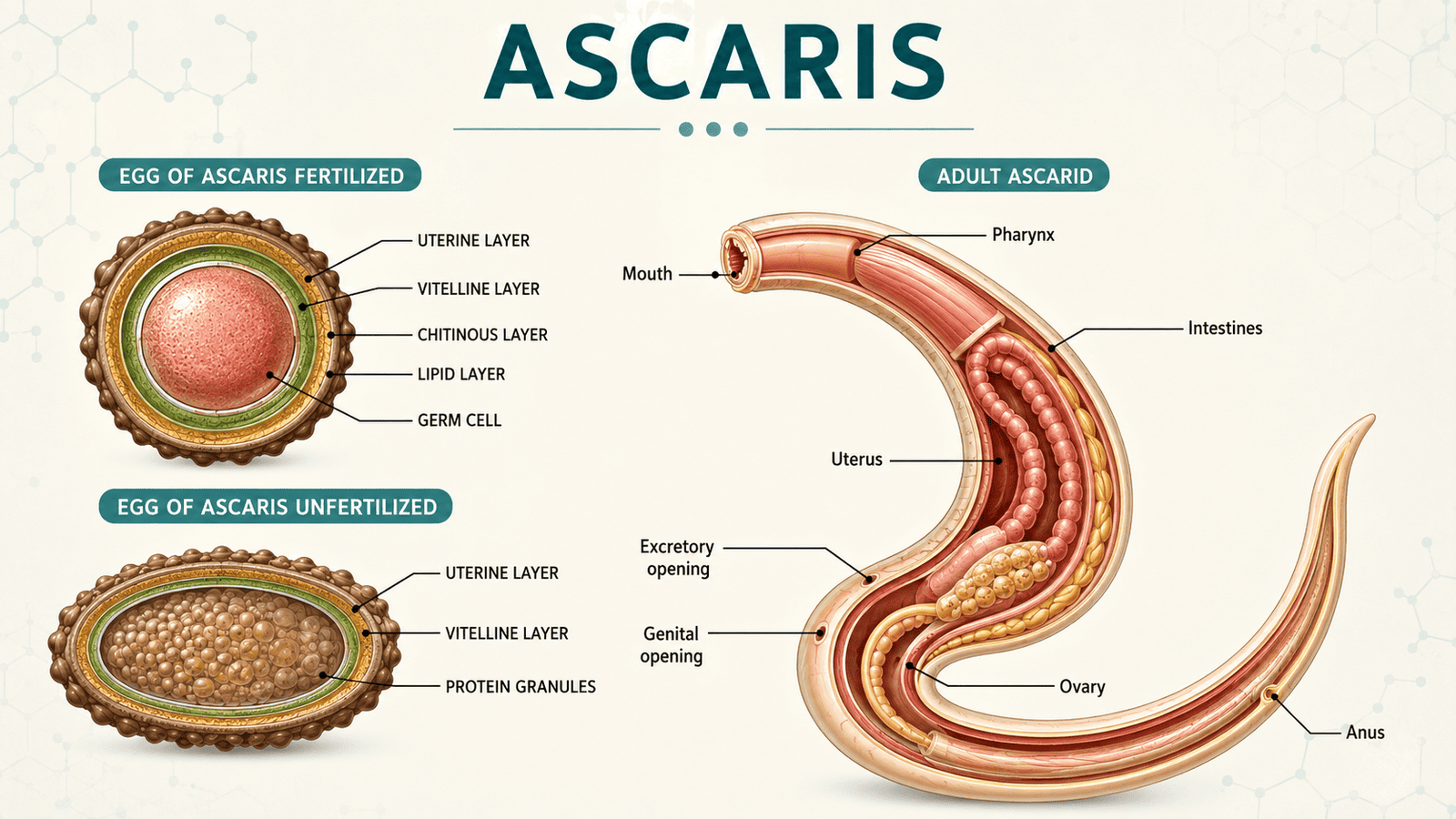
Ascariasis is an intestinal infection caused by the roundworm Ascaris lumbricoides, one of the most common soil-transmitted helminth infections worldwide.
Definition and Causative:
Agent: Ascariasis is defined as a parasitic infection of the small intestine caused by the nematode (roundworm) Ascaris lumbricoides. Adult worms are fleshy and cylindrical, with females reaching up to 25 cm (9.8 inches) in length. A single female can produce up to 200,000 to 240,000 eggs per day, which are excreted in feces and can survive in soil for years under favorable conditions.
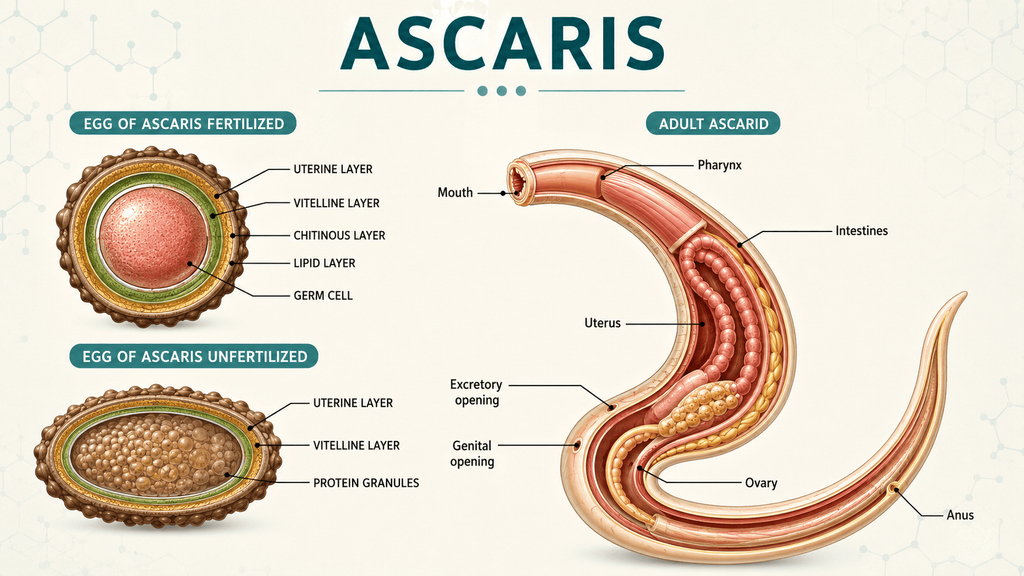
Symptoms and Clinical Manifestations:
Symptoms vary depending on the infection.
- Pulmonary phase (larval migration): Cough, wheezing, shortness of breath, and sometimes fever or hemoptysis.
- Intestinal phase (adult worms): abdominal pain, nausea, vomiting, diarrhea or constipation, visible worms in stool or vomit, and, in heavy infections, intestinal blockage.
- Chronic/heavy infection: malnutrition, stunted growth in children, weight loss, and cognitive or developmental delay.
Types and Variants:
There is essentially one primary species causing human ascariasis: Ascaris lumbricoides. A closely related species, Ascaris suum, primarily infects pigs but can occasionally infect humans, especially in settings with close human-pig contact or consumption of raw/undercooked pork or chicken liver.
Diagnosis and Diagnostic Methods:
Diagnosis is typically made through the following:
- Stool microscopy: detection of characteristic Ascaris eggs (most common and primary method).
- Sputum or gastric aspirate microscopy: may reveal larvae during the pulmonary phase.
- Blood tests: eosinophilia (elevated eosinophils) supports parasitic infection but is nonspecific.
Imaging:
- Chest X-ray: may show transient pulmonary infiltrates (Löffler’s syndrome).
- Abdominal X-ray/ultrasound/CT MRI: can reveal worm masses, intestinal obstruction, or worms in the biliary tree or pancreas.
- Advanced/emerging tests: serology for anti-Ascaris antibodies, elevated IgE, cytokine profiles (IL-4, IL-5, IL-13), and experimental urine-based metabolite detection.
Eggs appear in stool only after ~ 40 days post-infection, and infections with only male worms will not show eggs.
Treatment:
Treatment is primarily pharmacological, with surgery reserved for complications.
Anthelmintic Medications:
- Albendazole: Single dose (commonly 400 mg).
- Mebendazole: Single 500 mg dose or 100 mg twice daily for 3 days.
- Ivermectin: Single dose (150 μg/kg to 200 μg/kg)
- Pyrantel pamoate: preferred in pregnancy when treatment is necessary.
These drugs kill adult worms in the small intestine. Side effects are usually mild (abdominal pain, headache, diarrhea).
Surgical Intervention:
Surgery may be required for:
- Intestinal obstruction or perforation.
- Biliary or pancreatic duct obstruction.
- Appendicitis caused by worms.
Prevention and Control Measures:
1. Individual-Level Prevention:
- Wash hands thoroughly with soap, especially before eating and after using the toilet.
- Wash, peel, or cook raw vegetables and fruits, especially in endemic areas.
- Avoid consumption of food or water likely contaminated with human faces.
- Wear shoes to prevent soil contact and practice good personal hygiene.
2. Community and environmental control:
- Improved sanitation: construction and use of latrines to prevent open defecation and soil contamination.
- Safe disposal of human waste: sewage treatment and proper management of fecal sludge.
- Health education: promoting hygiene behaviors in schools and communities.
- Mass drug administration (MDA) for deworming: periodic deworming of at-risk populations, especially school-age children in endemic regions, as well as all non-endemic areas, as recommended by WHO.
- Agricultural practices: avoid using untreated human or pig manure as fertilizer; control pig farming practices where relevant.
Public Awareness, Community Engagement, and IEC Materials:
Effective control requires:
- Public awareness campaigns: using local languages and culturally appropriate messaging on transmission, symptoms, and prevention.
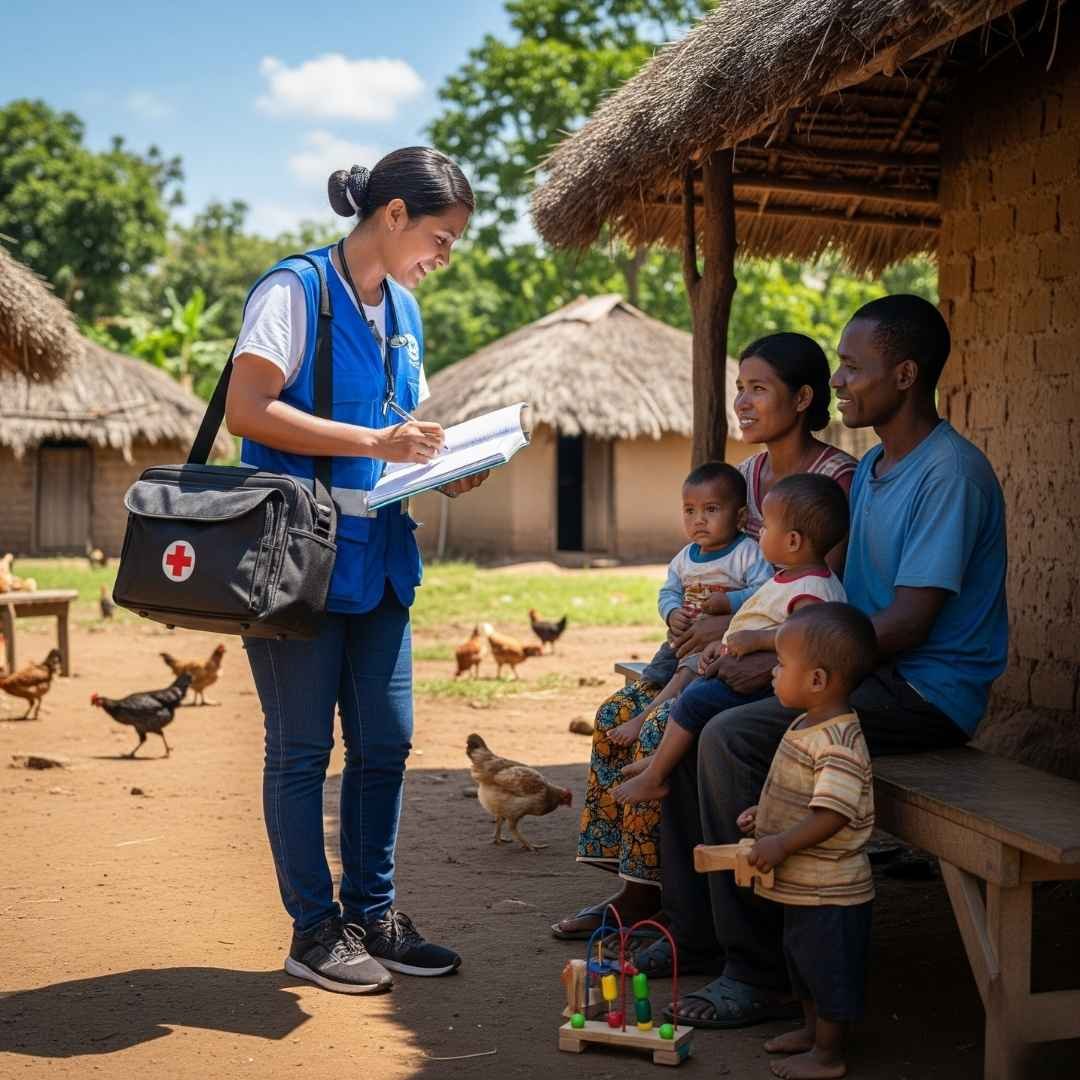
- Community engagement: involving local leaders, schools, and women’s groups to promote latrine use, handwashing, and participation in deworming programs.
- IEC (Information, Education, Communication) materials: posters, leaflets, radio messages, and school curricula illustrating
- How ascariasis spreads—fecal-oral route.
- Importance of handwashing, safe food, and footwear.
- Benefits and schedules of deworming tablets for children.
Role of the Public Health Department:
Public health departments are central to ascariasis control through:
- Surveillance: monitoring prevalence and intensity of infection via school-based or community surveys.
- Policy development: integrating deworming into national child health and school health programs.
- Coordination of MDA: organizing periodic distribution of albendazole/mebendazole to target groups.
- Wash (Water, Sanitation, and Hygiene) programs: improving access to clean water, sanitation infrastructure, and hygiene promotion.
- Training and capacity building: equipping health workers and teachers to deliver deworming and health education.
Magnitude and Global Risk:
Ascariasis remains one of the most prevalent neglected tropical diseases (NTDs).
- Global prevalence (2021): estimated 682 to 782 million people infected worldwide.
- Burden: approximately 648,000 disability-adjusted life years (DALYs) lost annually.
- Most affected regions: sub-Saharan Africa, Latin America, the Caribbean, South and Southeast Asia, and parts of East Asia.
- High-risk groups: children aged 5 to 15 years, people in poverty, and those living in warm, humid climates with poor sanitation.
Risk in India:
India bears a substantial share of the global ascariasis burden due to the following:
- High population density in rural and peri-urban areas.
- Incomplete coverage of safe sanitation and persistent open defecation in some regions.
- Warm, humid climate favorable for egg survival in soil.
- Large proportion of children in endemic settings.
While national programs (e.g., National Deworming Day) have reduced prevalence in many states, ascariasis remains a significant public health concern, particularly in socioeconomically disadvantaged communities. Continued emphasis on WASH, school-based deworming, and community education is critical.

2 Comments
Morphology Of Ascaris lumbricoides: 5 Critical Life Cycle Stages
August 31, 2026[…] Ascaris lumbricoides is the largest intestinal nematode infecting humans. resembling an earthworm in appearance. The sexes are separated and show marked sexual dimorphism, with the female generally larger than the male. […]
Epidemiological Factors of Ascariasis: 6 Critical Drivers
August 31, 2026[…] co-infection with other soil-transmitted helminths like hookworm, Trichuris, and other intestinal parasites due to shared transmission […]