



Ancient History of Leprosy
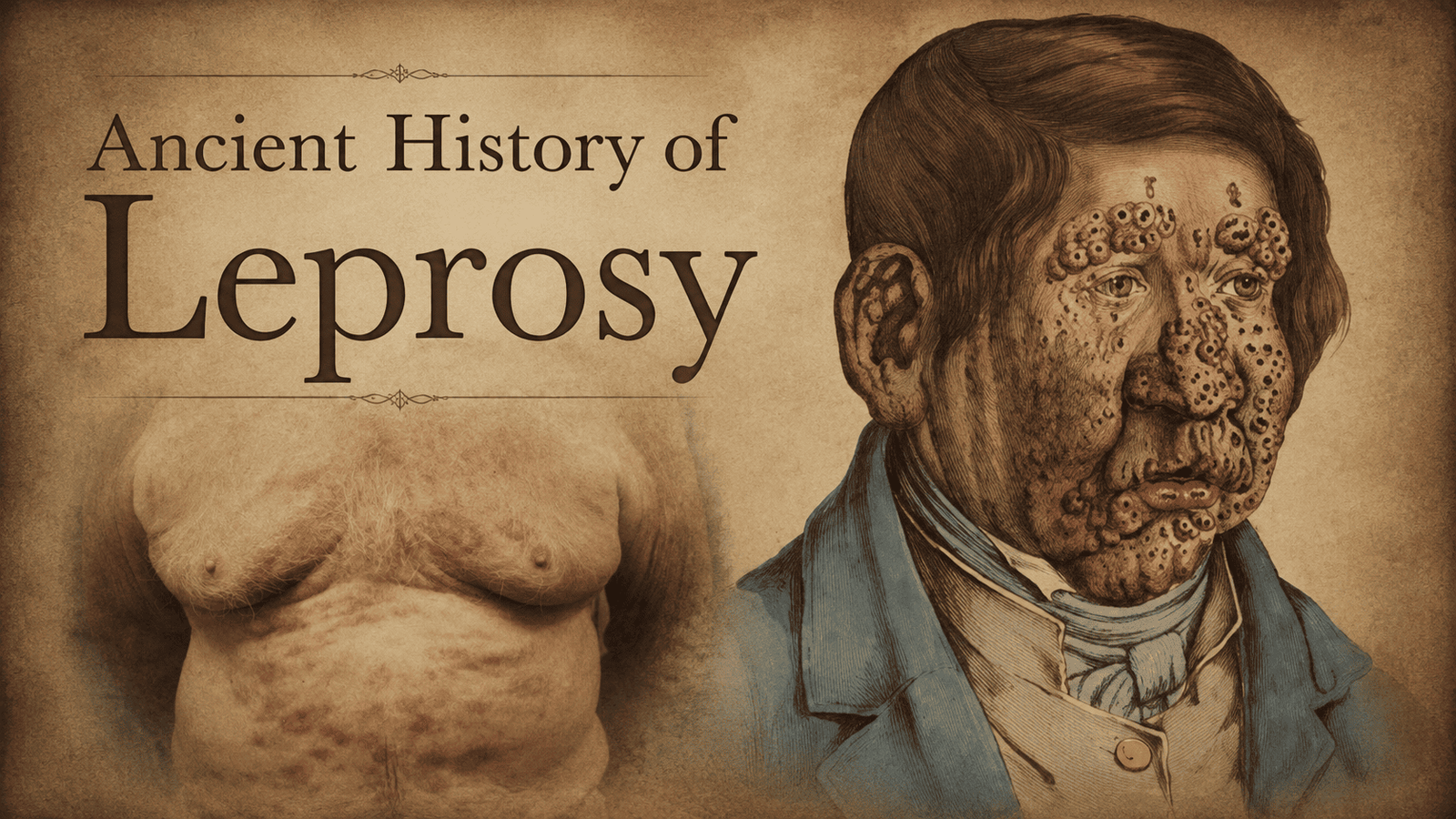
Kushtha in ancient Indian medicine was not limited to what is called leprosy today. It was a broad term used for several chronic skin diseases. Mahakushtha or Maharog meant a severe or major form of Kushtha; therefore, it is not correct to assume that every condition described as Kushtha in ancient texts was modern leprosy.
Modern leprosy is also called Hansen’s disease. It is a chronic infection caused by the bacterium Mycobacterium leprae, mainly affecting the skin, peripheral nerves, eyes, and the lining of the nose. If it is untreated, it can cause loss of sensation, deformity, and disability.
Ancient Evidence in India
The oldest physical evidence of leprosy comes from Balathal in Rajasthan, in India, and is believed to date to approximately 2000 BCE. A skeleton from ancient India showed changes in the nose and jaw, tibia, and other bones that were consistent with lepromatous leprosy. Researchers compared these findings with other diseases before reaching this conclusion. The word “Kushtha” appears in the Rigveda and especially in the Atharvaveda. However, in the Vedic contexts, the word could refer either to a skin disease or to a medicinal plant. Therefore, although these references may relate to leprosy, not every mention can be identified with certainty as the modern disease.
Some researchers believe that leprosy-like diseases were also known in ancient Egypt, Mesopotamia, China, and other parts of Asia. However, ancient disease names were often broad, so it is difficult to prove that every old reference specifically described modern leprosy.
Ayurvedic Texts
The Charaka Samhita, Sushruta Samhita, and later Ayurvedic texts classified Kushtha as a broad group of diseases. In the Sushruta tradition, it was mainly divided into two groups: Mahakushtha, meaning severe types, and Kshudrakushtha, meaning milder or minor skin disease.
The present form of the Sushruta Samhita is generally associated with around 600 BCE. It describes changes in skin colour, reduced sensation, wounds, nodules, and abnormalities in different parts of the body. Some of these descriptions resemble symptoms of modern leprosy.
Ancient Indian medicine treated Kushtha not merely as a religious punishment but as a medical condition. Physicians discussed its symptoms, types, progression, and treatment. Chaulmoogra oil was used in traditional treatments and remained an important remedy for leprosy for many centuries.
Meaning of “Maharog”
The word “Maharog” literally means “a great” or “serious disease.” Leprosy was sometimes called “Maharog” in Indian religious and popular traditions because
- It could continue for a long time.
- Nerve damage could cause numbness and disability.
- Effective treatment was unavailable in ancient times.
- Patients faced considerable fear and social stigma.
However, Maharog was not a precise modern medical diagnosis. Its meaning could vary between different regions and texts, where it might refer to a serious disease in general or specifically to leprosy.
Other Civilizations:
References to leprosy-like diseases have also been associated with ancient regions of the Middle East, China, Greece, and Egypt. However, the names and descriptions of the diseases in ancient texts do not always correspond directly to modern medical diagnoses. Some historians have suggested that the disease spread from Asia to the Mediterranean through ancient trade, migration, and military movements. Its exact origin is still being studied through historical and genetic research.
Social History
In ancient and medieval societies, people with leprosy were isolated because of the physical deformities associated with the disease. This isolation was usually based more on fear, religious beliefs, and the visible effects of the disease than on an accurate understanding of infection. Modern leprosy is curable. Multidrug therapy can control the infection, and early diagnosis and treatment greatly reduce the risk of nerve damage, disability, and transmission to others.
Ancient Indian Treatment
Ancient Indian physicians used various approaches to manage Kushtha, including herbal medicines, dietary restrictions, cleansing procedures, and external applications. Chaulmoogra oil became one of the best-known traditional remedies for leprosy and continued to be used for many centuries. These treatments were based on the medical theories of the time and were not cures in the modern sense. Effective antibacterial treatment became possible only after the discovery of the causative organism and the development of modern anti-leprosy medicines.
Spread Across the Word
Leprosy appears to have spread gradually from early population centers in Africa and Asia to the Middle East and Europe. Ancient trade routes, military campaigns, migration, and later colonial expansion probably contributed to its movement between regions. By the first millennium BCE, references to leprosy-like conditions had appeared in those parts of Asia, including China. Ancient Mediterranean and biblical writings also contain descriptions of the conditions traditionally associated with leprosy, although many of those passages may have referred to a variety of skin diseases rather than Hansen’s disease specifically.
Leprosy in Europe:
Leprosy became especially widespread in Europe during the medieval period. By around 1200 CE, Europe reportedly had thousands of hospitals or institutions for people regarded as having leprosy. Many patients were separated from society because of fear, religious beliefs, and the visible deformities caused by untreated disease. This led to strong social stigma, which often continued even when a person’s disease was no longer infectious.
Social and Religious Beliefs
In many ancient societies, leprosy was wrongly understood as a punishment for sin, impurity, or moral wrongdoing. Such beliefs resulted in exclusion and isolation. and discrimination. The disease’s slow progression and effects on the face, hands, and feet made it particularly feared. Ancient Indian traditions also included social and religious restrictions affecting people with severe skin diseases. However, Indian medical texts simultaneously attempted to describe and classify the illness as a physical condition, showing that medical explanations existed alongside religious and social beliefs.
Modern Understanding
In 1873, Norwegian physician Gerhard Armauer Hansen identified the bacterium associated with leprosy, which is why the disease is now called Hansen’s disease. Modern multidrug therapy can cure the infection, and early treatment helps prevent permanent nerve damage and disability. The ancient history of leprosy, therefore, combines three elements: very old archeological evidence, early medical descriptions such as Kushtha in India, and a long history of fear and social stigma. The oldest confirmed skeletal evidence currently comes from India, but the disease likely existed in several ancient regions and spread between populations over thousands of years.
Modern History in India
India has played an important role in leprosy research, treatment, and control. Traditional treatment initially included chaulmoogra oil, but Indian medical services later adopted sulphone therapy, newer anti-leprosy medicines, reconstructive surgery, and MDT.
India’s National Leprosy Control Programme began in 1955 and was renamed the National Leprosy Eradication Programme in 1983 after MDT was introduced. India reached the public health elimination target—less than one registered case per 10,000 people—at the national levels in 2005, although leprosy continued to occur in some communities.
Modern Indian programs focus on early case detection, free treatment, contact examination, prevention of disability, health education, and reducing discrimination. Elimination as a public health problem does not mean that the disease has completely disappeared.
Global Elimination Efforts
The WHO defined global elimination as a registered prevalence of fewer than one case per 10,000 population. The world achieved this target in 2000, but new cases continued to be detected afterward. The number of reported cases fell substantially from the late twentieth century onward, particularly after MDT became widely available. Nevertheless, leprosy remains present mainly in parts of Asia, Africa, and South America, with India continuing to account for a large proportion of global cases.
Changes in Social Attitudes
Modern medicine has shown that leprosy is not highly contagious and is curable with appropriate treatment. Once treatment begins, the risk of transmission falls greatly, but delayed diagnosis can still leave permanent nerve damage. The term “Hansen’s disease” is often used to reduce the fear and stigma associated with the word “leprosy.” Despite medical progress, discrimination, social exclusion, and misconceptions remain important modern challenges.