






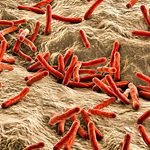
Mycobacterium leprae (Hansen’s bacillus) is an obligate intracellular, acid-fast, rod-shaped bacterium that causes leprosy (Hansen’s disease). Unlike most bacteria, it has never been successfully cultured on artificial media and has an extremely slow replication rate and highly host-dependent life cycle centered on macrophages and Schwann cells. with a doubling time of about 12 to 14 days.
Because it cannot be grown in standard culture, its “life cycle” is described in terms of how it enters the human host, survives and multiplies inside specific cells, spreads within tissues, and is transmitted to new hosts, often studied using animal models like the mouse footpad and armadillo.
Basic Microbiology Relevant to the Life Cycle:
- Morphology: Slender, slightly curved rods; weakly acid-fast (stains red with modified Ziehl-Neelsen/Fite stains).
- Growth: Non-motile, non-spore-forming; divides by binary fission with a generation time of ~12 to 14 days (the longest known among bacteria).
- Obligate intracellular: Requires host cells for survival and replication; cannot live long or multiply outside a host.
- Temperature preference: Grows best at cooler temperatures (about 33-35 degrees Celsius), which helps explain its tropism for skin, peripheral nerves, and extremities.
Reservoirs and Transmission (How the Cycle Starts):
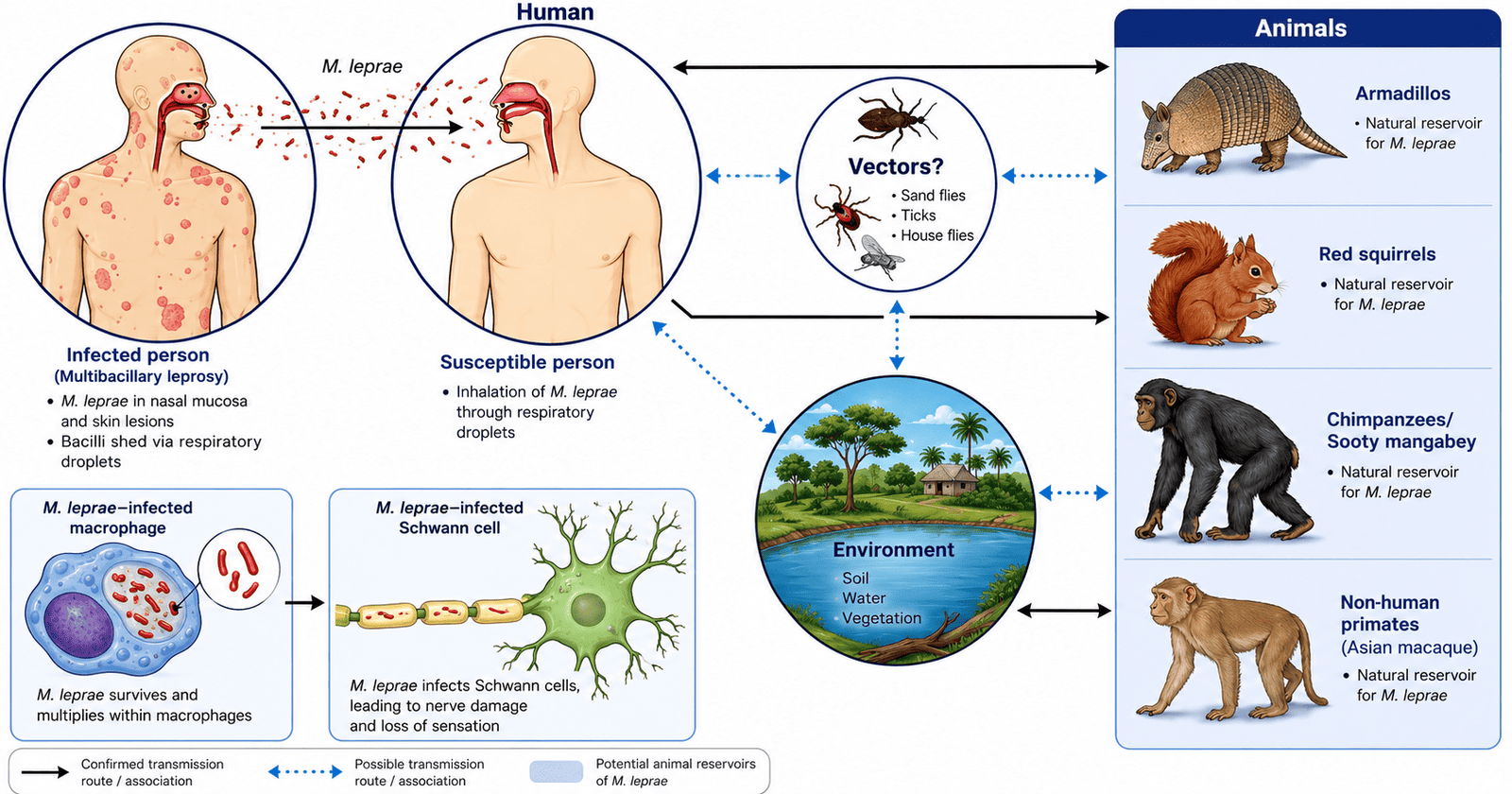
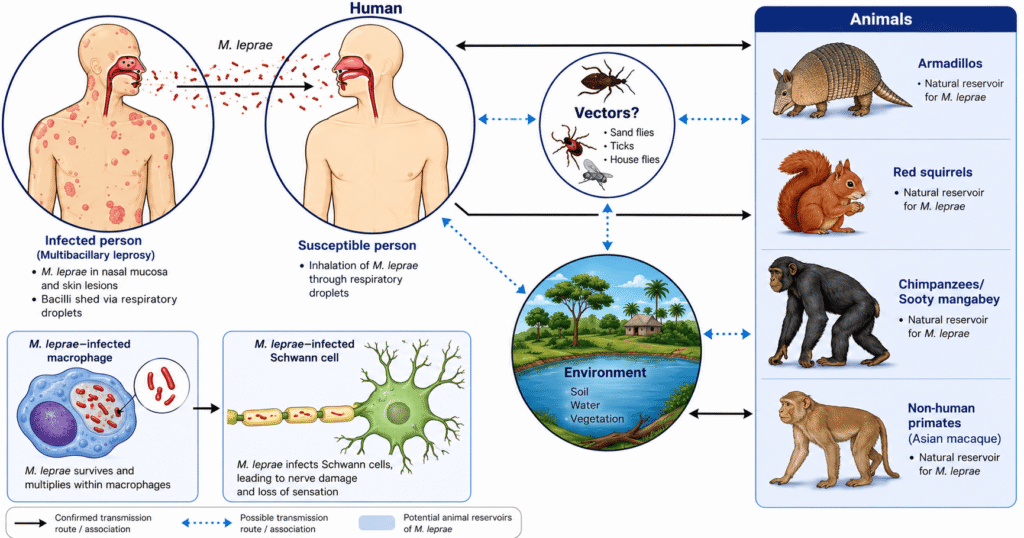
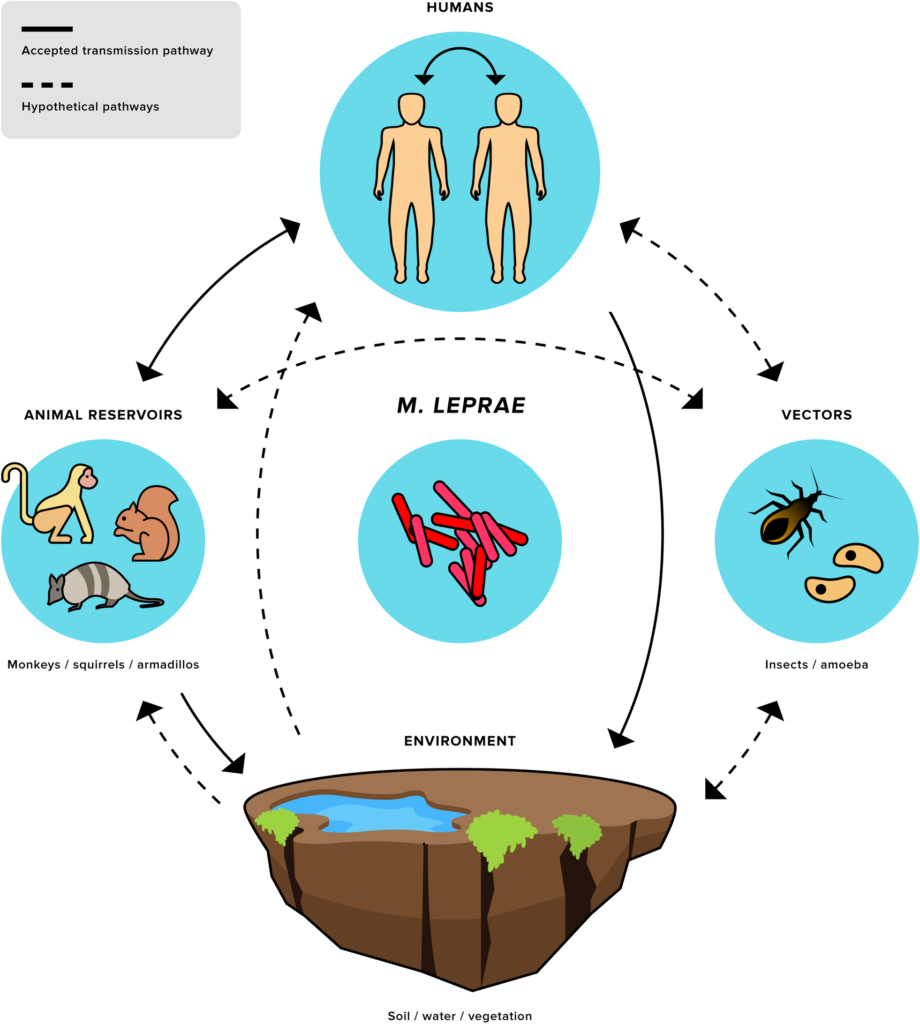
- Humans are the main reservoir; heavy bacterial loads occur in untreated lepromatous cases.
- Armadillos (especially nine-banded armadillos) are a natural reservoir in some regions and can transmit infection to humans.
Mode of Transmission:
Exact details are still not fully resolved, but the prevailing view is the following:
- Primary route: Inhalation of aerosolized nasal secretions from an infectious person; bacteria enter via the nasal or respiratory mucosa.
- Secondary routes: Entry through broken skin or possibly via minor trauma; some evidence suggests possible roles for insects or environmental contamination, but these are less certain.
Outside the human body, M. leprae can survive for several days under favorable (tropical) conditions but does not replicate in the environment.
Entry and Establishment in the Host:
Entry through mucosa or skin:
Bacteria in nasal droplets or on fomites contact the nasal/respiratory epithelium or broken skin.
Initial interaction with immune cells:
M. leprae is taken up by macrophages and dendritic cells in the submucosa and skin.
It can survive inside these phagocytes by interfering with normal phagolysosome maturation and resisting oxidative killing.
Colonization of Schwann cells:
A key feature of M. leprae is its strong affinity for Schwann cells of peripheral nerves; it binds to components on the Schwann cell surface and enters them.
Inside Schwann cells, it can persist and replicate, contributing directly to nerve damage and the characteristic sensory loss in leprosy.
5) Intracellular Survival and Multiplication:
Once inside host cells (macrophages, histiocytes, and Schwann cells):
Avoidance of destruction:
Prevents full fusion of phagosomes with lysosomes and resists reactive oxygen species, allowing survival within macrophages.
Replication:
Multiplies by binary fission but very slowly; each division takes ~12 to 14 days, leading to gradual accumulation over months to years.
Inside macrophages, bacterial numbers can reach ~ 100 organisms per cell; in heavily infected tissues, dense clusters called “globi” (aggregates of bacilli) form.
Intracellular niche:
Acts as an obligate intracellular pathogen, depending on host cell metabolism and nutrients for growth.
6) Spread Within the Host and Tissue Tropism:
After initial establishment:
Local spread:
Bacteria move from initially infected cells to adjacent macrophages and Schwann cells.
Lymphatic and hematogenous dissemination:
Some bacilli travel via the lymphatic system and blood to other sites, especially cooler areas (skin of extremities, face, ears, peripheral nerves, nasal mucosa, and testes).
Nerve involvement:
Preferential infection and multiplication within Schwann cells. lead to demyelination, axonal damage, and the hallmark sensory and motor deficits.
Skin lesions:
Accumulation of bacilli in macrophages and histocytes in the dermis produces characteristic skin patches, nodules, and plaques, especially in lepromatous disease.
7) Incubation period and chronicity:
Incubation period: Typically 2 to 7 years on average, but can range from ~ 9 months up to 20 years.
This long incubation reflects the slow replication rate and the time needed for bacterial load and immune responses to reach thresholds that produce clinical disease.
8) Shedding and Transmission to New Hosts (Completing the Cycle):
In untreated or inadequately treated multibacillary (lepromatous) cases:
High bacterial load:
Tissues such as nasal mucosa, skin, and sometimes other secretions can contain very large numbers of bacilli (up to billions per gram of tissue).
Release into the environment:
Bacteria are shed in nasal secretions (runny nose, sneezing) and possibly in skin exudates from lesions.
Infectiousness:
These shed bacilli can be inhaled by close, prolonged contacts, initiating a new infection cycle in another susceptible host.
Effective multidrug therapy rapidly reduces viability; most organisms quickly lose solid acid-fast staining and become non-viable in experimental systems, sharply reducing transmission risk.
Experimental Models (How We Know the Life Cycle):
Because M. laprae cannot be cultured in vitro, key aspects of its life cycle have been worked out using the following:
Mouse footprint model:
Viable bacilli injected into the footpad of immunocompetent mice multiply locally with a doubling time of ~ 12 to 14 days, reaching a peak around 5 to 6 months, then plateau due to immune control.
In immunodeficient mice, multiplication continues to very high loads, confirming its intracellular replicative capacity.
Armadillo model:
Nine-banded armadillos develop systemic infection with high bacillary loads, mimicking human lepromatous disease and serving as a natural host model.
Simplified Step-by-step Life Cycle Summary:
- Transmission: Inhalation of aerosolized nasal droplets or entry via broken skin from an infectious human or armadillo.
- Entry and uptake: Bacteria enter nasal/respiratory mucosa or skin and are phagocytosed by macrophages/dendritic cells.
- Intracellular survival: Escape full killing by inhibiting phagolysosome fusion and resisting oxidative stress.
- Schwann cell infection: Bind to and enter Schwann cells of peripheral nerves; establish a long-term intracellular niche.
- Slow replication: Divide by binary fission every ~ 12 to 14 days, forming globes in heavily infected tissues.
- Dissemination: Speed via lymphatics and blood to cool tissues like skin, peripheral nerves, nasal mucosa, and extremities.
- Chronic infection: Long incubation (years) followed by skin lesions and nerve damage depending on host immunity.
- Shedding: In multibacillary disease, large numbers of bacilli are released in nasal secretions and skin exudates.
- New host infection: Shed bacilli infect new susceptible individuals, restarting the cycle.
Doubling time:
The 14-day doubling time means that, under suitable conditions, one viable bacterial population may approximately double every two weeks. This is an estimate obtained mainly from experimental growth in mouse footpads; it does not mean that symptoms appear after 14 days. The unusually slow growth contributes to the chronic nature of leprosy.
Incubation period:
The incubation period is the time between infection and the appearance of clinical signs. In leprosy, it is commonly several years—often around 2 to 7 years or approximately 3 to 10 years—but it may extend to 20 years or more in some individuals.
Thus:
- Doubling time: about 12 to 14 days
- Typical incubation: several years.
- Maximum reported incubation: up to approximately 20 years.
- Important distinction: The 14-day doubling time refers to bacterial multiplication, whereas the 20-year incubation period refers to the delayed appearance of disease symptoms.
2 Comments
Mycobacterium leprae: 5 Critical Morphological Features & Sites
August 18, 2026[…] M. leprae is an obligate intracellular bacillus that grows best at cooler temperatures (approximately 27 to 30°C), which are found in superficial tissues rather than the core body temperature (37°C). This explains why it colonizes: […]
Ancient History of Leprosy: 5 Critical Historical Facts
August 18, 2026[…] The present form of the Sushruta Samhita is generally associated with around 600 BCE. It describes changes in skin colour, reduced sensation, wounds, nodules, and abnormalities in different parts of the body. Some of these descriptions resemble symptoms of modern leprosy. […]