



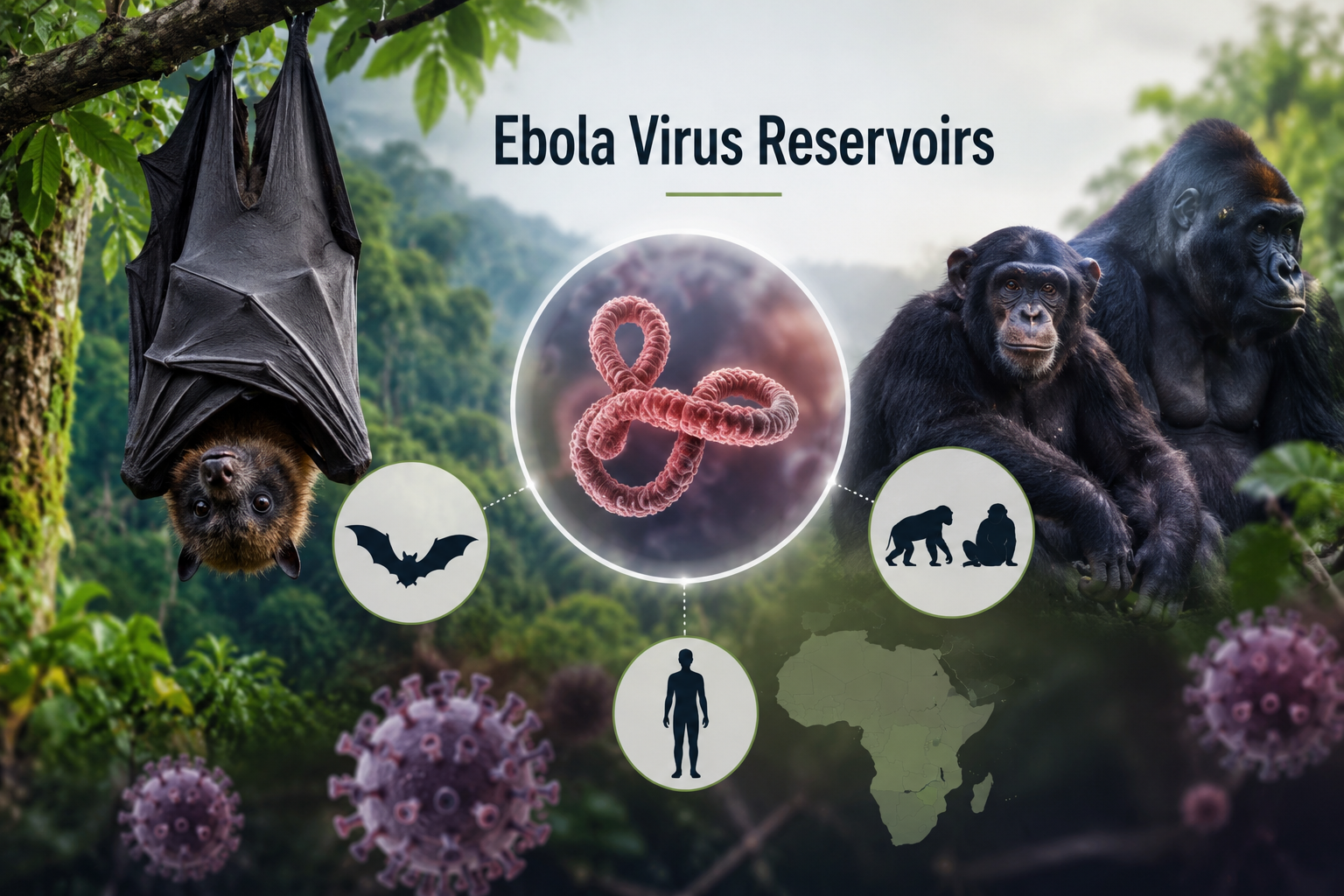
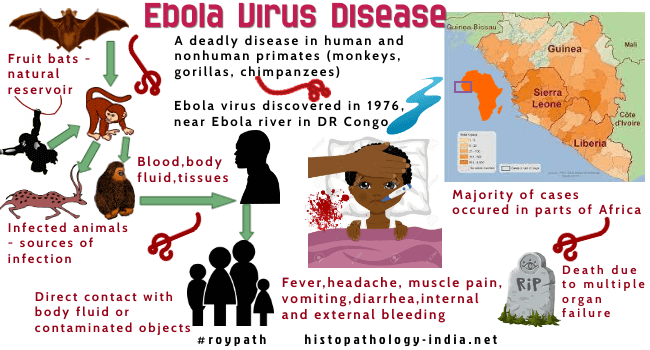
The Ebola virus is a zoonotic virus, meaning it is maintained in nature in an animal reservoir and can occasionally spill over to humans. Researchers believe bats are the most likely natural reservoir, but the exact species has not been confirmed.
📌 Key Takeaways: Ebola Virus Reservoirs & Ecology
- Primary Natural Reservoir: Fruit bats remain the leading suspected long-term natural reservoir hosts capable of maintaining the Ebola virus asymptomatically in the wild.
- Amplifier Hosts vs. Reservoirs: Non-human primates (gorillas and chimpanzees) are highly susceptible, vulnerable hosts that suffer extreme mortality; they act as virus amplifiers during local outbreaks rather than permanent environmental reservoirs.
- Maintenance Mechanisms: The virus persists in bat populations through seasonal birth pulses that introduce new susceptible hosts, coupled with horizontal colony transmission and vertical (mother-to-fetus) transmission paths.
- Spillover Risk Drivers: Zoonotic spillover into human communities typically occurs in forested African ecosystems, frequently linked to direct contact with infected wildlife fluids, deforestation, or habitat fragmentation.
What Is the Ecological Habitat of the Ebola Virus?
Ebola viruses are thought to persist in forested ecosystems in parts of Africa, where spillover can occur through contact with infected wildlife or contaminated animal fluids. The virus is associated with an enzootic cycle in nature, and outbreaks in humans usually begin after a spillover event from wildlife.
Which Animals Act as Hosts for the Ebola Virus?
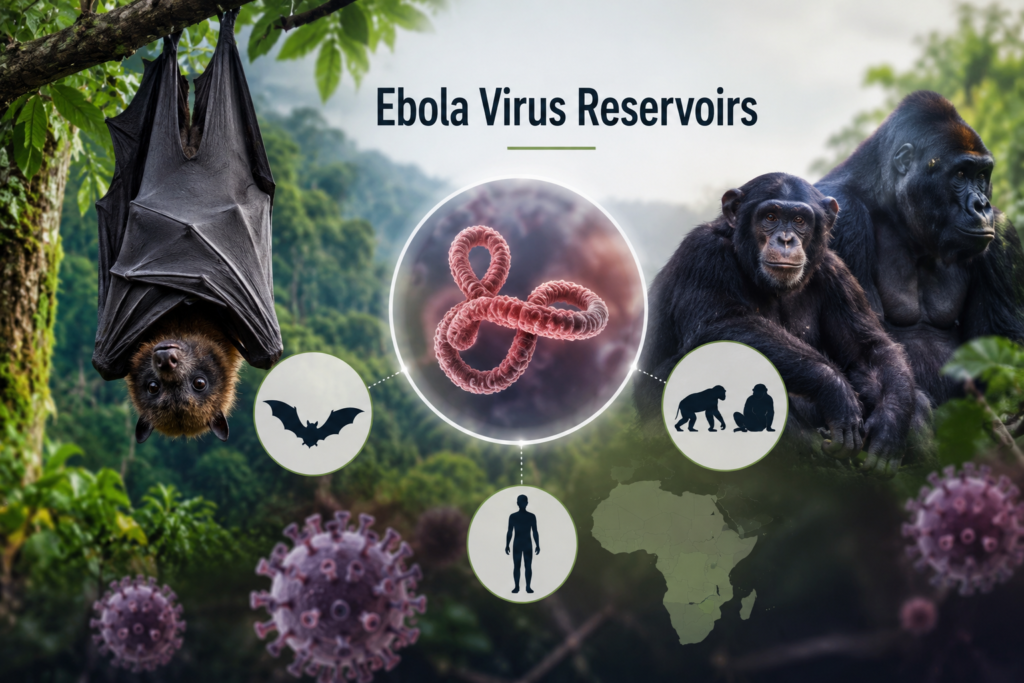
Bats are the leading suspected reservoir hosts, especially fruit bats, but direct proof for a single definitive species is still lacking. Non-human primates such as gorillas and chimpanzees are not considered reservoirs; instead, they are vulnerable hosts that can become infected and sometimes help amplify outbreaks.
Why Is Tracking Ebola Reservoirs Important for Public Health?
Understanding the reservoir and ecology of Ebola virus is important because it helps public health teams reduce spillover risk and design better surveillance in wildlife and human communities. This knowledge is also key for preventing future outbreaks in regions where people live near forests and wildlife.
Why Non-Human Primates Act as Amplifiers Rather Than Reservoirs
Non-human primates are considered amplifiers rather than true reservoirs because they can become infected and spread the Ebola virus, but they do not appear to maintain it long-term in nature. A reservoir host usually carries the virus persistently in the wild and helps keep it circulating between outbreaks; primates, by contrast, are highly susceptible and often die, so they are more likely to reflect spillover from the real reservoir than to sustain the virus themselves. In simple terms, bats are thought to be the long-term natural hosts, while gorillas and chimpanzees can get infected and then pass the virus onwards during a local outbreak, increasing transmission without being the main source that preserves the virus over time.
Mechanism of Ebola Virus Maintenance in Bat Populations
The Ebola virus may be maintained in bat populations through a combination of seasonal birth pulses, long enough incubation periods, and bat-to-bat transmission that lets the virus persist without killing the host population. Modeling studies suggest that biannual breeding, especially in large colonies, can keep the virus circulating by continually adding susceptible young bats, while infected bats may shed virus after a delay. Recent experimental works also suggest that some bats can support selective Ebola virus replication and may allow both horizontal transmission between bats and vertical transmission from mother to fetus. This matters because vertical transmission and infection during pregnancy can help the virus survive between breeding cycles and remain in the bat population over time. In simple terms, the virus is thought to persist in bats by using the bat’s own ecology: regular births create new susceptible hosts, and transmission can happen within colonies as well as from mother to offspring.
Evidence for Vertical Transmission in Specific Bat Species
Evidence for vertical transmission is species-specific and limited, but it has been demonstrated in some bat-virus systems. For the Ebola virus, a 2024 experimental study showed placental tissue tropism and concluded that Angolan free-tailed bats can support potential vertical transmission.
Outside of Ebola, vertical transmission has also been reported in other bat species-virus pairs, such as fruit bats with Hendra virus, which supports the idea that some bats can pass viruses from mother to offspring. In general, however, the evidence is not broad across all bat species: it tends to come from a few well-studied host-virus combinations rather than a universal bat trait.
Are Other Animal Species Suspected as Ebola Reservoirs?
Yes, beyond fruits, bats and non-human primates such as chimpanzees, gorillas, and monkeys are suspected in Ebola ecology, but they are generally thought to be victims or intermediate hosts rather than the main long-term reservoir. Ebola is also considered a zoonotic disease, and wildlife surveillance studies look at multiple animal species because the exact reservoir has not been definitively proven.
Bats remain the leading suspected natural reservoir, while primates are important because outbreaks in people and great apes have often been linked to contact with sick or dead animals. In other words, primates can be part of transmission chains, but current evidence does not show they are the primary reservoir. For complete ecological profiles on wildlife vectors, consult the World Health Organization.
Scientists still investigate other wildlife because Ebola spillover is complex and may involve several species depending on the outbreak setting. That is why animal sampling and wildlife surveillance continue during outbreak investigation.
How Do Wildlife Surveillance Studies Identify Potential Reservoirs?
Wildlife surveillance studies identify potential reservoirs by combining field sampling, lab testing, and ecological analysis to see which species carry a pathogen without obvious illness. They look for repeated evidence of infection in the same species across places and time, especially when that species lives in areas where spillover into humans is more likely.
How Studies Work
Capture and Sample Animals
Researchers collect blood, swabs, tissues, or fecal samples from wild animals to test for antibodies, viral RNA, or live virus.
Compare Many Species
They sample multiple candidate species to see which ones repeatedly show evidence of infection.
Look for Asymptomatic Infection
A reservoir is more likely if animals show infection markers but do not become severely sick.
Map Ecology and Behavior
Scientists study where the species lives, how it moves, and how it overlaps with human activity or outbreak areas.
Use Genetics and Epidemiology
Viral sequences and outbreak investigations help connect animal infections to human cases.
What Makes a Species a Candidate Reservoir?
A species becomes a stronger reservoir candidate when it has antibodies or viral RNA in nature, can carry the pathogen over time, and fits the geographic and ecological pattern of outbreaks. Researchers also look for whether the species could realistically maintain the virus in the wild and potentially transmit it to animals or people.
Limits of the Evidence
Finding infection in an animal does not automatically prove it is the reservoir. A species may be an infected victim, an intermediate host, or part of a transmission chain rather than the true long-term source.
Role of Longitudinal Ecological Studies in Mapping Zoonotic Viruses
Longitudinal ecological studies help map zoonotic viruses by tracking hosts, pathogens, and environmental conditions over time, rather than at a single point in time. This makes them useful for spotting patterns in spillover risk, seasonal changes, and geographic hotspots before outbreaks grow.
Why They Matter
These studies show how wildlife reservoir populations change across seasons, landscapes, and human disturbances, which help identify when and where spillover is more likely. They are especially valuable for zoonoses because the virus, host species, climate, and land use all interact dynamically.
What They Can Reveal
Reservoir Behavior
They track how often candidate reservoir species carry infection and whether that changes over time.
Hotspots
Repeated sampling can reveal geographic areas where infections cluster.
Spillover Drivers
They can link outbreaks to deforestation, habitat fragmentation, farming expansion, or climate variation.
Early Warning
Long-term monitoring can detect rising risk before human cases appear.
Public Health Use
The findings support better surveillance, targeted prevention, and one health planning across human, animal, and environmental sectors. In practice, this means health departments can focus testing, community messaging, and response resources in places where ecological risk is building.
Main Limitation
These studies are powerful, but they do not prove causation on their own. They show associations and trends, which still need confirmation through virology, field investigation, and outbreak data.
Conclusion
Ebola virus disease is a serious infectious disease that needs early detection, strong prevention, and public cooperation. Better awareness, community engagement, and public health response are essential to control it and reduce its impact.
1 Comment
Ebola Virus Life Cycle: 7 Critical Morphological Facts - Health Care Guruji
June 25, 2026[…] humans, Ebola can suppress early immune responses, which allows rapid replication before antibodies […]