




Snake morphology refers to the structure and form of a snake’s body. Snakes are elongated, limbless reptiles highly adapted for crawling, swallowing large prey, and living in terrestrial, aquatic, arboreal, or fossorial habitats. There are more than 3,000 snake species worldwide. About 600 are venomous, but only around 200 can seriously harm or kill humans. Snake venom is not technically “poison”; it is venom injected through a bite.
1. General body plan:
- The body is long, cylindrical, and covered with scales.
- Snakes lack external forelimbs and hind limbs: some primitive snakes retain small internal pelvic remnants or external spurs.
- The body is divided broadly into head, short neck, trunk, and tail. Modern anatomical studies identify distinct vertebral regions rather than a completely uniform spine.
- Snakes possess a very large number of vertebrae—often more than 300, giving them great flexibility.
2. Head:
The snake’s head is relatively distinct from the neck and contains specialized structures for feeding and sensing.
- The skull is lightweight and highly kinetic, meaning that several bones can move relative to one another.
- The two halves of the lower jaw are connected by elastic tissue rather than being rigidly fused.
- The upper and lower jaws can spread and move alternatively, allowing snakes to swallow prey much wider than their head.
- The head is covered by large, named scales or shields, including the rostral, nasal, loreal, prefrontal, parietal, supraocular, and labial scales.
- The eyes lack movable eyelids. They are protected by a transparent scale called the spectacle or brille.
- Many snakes have a forked tongue that transfers chemical particles to the vomeronasal, or Jacobson’s, organ.
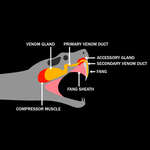
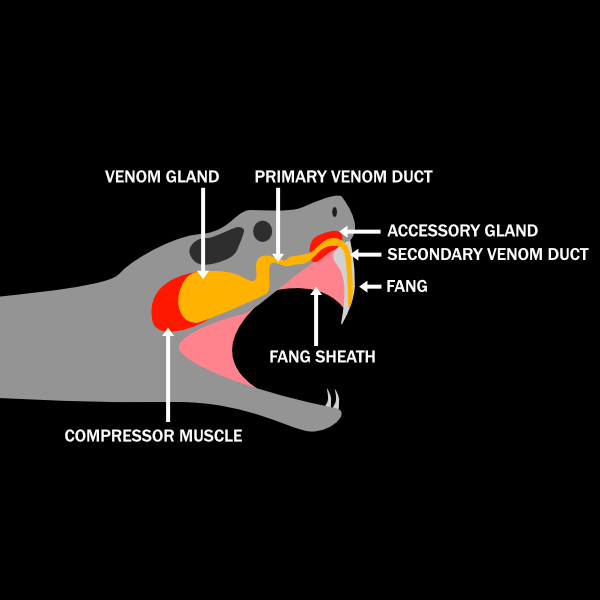
- Venomous snakes may possess specialized fangs connected to venom glands. Fangs can be grooved or hollow and vary in position among snake groups.
3. Trunk and vertebral column:
The trunk forms most of the snake’s length.
- Most trunk vertebrae bear ribs, unlike the vertebral column of typical four-legged reptiles.
- The vertebrae are linked by strong muscles, ligaments, and specialized joints that permit lateral bending.
- The backbone is relatively uniform along much of the trunk, although it contains recognizable cervical, thoracic, and lumbar-related regions.
- The long rib series helps support the body and assists in locomotion and respiration.
- The absence of limbs and reduction of the shoulder and pelvic girdles create the characteristic streamlined, elongated body.
4. Scales and skin:
The skin is covered with keratinized scales that protect the body and reduce water loss.
- Dorsal scales cover the back and sides. They may be smooth, keeled, or granular.
- Ventral scutes are enlarged scales arranged in a single row along the underside and help the snakes grip the ground during locomotion.
- Subcaudal scales occur beneath the tail and may be single or paired.
- The anal scale covers the cloacal opening and may be single or divided.
- Snakes periodically shed the outer layer of skin in a process called ecdysis. Scale arrangement, or scalation, is important in identifying snake species.
5. Tail:
The tail begins behind the cloaca and contains fewer vertebrae than the trunk.
- It is usually a tapering continuation of the body.
- In some species, the tail is adapted for climbing, grasping, swimming, or defense.
- Aquatic snakes often have a laterally compressed, paddle-like tail that improves propulsion in water.
- Rattlesnakes possess modified terminal tail segments that form a rattle.
6. Internal organs:
Snake organs are elongated and arranged asymmetrically because of the narrow body cavity.
- The right lung is usually long and functional; the left lung is reduced or absent in many species.
- The heart is positioned relatively far forward and can move slightly within the body, helping food pass through the esophagus.
- The liver, kidneys, and reproductive organs are elongated.
- The digestive tract expands considerably after a large meal.
- Snakes have a cloaca, a common chamber for the digestive, urinary, and reproductive systems.
7. Locomotor adaptations:
Snakes use several forms of locomotion:
- Lateral undulation: the body pushes against irregularities in the ground.
- Concertina movement: the snake anchors parts of its body while extending other parts.
- Rectilinear movement: Large muscles and belly scales produce slow, straight movement.
- Sidewinding: loops of the body contact the ground, useful on loose sand.
- Swimming and climbing: specialized body shapes and muscles control movement in water and trees.
The combination of flexible vertebrae, ribs, powerful muscles, and ventral scales enables locomotion without limbs.
The main morphological features of snakes are an elongated, limbless body; numerous vertebrae and ribs; a highly flexible skull; specialized jaws; asymmetrical internal organs; and a tapering tail. These features allow snakes to move efficiently, capture and swallow large prey, and occupy a wide variety of habitats.
Ancient Armies Weaponized Snake Venom in Warfare:
Ancient armies turned snake venom into a weapon in two main ways: by coating arrows and blades with venomous mixtures and by literally hurling live venomous snakes at enemy troops as “biological bombs.”
Scythian arches and scythicon:
The best documented case comes from the Scythians, nomadic horse-archers of the Black Sea steppe. Greek sources, especially Herodotus, describe their use of a dreaded arrow poison called scyphron

To make it, they:
- Collected venomous adders (vipers) native to their region.
- Mixed decomposing snake bodies and their venom with human blood and animal or human dung.
- Sealed the mixture in containers and buried it until it purrified.
The result was not just venom; it was also contaminated with bacteria and spores, including tetanus- and gangrene-causing organisms from the dung and rotting tissue. Even a shallow wound could lead to:
- Rapid, excruciating pain and swelling at the wound site.
- Systemic shock and tissue necrosis.
- Severe infection, often fatal within hours to a couple of days.
Others ancient poison-arrow traditions:
Similar practices appear elsewhere:
- South Asia (India): Vedic and later Sanskrit texts mention poisoned arrows in warfare. Classical accounts of Alexander the Great’s Indian campaign describe enemies using arrows whose symptoms match viper venoms, e.g., Russell’s viper, causing convulsions, paralysis, or severe tissue damage.
- Africa and the Near East: Greek and Roman authors report archers in Egypt, Nubia, and neighboring regions using snake-venom arrows; a minor scratch could trigger shock, necrosis, and fatal infection.
- Greek myth and early lore: Stories like Heracles dipping arrows in the Hydra’s blood reflect an early cultural memory of venom-coated weapons, even if mythologized.
- In many of these cases, commanders understood that venom made arrows disproportionately lethal, especially against armored foes where a small penetration might otherwise be non-fatal.
Snakes Bombs: Live snakes as battlefield weapons:
The most dramatic use of snakes as weapons is Hannibal’s so-called “snake bombs.”
Hannibal’s snake jars at sea:
After his wars with Rome, Hannibal served as a naval advisor to King Prusias of Bithynia in Asia Minor. In a naval battle against Eumenes II of Pergamon, ancient sources say Hannibal deployed an unconventional biological weapon:
- He ordered his men to collect large numbers of venomous snakes (often described as cobras, kraits, and other highly toxic species).
- The snakes were packed into clay pots or jars small enough for one sailor to handle.
- During the engagement, Hannibal’s ships maneuvered close to the enemy and hurled these pots onto the decks of Pergamene vessels.
- The pots shattered on impact, releasing angry , biting snakes among the barefoot or lightly shod sailors.
The effect was immediate chaos:
- Sailors panicked as snakes bit legs and feet.
- Discipline broke down; crews focused on killing or avoiding snakes rather than fighting.
- Hannibal exploited the confusion to overwhelm the Pergamene fleet and win the battle.
This episode is often cited as one of the earliest documented uses of biological warfare: not a chemical toxin in the modern sense, but a deliberate release of venomous animals to incapacitate and terrify the enemy.
How Venom-Coated Weapons Affected Soldiers in Battle:
Ancient commanders did not know biochemistry, but they understood outcomes:
- Venom-tipped arrows turned glancing hits into potentially fatal wounds. Symptoms recorded by later physicians (burning pain, swelling, paralysis, bleeding, gangrene, and convulsions) match what we now call neurotoxic, hemotoxic, and cytotoxic envenomation, compounded by severe infection from dung and rotting matter.
- Live snake projectiles caused multiple bites in a confined space (ship decks, siege zones), leading to rapid onset of pain, paralysis, respiratory failure, or shock in some victims, while inducing mass panic even in those not bitten.
In both cases, snake venom amplified lethality and terror far beyond what conventional weapons alone could achieve.