

For diagnosis of malaria, blood should ideally be taken directly from the patient’s finger, and the smears should be prepared in the field beside or in the clinic. Such sample collection is better for the slides, leaving a cleaner background after lysis, and parasite and red blood cell changes are minimal. If anticoagulants are used for blood collection, then the smear/film should be made as early as possible. {Certainly within three hours after the collection of blood}. Otherwise, parasite and red blood cell morphology can be seriously affected.
If possible, blood should be collected during or after pyrexia and before the administration of antimalarial drugs. Antimalarial drug treatment makes it harder (confusion) to detect parasitemia and also confuses morphological changes in the parasites. For example, chloroquine causes clumping of pigment vesicles and can lead to their species looking like P. falciparum.
If a blood sample with parasites is left at a warm laboratory temperature, red cells may be invaded by released merozoites. This may look like the “accole” form—characteristic of P. falciparum.
The traditional method of diagnosis by microscopic examination is simple and very useful. Thick B.S. is used for diagnosis, whereas thin B.S. is used for species identification.
Equipments required to take blood sample (i.e., B.S.)
Apparatus required for taking a blood sample are as follows:
- Clean slides with smooth edges.
- Pricking lancet or needle.
- Spirit swab of cotton.
- Lead pencil.
- Slides box
- Hanker chief
- SF-2 or MF-2 form (malaria or surveillance form), i.e., M-2 form
- Ballpoint pen
- Patient or blood sample
- Carbon paper
- Antimalarial drugs
Preparation of smear or Method to take smear
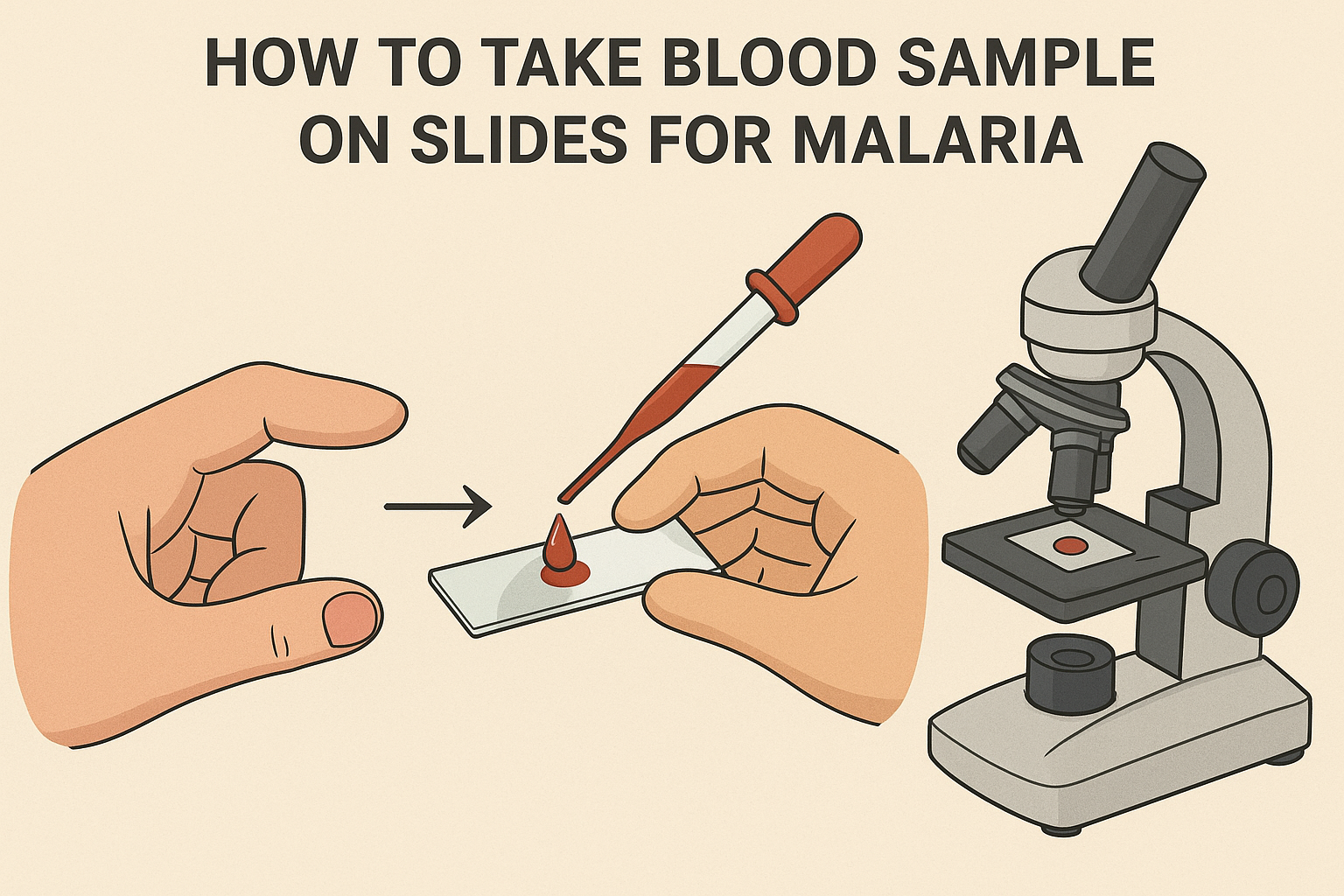
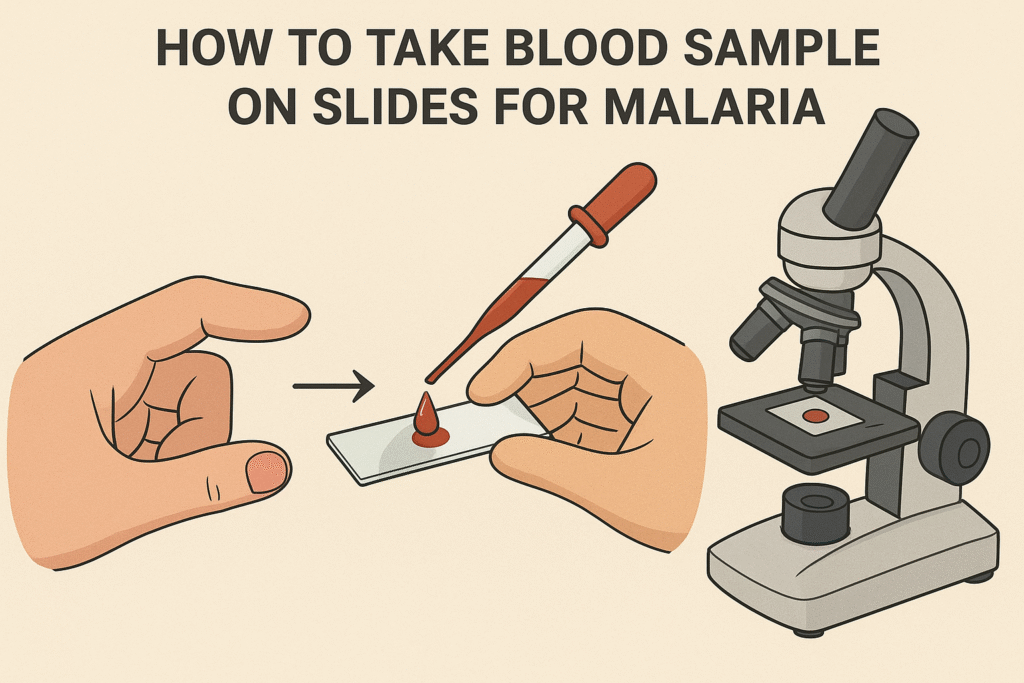
1) The third finger of the left hand (ring finger) of the patient should be held with the left hand between the thumb and finger by the blood side. Collect the first phalangeal joint. Wipe the finger with a swab dipped in spirit, and allow the fingertip to dry.
2) Hold the pricking needle in the right hand and prick the finger. Allow the blood to ooze out.
3) Take the clean slide, and take 6 microliters of blood 10 mm from the edge of the slide. Take another drop of blood with 2 microliters away 10 mm from the first drop of blood.
4) Take another clean slide with smooth edges and use it as a spreader, making thick and thin smears, and allow it to dry.
5) Put the slide number on the thin smear with a lead pencil.
6) In the case of an infant, his/her foot toe or hand thumb’s blood is taken for examination.
Quality of Thick B.S.
Formula: 4 Times = 10 mm = 1 cm
1) It is 10 mm away from the edge of the slide.
2) It is round in shape with 10 mm diameter and it is uniformly spread
3) Thickness contains 10 layers of RBC, i.e., 10 to 12 WBC should be visible in one field.
4) Distance between the thick and thin (two smear) smear is 10 mm
Quality of Thin B.S.
- It is 10 mm away from the edge of slide as well as from thick smear
- It is tongue-shaped.
- Thickness contains a single layer of RBC, i.e., one WBC should be visible in one field or per field.
- We can see a rainbow in these slides if we keep them in sunrays properly.
- It can be made by making an angle of 45 degrees between the slides and the spreader.
Advantages of Thick Blood Smear.
- It is more convenient to detect parasites easily in less time.
- Density of malaria parasite is more
- The quantity of blood is more, i.e., BS having 10 layer of RBC in one field
- It is used sometime to write code no. & BS no.
Advantages of Thin Blood. Smear.
- It is used to write code no. and BS no.
- It is used to study the morphological characteristic of species, i.e., whether it is Pv, Pf, or Po etc.
- It is used for identification or to confirm the species, whether it is Pv or Pf rings.
- To see enlargement of RBC for confirming ring of Pv.
- If a thick smear is damaged or spoiled or washed out, at that time it can be used for detecting parasites.