



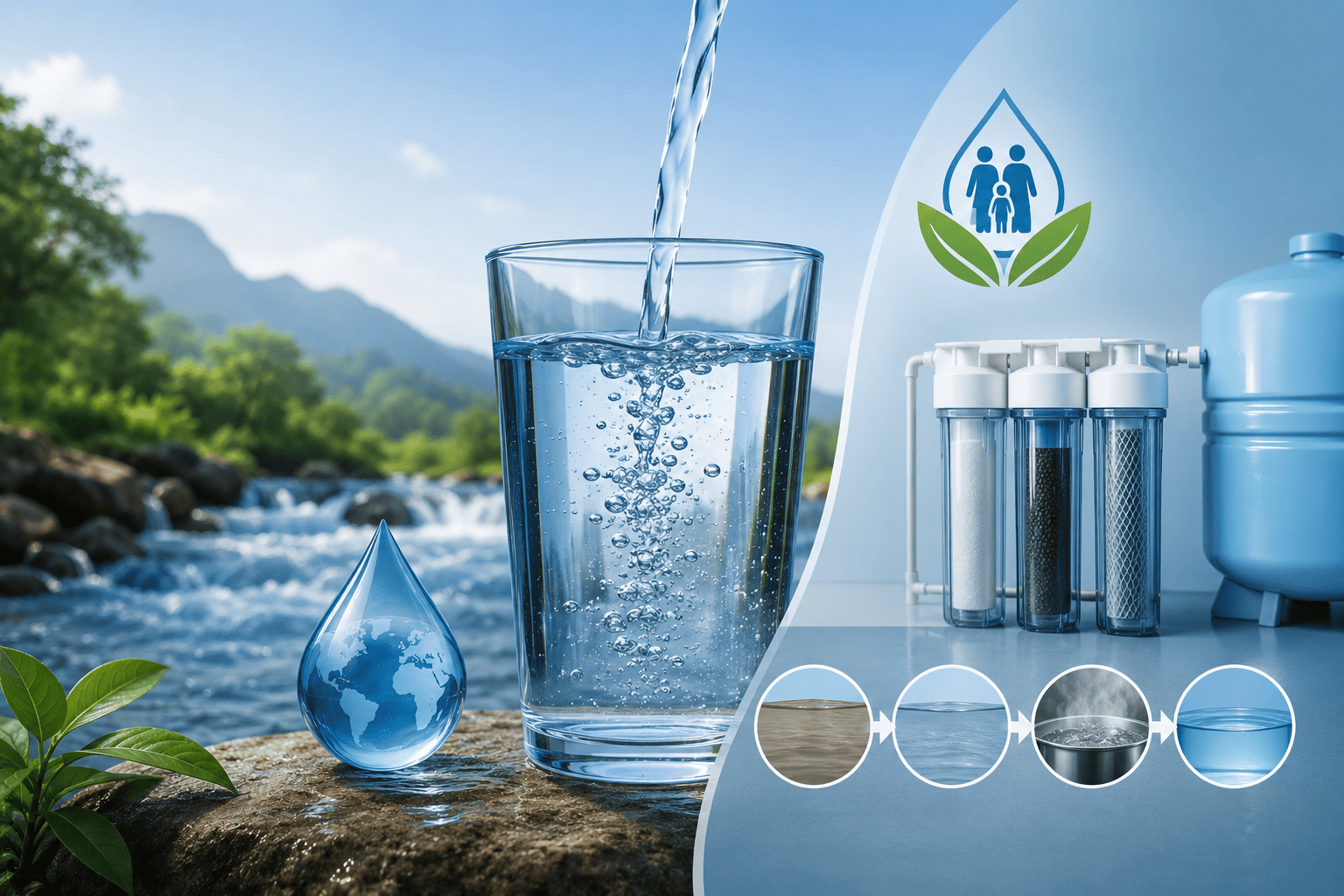
Drinking water is water that is safe and suitable for human consumption, meaning it is free from harmful microorganisms, toxic chemicals, and excessive turbidity.
Impurities in water are physical, chemical, or biological substances that make it unsafe or unpleasant to drink. Natural sources of water include rain, rivers, lakes, ponds, and groundwater, all of which may contain impurities and usually need purifying before drinking.
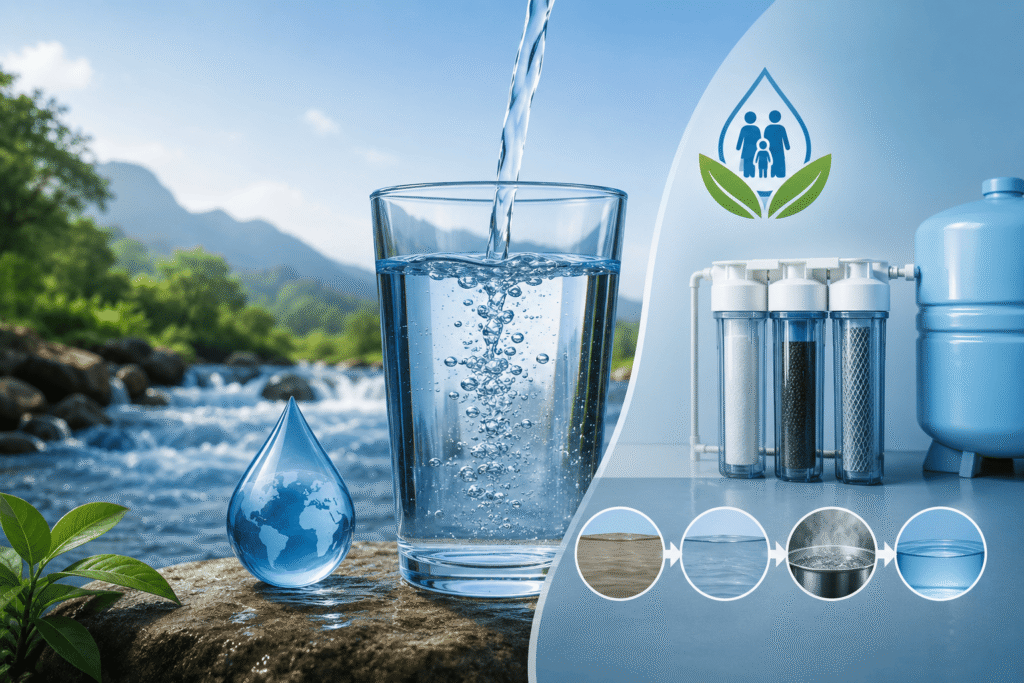
Definition of Drinking Water
Drinking water (also called potable water) is a clear, colorless, transparent, tasteless, odorless liquid with the chemical formula H₂O (two hydrogen atoms bonded to one oxygen atom), essential for all known forms of life. That is intended for human consumption and has been treated or tested to meet health-based standards for safety and quality. It should be clear, free of objectionable odor or taste, and low in disease-causing pathogens and toxic chemicals. It falls from the sky as rain, exists in lakes, rivers, and seas, and is essential for all animals and plant life.
Definition of Water as per Cambridge Dictionary
“Water that is suitable drinking”
Definition of Water as per Simple Wikipedia
“Water that is safe to drink or to use for food preparation.”
Definition of Water as per WHO
“Water clean enough to drink without health risk”
Need of Water Per Person
Basic requirement: About 150 to 200 liters per head per day
Natural Resources of Water
Water is a natural resource that comes in three main categories.
Rainwater
Collected directly from the atmosphere; relatively pure but can pick up air pollutants and dust.
Surface Water
Rivers, lakes, streams, and ponds are often rich in suspended solids, organic matter, and microorganisms.
Groundwater
Wells and springs fed by aquifers are usually clear but may contain dissolved salts, iron, fluoride, or arsenic depending on geology.
Common Impurities in Water
Natural water is usually contaminated with three types of impurities.
Physical Impurities
e.g., sand, silt, debris, suspended particles, and solids such as dust, sand, clay, rust, and organic debris that make water cloudy or turbid.
Chemical Impurities
e.g., heavy metals like lead and arsenic, salts, minerals, pesticides, and herbicides. Dissolved salts, heavy metals like lead, arsenic, nitrates, pesticides, and excess minerals (hardness, fluoride, etc.)
Biological Impurities
e.g., bacteria, viruses, parasites, and microorganisms. Bacteria, e.g., E. coli; viruses; protozoa, e.g., Giardia; helminth eggs; algae; and other pathogens that can cause diarrheal and waterborne diseases.
Additional Impurities Include
- water-soluble inorganic compounds like salts and minerals.
- Organic compounds like pesticides and industrial chemicals.
- Gases like oxygen, nitrogen, and carbon dioxide.
- Biomolecules, e.g., proteins, DNA.
Global Issue
The drinking water of hundreds of millions is contaminated due to urban, industrial, and agricultural wastewater.
Methods of Purifying Drinking Water
Several well-known methods are used at household as well as municipal levels. There are three main categories of purification methods.
Physical Methods
1) Boiling
Bringing water to a rolling boil for at least 1 minute (3 minutes above 1000 m elevation) kills most pathogens and bacteria.
2) Filtration
Using mesh screens, gravel, and cloth/sand filters removes suspended solids.
Microporous ceramic or membrane filters, including RO, can remove bacteria, cysts, some viruses, and dissolved salts.
3) Reverse Osmosis (RO)
Water forced through a semi-permeable membrane to remove heavy metals, microorganisms, and dissolved solids.
4) Sedimentation and Flocculation
Allowing solids to settle by gravity; adding coagulants (alum) to clump particles.
5) Distillation
Heating to steam and cooling back to liquid; removing odors, microbes, nitrates, and heavy metals.
Boiling water and collecting the condensed steam produces very pure water, removing most salts, metals, and microorganisms; however, it is energy-intensive and not commonly used domestically.
6) Activated Carbon Adsorption
Adsorbs organic matter, chlorine, color, and odors.
Chemical Methods
Chlorination and Disinfection
Adding small amounts of chlorine or bleach or using chlorine gas/tablets inactivates bacteria and viruses; they must be dosed correctly to avoid harmful residual levels.
Ozonation
Using ozone to destroy microbial structures.
Biological Methods
Using microorganisms to break down organic pollutants, mainly for wastewater.
UV and Solar Disinfection
UV-light devices or solar disinfection (SODIS) using clear plastic bottles in sunlight inactivates microbes by ultraviolet radiation.
Recommended Safe Drinking Water Purification Process
For a safe drinking water program, a combination of steps is needed:
Sedimentation → Filtration → Disinfection
is usually recommended rather than relying on a single method.
Chlorination Method
Chlorination is the process of adding chlorine to drinking water to reduce or eliminate microorganisms like bacteria, viruses, and fungi present in water supplies. It is one of the most effective and widely used methods for disinfecting water.
Process
- Uses chlorine gas or chlorine compounds.
- Kills harmful microorganisms by damaging their DNA.
- Has greatly reduced the risk of waterborne diseases.
- Used at both household and large-scale municipal levels.
- Forms hypochlorous acid when chlorine is added to water.
Types of Chlorination
- Plain chlorination
- Pre-chlorination
- Post-chlorination
- Double-chlorination
- Super-chlorination
- Breakpoint chlorination
- Dechlorination
Formulas for Chlorination Methods
Volume Calculation Formulas for Circular/Round Wells or Tanks (Measure in Meters)
Volume (liters) = 3.14 × D² × H × 100
Where,
- D = diameter in meters
- H = depth of water column in meters
Volume Calculation Formulas for Square/Rectangular Wells or Tanks (Measure in Meters)
Volume (liters) = length × breath × Depth
For Square and Rectangular Tanks (Measure in Feet)
Capacity (gallons) = length × width × Depth
For Cylindrical Tanks (Measure in Feet)
Capacity (gallons) = Diameter × Diameter × 1
Note
1 cubic meter = 1000 liters of water
Chlorination Dosages for Drinking Water
Bleaching Powder
- 5 grams per 1000 liters of water.
- Make into a paste, add water to ¾ bucket, and mix thoroughly.
- Wait 10 to 15 minutes for sediments to settle.
- Use supernatant chlorine water.
- After 1 hour, water can be used for drinking.
Liquid Chlorine (5% to 6%)
- 20 ml per 1000 liters of drinking water.
- Mix well.
- After 1 hour, water can be used for drinking.
Chlorine Tablet (0.5 gm)
- Crush tablet.
- Apply to a 20-liter pot.
- Wait 1 hour before use.
Recommended Chlorine Levels (in ppm)
| Location | Normal | During Floods/disasters |
|---|---|---|
| Head works | 2 ppm | 3 to 4 ppm |
| Overhead Tanks/Ground Reservoirs | 2 ppm | 2 ppm |
| Tankers lorries | 2pmm | 2 ppm |
| Street fountains | 0.2 to 0.5 ppm | 0.5 to 1 ppm |
Well Disinfection (5% Chlorine Bleach)
For Dug Wells (As per Foot of Water Depth)
| Well Diameter | Bleach Amount |
|---|---|
| 1 to 3 feet | ½ Pint |
| 4 feet | 1 Pint |
| 5 feet | 1½ pints |
For Drilled Wells (4 to 5 Inches in Diameter)
1¼ pints of 5% chlorine solution per 100 feet of water.
For Small Driven Wells (2 Inches or Smaller)
¼ measuring cup per 25 feet of water.
Chlorine Testing Methods
6) Chlorine Testing Methods
- Take a sample of water ¾ level in a test tube.
- Add 2 to 3 drops of orthotolidine solution.
- Close mouth with thumb and tilt upside down twice.
- Observe color change and compare with the “Residual Chlorine Measurement Chart.”
- Infer chlorine level in PPM (parts per million).
Conclusion
This comprehensive guide covers all aspects of drinking water from definition to chlorination calculations. In our location in Nagpur, Maharashtra, in India, these methods are commonly used for household and community water purification.
1 Comment
Health Effects of Contaminated Water: 5 Critical Risks
July 9, 2026[…] tap water significantly reduces sickness […]