

Day by day, there is an increase in insect-borne diseases, especially dengue, chikungunya, yellow fever, Japanese encephalitis (JE), and Chandipura encephalitis. Geographical conditions, changes in climate, and genetic changes in the species are increasing the prevalence of insect-borne diseases.
Dengue, JE, yellow fever, Chandipura encephalitis, and malaria are fatal diseases. Chikungunya, Filaria, etc., cause disability. Due to this, human strength is being depleted , which is definitely not affordable for a developing country like India.
Every 30 seconds, one person dies from dengue fever in the world. Annually, 250 to 500 million people are infected with dengue fever, resulting in 1 to 3 million deaths (WHO 2001). Dengue fever affects 100 million people, of whom 5% die. In 2002, 19,000 people died in India due to dengue fever.
Chikungunya was first detected in Tanzania in 1953. In 2005-2006, 1.4 million people were infected across 13 states of India. For Chandipura and JE, the prevalence of the disease is also highest among young children, and the mortality rate is also highest.
Therefore, it is very important to study these insect-borne diseases and implement preventive measures. The complete eradication of insects is now impossible, and the government has focused on protection from insects. Due to the increasing cost of insecticides and the resistance found in mosquitoes, the complete eradication of insects is not possible.
It is more important to prevent a disease than to treat it. The same can be said about mosquitoes. It is more important to prevent the development of gnats from the larvae than to prevent their bites. Therefore, if the gnat survey program is implemented effectively, insect-borne diseases will definitely be prevented.
Importance of Entomological Survey
- To identify mosquitoes that spread various diseases.
- The basic knowledge of insects is essential to implement preventive measures.
- The study of insect density, disease vectors, and resistance to insecticide.
- To classify problem areas based on the spread of insect-borne diseases and insect biodiversity.
Type of Mosquito Survey
There are four types of mosquito surveys
1) Preliminary Survey
- Survey and identification of major mosquito species.
- Study of mosquito habits: resting patterns, biting habits and timing, flying habits, and breeding habits.
- Studying the relationship between humans and mosquitoes and the lifestyle of mosquitoes.
- Identifying mosquitoes that transmit insect-borne diseases.
- Studying the life cycle of mosquito larvae and classifying water bodies.
- Testing the susceptibility of mosquitoes to insecticides.
2) Regular Survey
- Studying the increase and decrease in mosquito density.
- Study of changes in the lifestyle of mosquitoes, including life cycle, biting habits, etc..
- Detection of disease-transmitting agents through dissection of mosquitoes.
- Studying immunity (Cone Bioassay test).
3) Regular Survey of Selected Location
- Conducting monthly surveys throughout the year in specific locations.
- Studying the increase and decrease in mosquito density.
4) Survey in Outbreak-Affected Areas
- Survey in areas affected by outbreaks of yellow fever, dengue, Chikungunya, Chandipura, malaria, JE, etc.
- Collecting insects and testing them for disease transmission in the laboratory.
- Suggesting measures for implementing preventive controls.
Identification of Mosquitoes
Identification of mosquitoes is very important. The primary structure criteria for mosquitoes are:
- A single pair of wings and three pairs of legs.
- A long, well-developed proboscis.
- Presence of scales all over the body.
Criteria for Mosquito Collection
- In a village, mosquito collection should be done for 2 hours and 30 minutes.
- In a house or cowshed, mosquito collection should be done for 15 minutes at each of 10 places.
- The selection should be made from cowsheds, houses, and mixed dwellings.
- Four houses, four cattle sheds, and two mixed dwellings should be selected.
- For collection, 5 places from the periphery of the village and 5 places from the central part should be selected.
Mosquito Collection
Essential Components of Mosquito Collection
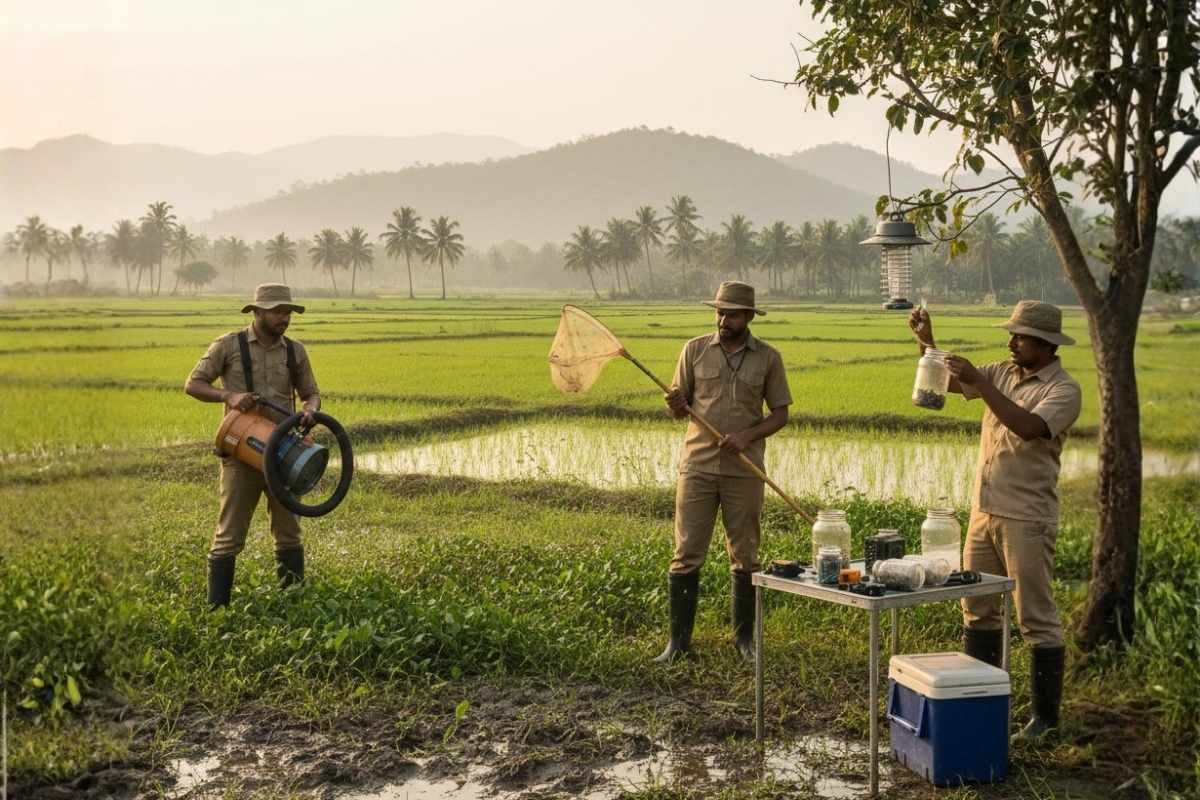
Suction tube, test tube, cotton, cotton bag, battery, and lens.
Manual Collection Method
- A) With the help of a suction tube.
- B) With the help of a test tube.
Procedure:
- Collect mosquitoes using the suction tube and then release them into the test tube.
- Then, do the labeling with details such as village name, total time spent for collection, type of house, and whether sprayed or not sprayed.
- Keep the caught mosquitoes alive until they are brought to the laboratory by taking the following precautions:
- Wrap them in a moist cloth.
- Sprinkle water on the cotton cloth regularly.
- Seal the test tube with cotton soaked in glucose solution.
- In this way, mosquitoes can survive for 24 to 48 hours.
Mosquito Dissection
- When transportation is done without causing any damage to the mosquito, species identification becomes easier.
- Calculate mosquito density.
- Then, firstly, anesthetize the female mosquito.
- The wings and legs of the anesthetized female mosquito should be removed using a dissection needle.
- Take three separate drops of saline water on a clean glass slide.
- In each drop, place the head, thorax, and abdomen separately, dissect them, and tease them out using a needle.
- Then, examine under the microscope using the low-power objective.
- Observe findings, note them, and then calculate infection rate, infectivity rate, mosquito ages, microfilaria (mf) rate, sporozoite rate, etc.
Spray Sheet Collection
- For this method, a pyrethrum spray pump, white paper, a bedsheet, and other materials are required.
- With this technique, the exact density of mosquitoes can be determined.
- A white paper or bedsheet is spread on the floor, and after closing the doors and windows of the house, pyrethrum is sprayed into the air.
- After about half an hour, all the mosquitoes can be found dead on the bedsheet.