

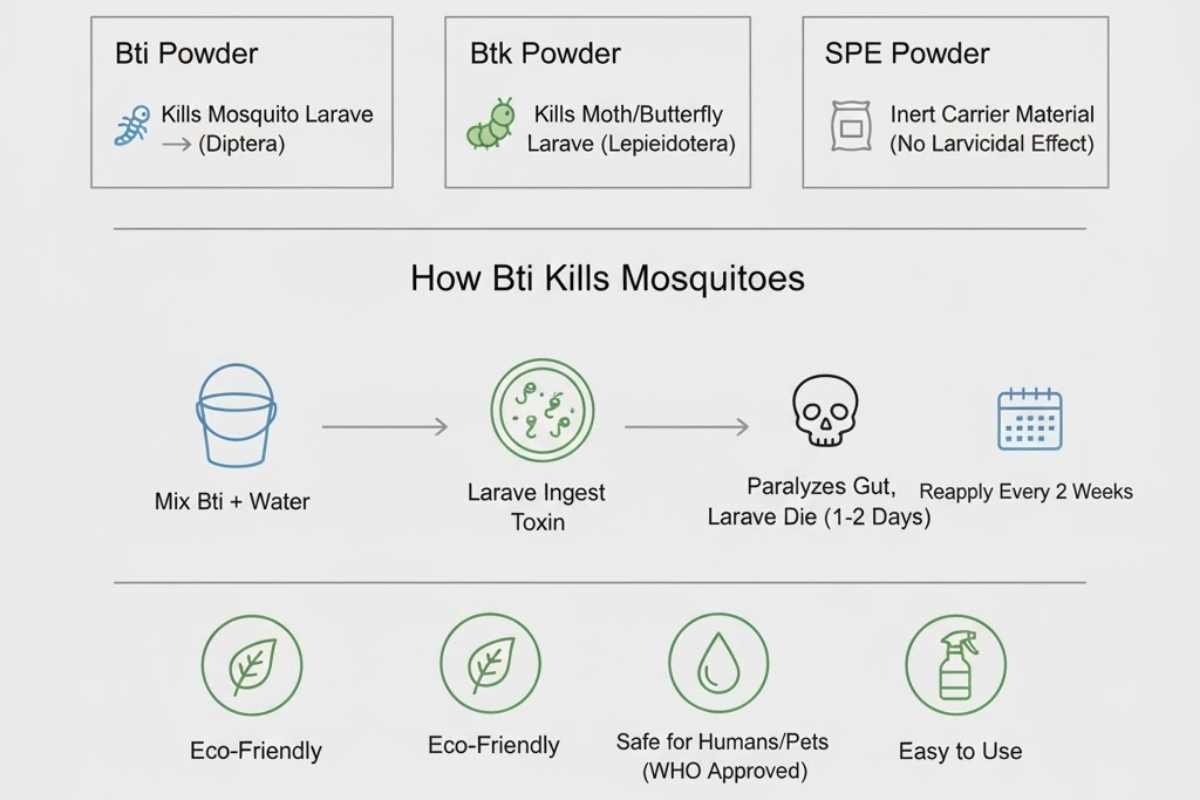
Mechanism of Bti and Btk, SPE Powder
Bti powder is used as a biological larvicide to kill larvae in stagnant water, ponds, ditches, puddles, or containers.
- Bti and Btk (where k stands for Kurstaki) are both used as a larvicidal agent to control mosquito larvae in breeding sites.
SPE powder (seashell powder or similar natural powder) is also used as a larvicide, especially against Aedes aegypti.
How to Kill Mosquito Larvae with Bti Powder
To kill mosquito larvae with Bti powder, you must mix it with water and apply the solution directly to stagnant water sources, drinking water, irrigation of food crops, polluted water, etc., where larvae are present.
- The larvae ingest the Bti bacteria, which produce a toxin that paralyzes their digestive system and causes them to die within 24 to 48 hours.
- Bti only affects larvae that are actively feeding.
- Bti will not harm mosquito pupae or adults.
- Re-application of Bti powder is recommended every 14 days for optimal control, depending on the specific product and conditions.
Storage: Keep unused Bti powder in a cool, dry, and dark place away from direct sunlight to maintain effectiveness.
Benefits of Bti Powder
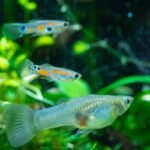
- Non-toxic: Bti powder is safe for humans, pets, fish, wildlife, and beneficial insects like honeybees. The World Health Organization (WHO) has approved it for use in drinking water.
- Eco-friendly: Bti powder is a popular choice for organic and environmentally sound pest control due to its high specificity.
- Easy to use: Compared to chemical pesticides, Bti requires minimal personal protective equipment.
Standard Procedure for Bti Powder Solution
- Select clean equipment, such as a bucket or any container, and use clean water.
- Measure the required amount of Bti powder according to product guidelines.
- Example: 250 grams of Bti powder in 10 liters of water (or 0.5 gram to 1 gram of Bti powder per one liter of water).
- Take the Bti powder and add it to a small portion of water to make a paste-like suspension (thick paste).
- Pour the paste into the rest of the water and agitate (stir or shake) until fully dissolved to make a homogeneous suspension.
- Transfer this solution to a sprayer or pour directly.
- Apply the solution immediately or within 24 hours to stagnant water, drinking water, irrigation of food crops, polluted water, etc., where larvae are present, either by pouring or spraying.
Application Details
- Sprayers Used: Hand compression or knapsack sprayers.
- Discharge Rate (for hand compression sprayers): 740–850 CC/minute at a pressure of 0.7 kg/cm² (10 lbs/in²).
- Dosage: 5 kg Bti (WP) per hectare.
- Frequency: Once every two weeks (fortnightly) at the above dosage.
Differences between Bti, SPE, and Btk
Bti vs. SPE
BTI and SPE are fundamentally different substances with distinct uses and compositions.
- BTI refers to Bacillus thuringiensis subspecies israelensis, a bacterial larvicide.
- SPE refers to Silica Powder Extract or Silica Powder, which is used as a carrier or inert material in formulation.
- Bti is the larvicide, while SPE is a supporting or inert material with no larvicidal effects on its own. It has no direct biocidal activities but affects the physical properties of the final product, such as flow and dispersion.
Bti vs. Btk
Bti and Btk target different insects.
- BTI targets mosquito larvae (Diptera).
- BTK targets moth and butterfly larvae (Lepidoptera).
Their crystal shapes and toxin profiles correspond to their specific insect targets.