


Recent Hantavirus Outbreaks Worldwide
The main recent worldwide hantavirus outbreak in the news is the multicountry cruise-ship cluster linked to the MV Hondius, which the WHO reported on 2 May 2026 and updated on 4 May 2026. WHO said this cluster involved seven cases at the time of reporting, including two laboratory-confirmed hantavirus infections, five suspected cases, three deaths, one critically ill patient, and three people with mild symptoms.
The illness started between 6 and 28 April 2026 among passengers and crew on the vessels, with symptoms including fever, gastrointestinal symptoms, rapid progression to pneumonia, acute respiratory distress syndrome, and shock. The outbreak is being investigated across multiple countries through isolation, contact tracing, medical evacuation, and lab testing.
The cluster has been linked to Andes virus, a hantavirus species known for rodent-to-human transmission and unusually limited human-to-human spread in some previous outbreaks. WHO noted that this close-contact transmission is uncommon and has mainly been documented with the Andes virus.
Public Risk Assessment
Public risk:
WHO assessed the risk to the global population from this event as low. That said, public health authorities are tracing passengers and contacts across several countries because the ship carried people of many nationalities and disembarked in different locations.
Regional Pattern of Hantavirus Activity
Regional pattern:
Outside this cruise ship event, hantavirus activity remains largely tied to endemic regions rather than a single global pandemic pattern. The broader burden still tends to be concentrated in the Americas, Europe, and Asia, depending on the hantavirus type and rodent reservoir.
Public Health Significance
Public Health meaning:
For surveillance purposes, this outbreak matters because it shows how a rare zoonosis can spread across borders through travel, even when the overall global risk remains low. It also highlights the need for rapid fever and respiratory symptom investigation, rodent exposure history, and international notification systems.
Symptoms of Andes Hantavirus
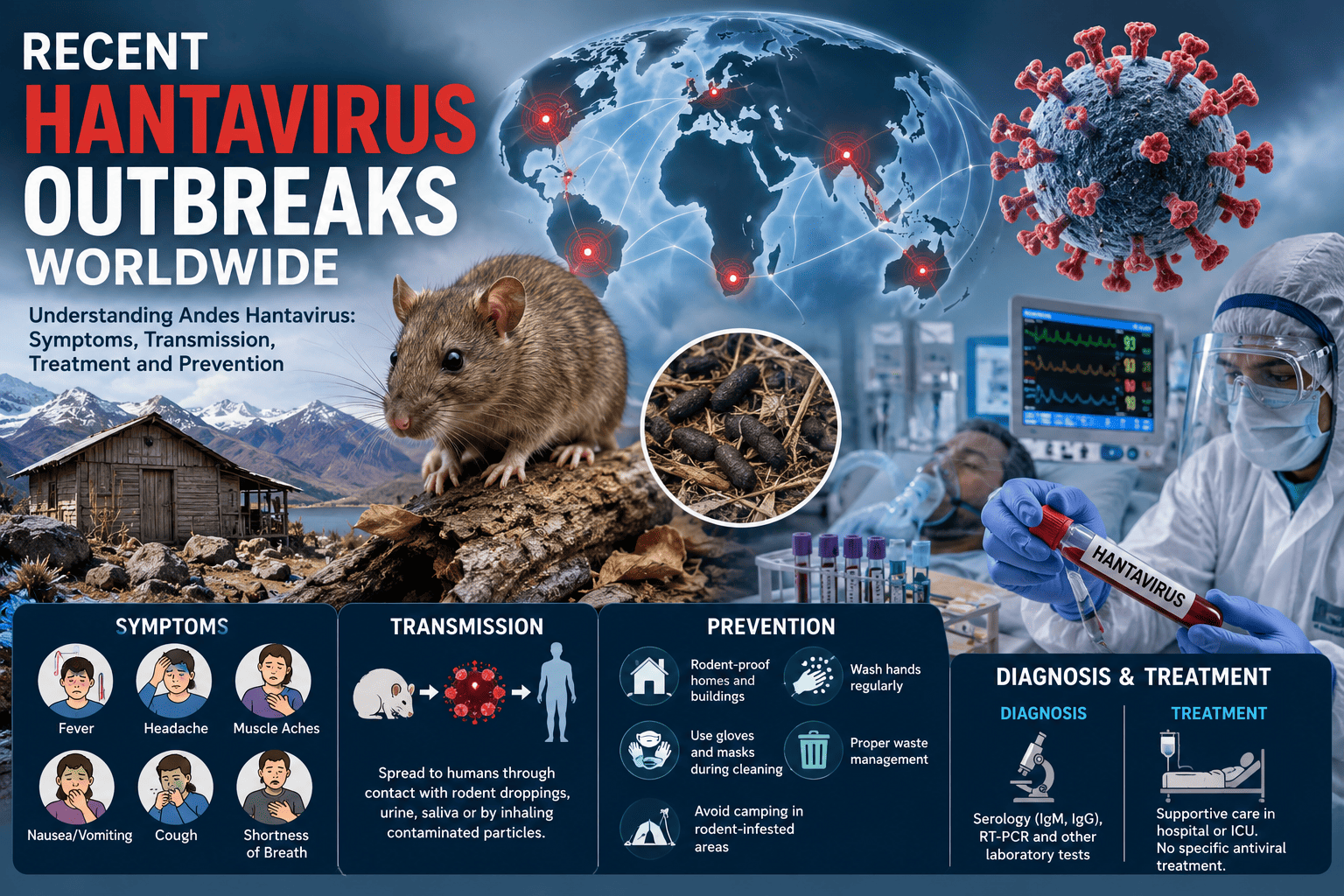
Andes hantavirus usually starts like a flu-like illness and can then progress quickly to a severe lung disease called hantavirus pulmonary syndrome (HPS).
Early Symptoms
Common early symptoms include:
Fever; fatigue; muscle aches, especially in the thighs, hips, back, or shoulders; headache; dizziness; chills; nausea; vomiting; diarrhea; and abdominal pain.
Progressive Symptoms
As the illness worsens, people may develop the following:
Cough, shortness of breath, and fluid in the lungs. Low blood pressure, rapid or irregular heart rate, shock, or respiratory failure in severe cases.
Clinical Observation
The early phase can look like ordinary viral fever or food poisoning, but breathing problems appearing a few days later are a red flag. In suspected cases, urgent medical evaluation is important because the disease can deteriorate fast.
Differences Between Andes Hantavirus and Other Hantaviruses
Andes hantavirus is different from most other hantaviruses mainly because it is the only well-documented hantavirus that can spread from person to person under close-contact conditions. Most hantaviruses are transmitted from rodents to humans only and do not continue spreading between people.
Main Differences
Transmission
Andes virus can spread by close human contact, while most other hantaviruses are “dead-end” infections in humans.
Geography
Andes virus is mainly associated with South America, especially Argentina, Chile, and Uruguay, whereas Old World hantaviruses are mainly in Europe and Asia, and New World hantaviruses are found across the Americas.
Disease Pattern
Like other New World hantaviruses, Andes virus commonly causes hantavirus cardiopulmonary syndrome with severe lung involvement.
Outbreak Potential
Because limited human-to-human spread is possible, Andes virus can cause family or close contact clusters, unlike most other hantaviruses.
Prevention
For public health, Andes virus needs the same rodent control approach as other hantaviruses, but contact tracing becomes more important when a human case is confirmed. That is why outbreaks linked to the Andes attract more attention than typical hantavirus cases. Most hantaviruses are “rodent to human only,” but Andes virus is the exception that can also spread human to human in close settings.
Fatality Rate of Andes Virus
The case fatality rate of Andes hantavirus is commonly reported at about 35% to 50%, with many sources placing it around 40%. WHO also notes that hantavirus cardiopulmonary syndrome in the Americas can have a case fatality rate of up to 50%. In severe outbreaks or advanced cardiopulmonary failure, mortality can be higher than the usual average.
How Andes Hantavirus Is Treated
Andes hantavirus is managed mainly with supportive hospital care because there is no proven specific cure or vaccine. Early recognition and rapid transfer to intensive care are important because patients can deteriorate quickly.
Clinical Management
- Oxygen therapy and, if needed, intubation and mechanical ventilation for severe respiratory distress.
- Careful fluid management, since overhydration can worsen lung problems.
- Hemodynamic support, including medications to maintain blood pressure when shock develops.
- ECMO in severe cases where heart-lung support is needed and resources are available.
Drugs
There is no proven routine antiviral treatment for Andes virus infection. Ribavirin is not supported by evidence for Andes hantavirus management in some guidance, and corticosteroids are also not recommended as standard treatment.
Infection Control
Suspected or confirmed cases should be managed with appropriate respiratory isolation and enhanced PPE for healthcare workers because of the high-consequence nature of the infection. The best outcomes come from early suspicion, early hospitalization, and ICU-level supportive care rather than waiting for symptoms to become severe.
Diagnosis of Andes Hantavirus Clinically
Clinically, Andes hantavirus is diagnosed by combining exposure history, symptoms, and laboratory confirmation. Early illness often looks like influenza or another febrile infection, so a recent history of rodent exposure, travel to endemic areas, or contact with a known case is a key clue.
Doctors suspect it in those with fever, myalgia, headache, fatigue, and then rapidly developing cough or shortness of breath, especially if there is a relevant exposure history. Severe acute respiratory illness within about 8 weeks of exposure is particularly concerning for Andes virus infection.
Laboratory Confirmation
Confirmation is usually by serology and molecular testing. The main tests are:
- IgM antibody detection
- Rising IgG titers on paired samples.
- RT-PCR for viral RNA during the acute phase.
- In some settings, immunohistochemistry or other confirmatory assays may also be used.
Supportive Clinical Findings
Routine tests are not specific, but they often show clues such as thrombocytopenia, leukocytosis, hemoconcentration, or signs of respiratory failure and shock in severe disease. These findings support the diagnosis but do not prove it.
If early testing can be negative, then repeat testing may be needed if suspicion remains high. Suspected cases should be handled with strict infection control precautions because the Andes virus can pose a transmission risk in close contact settings.
Prevention Strategies for Andes Hantavirus in Endemic Areas
Prevention in endemic areas centers on avoiding rodent exposure and using safe cleaning practices. In practical terms, that means rodent-proofing buildings, storing food securely, keeping waste under control, and not camping or staying in cabins where rodent droppings, nests, or burrows are visible.
Personal Protection
- Avoid touching rodents or their droppings, urine, or nests.
- Wash hands frequently, especially after outdoor or cleaning activities.
- Wear gloves when cleaning contaminated areas.
- Use a respirator or well-fitted mask for enclosed, dusty, or heavily contaminated spaces.
Safe Cleaning
- Ventilate closed spaces before entering or cleaning them.
- Do not dry sweep or vacuum droppings, because that can aerosolize virus particles.
- Wet contaminated surfaces with disinfectant first, then wipe up material safely.
- Wash hands and clean tools after the job.
Travel and Outdoor Risk Reduction
People traveling to endemic rural areas, especially in Chile and Argentina, should avoid places with signs of rodent infestation and should not use cabins or burrows. If camping is unavoidable, use a ground sheet and sleep off the ground where possible.
Public Health Control
During suspected outbreaks, rapid identification of cases, isolation, monitoring of close contacts, and strict infection prevention and control in healthcare settings are recommended. Public awareness campaigns should focus on rodent control, safe cleanup, early symptom recognition, and when to seek medical care.
There is no vaccine for routine public use, so prevention depends mainly on environmental control, safe behavior, and early public health response.