

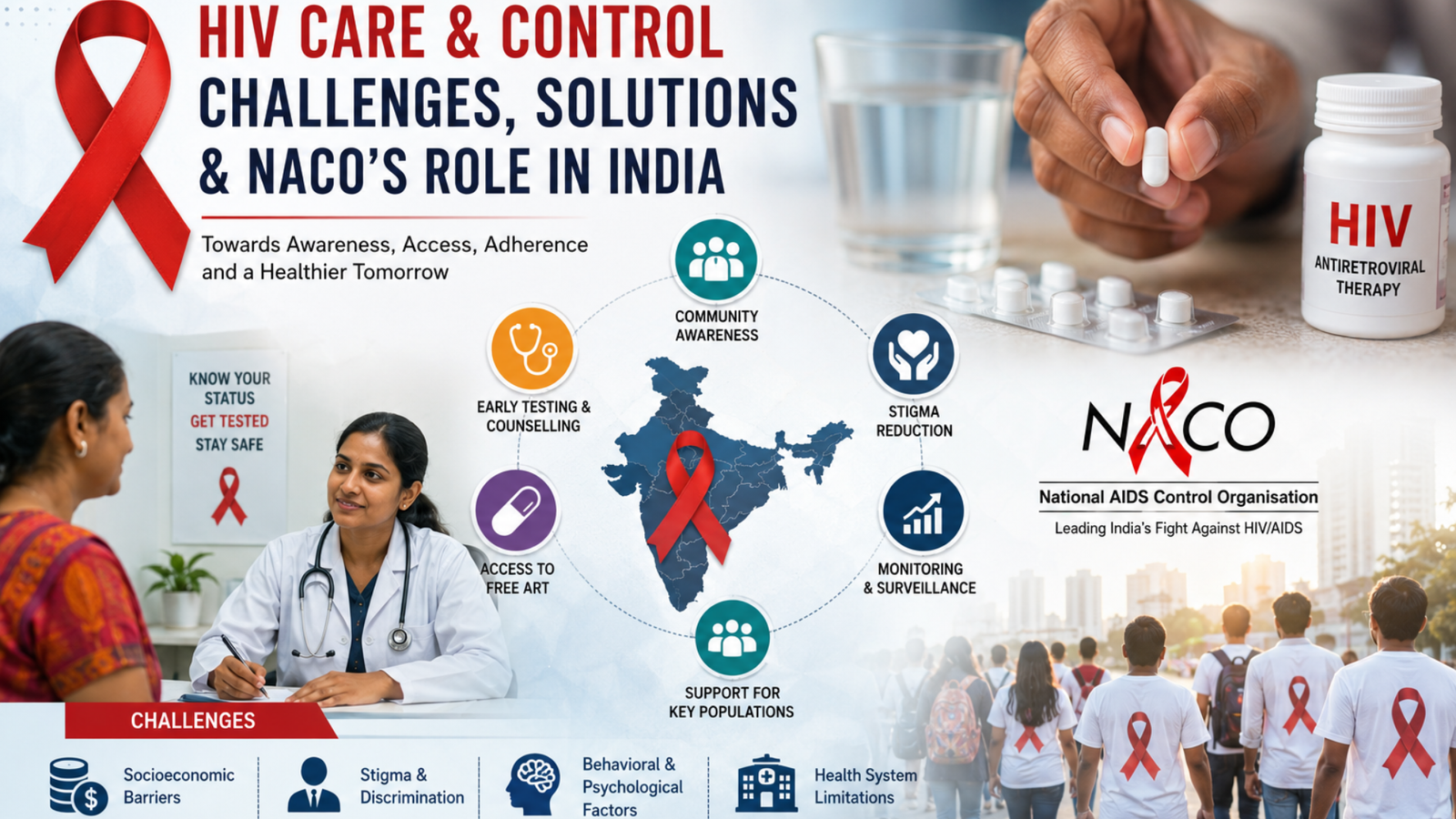
Challenges to HIV treatment adherence in India stem from socioeconomic, behavioral, and systemic factors, despite free ART availability through NACO programs. Adherence rates hover around 70%, below the 95% needed for optimal viral suppression.
Socioeconomic Barriers
Financial issues like travel costs, unemployment, debt, and economic dependency often lead to missed doses or clinic visits, even with free drugs.
Low education levels contribute to poor understanding of ART’s lifelong necessity.
Stigma and Social Factors
Self-perceived stigma; fear of disclosure, e.g., to family or clients; and living alone reduce adherence.
Key populations like sex workers and MSM hide pills to avoid detection.
Socio-cultural obligations, such as family rituals, cause interruptions.
Behavioral and Patient-Related Issues
Forgetfulness; fear of side effects (e.g., rash, nausea); alcohol/substance use; and negative perceptions, e.g., testing pill holidays, are common.
Younger age and depression exacerbate non-adherence.
Healthcare System Challenges
Long waiting times at ART centers, inadequate counseling time, poor doctor-patient relationships, and stock shortages lead to missed visits.
Overburdened services hinder personalized support for marginalized groups.
Key Population Specifics
For FSWs, MSM, and transgender individuals, erratic work schedules, lack of social support (e.g., from brothel keepers or gurus), and business loss fears mediate poor pill practices and viral non-suppression.
Role of NACO in HIV Control Programs in India
NACO, established in 1992 under India’s Ministry of Health and Family Welfare, serves as the nodal agency leading the National AIDS Control Programme (NACP) for HIV prevention, care, and treatment nationwide.
Policy Formulation
NACO develops national policies and strategic plans, e.g., NACP-I to V, and guidelines for HIV surveillance, blood safety, and integration with TB/STI programs.
It coordinates with 35 state AIDS control societies for decentralized implementation.
Program Implementation
Oversees targeted intervention for high-risk groups like sex workers, MSM, and PWID via NGOs, including condom promotion, needle exchange, and HIV testing. exchange and HIV testing. exchange, and HIV testing. exchange, and HIV testing. exchange, HIV testing, PrEP rollout, and linkage to ART centers.
Manages free ART for 1.86 million PLHIV and PMTCT services.
Surveillance and Monitoring
Conducts biennial HIV estimations with ICMR; tracks epidemic trends; monitors ART adherence / drug resistance via early warning system; and ensures blood bank screening nationwide.
Capacity Building and Awareness
Trains healthcare workers.
Supports Red Ribbon Clubs in colleges.
Funds IEC campaigns.
Promotes stigma reduction.
Pilots innovations like self-testing.
Integrates HIV into general health services.
Achievements and Thrust Areas
Under NACP-V to 2026, NACO aims for an 80% reduction in new infections/deaths by the 2025-26 baseline, dual elimination of mother-to-child transmission, universal STI access, and scaled testing to 66M annually.
NACO Organizational Structure and State Societies
NACO, a division of India’s Ministry of Health and Family Welfare since 1992, features a decentralized execution through 35 State AIDS Control Societies (SACS).
National Structure
Headed by a director general (DG, usually additional secretary rank), supported by 8 core divisions: strategy and program support, care support and treatment, and prevention.
Monitoring and evaluation, procurement and supply management, communication and advocacy, blood safety, and state support. Technical units include ICMR for surveillance.
State Society (SACS)
Each state/UT has an autonomous SACS mirroring NACO’s divisions but on a smaller scale.
Led by project direction, they implement NACP locally via district-level ART centers, targeted interventions, testing labs, and IEC campaigns, funded 100% by NACO with state coordination.
Linkages and Oversight
NACO provides guidelines, funds (e.g., Rs. 3,000+ crore annually), training, and monitoring.
SACS reports data via the National AIDS Reporting System (NARS).
Project directors meet quarterly at NACO for alignment.
How NACO Coordinates with 13 Focus Ministries for the HIV Programs
NACO coordinates with 13 focus ministries—such as women & child development, labor, rural development, youth affairs, social justice, transport, tourism, education, defense, home affairs, railways, shipping, and textiles—to mainstream HIV programs into their schemes for broader reach and sustainability.
National Coordination Mechanisms
Through the national council on AIDS (NCA, chaired by the prime minister) and state councils on AIDS, NACO engages ministries via policy advocacy, joint guidelines, and resource convergence.
E.g., integrating HIV awareness into NSS/NYKS youth programs or labor’s workers’ health schemes.
Mainstreaming Strategies- HIV Treatment
NACO develops ministry-specific action plans under NACP-IV/V, focusing on social protection for PLHIV, staff training (e.g., truckers via the transport ministry), condom promotion in tourism, and stigma reduction.
It includes funding linkages, IEC material co-branding, and performance monitoring.
Key Activities and Outcomes
Joint campaigns reach millions (e.g., Red Ribbon Clubs via the Education Ministry).
Partnerships improve PLHIV access to welfare schemes like pensions or scholarships.
Regular inter-ministerial meetings ensure alignment with NACP goals like 95% testing / treatment coverage.
Top States with Highest HIV Cases
India’s top states for HIV burden are led by Maharashtra, which has the highest number of people living with PLHIV.
Highest PLHIV Estimates 2024
Maharashtra
~399,000 PLHIV, top state, accounting for a significant share.
Andhra Pradesh
~310,000 PLHIV.
Karnataka
~291,000 PLHIV.
Tamil Nadu and Uttar Pradesh follow closely, with these five states comprising ~74% of India’s total ~2.56 million PLHIV.
Highest Prevalence Rates
Northeast states dominate prevalence: Mizoram (2.37% adult prevalence), Nagaland (1.44%), and Manipur (1.15%).
Southern states like Andhra Pradesh (0.66%), Telangana (0.47%), and Karnataka (0.46%).
National adult prevalence remains low at 0.20%.
Reasons for High HIV Cases in Maharashtra
Maharashtra leads India in total HIV cases (~399,000 PLHIV in 2024) due to its large population, urbanization, and high-risk behaviors in key groups.
Urbanization and Migration
Mumbai and other cities attract migrant workers, truckers, and laborers, fueling heterosexual transmission via commercial sex.
Temporary rural-urban movement spreads like the virus to villages.
High-Risk Population
Elevated prevalence among MSM (13% in 2010-11), female sex workers, and PWID.
Sex work thrives in urban hubs like Mumbai amid economic pressures and poor condom use.
Mother-to-Child Transmission
State rate at 4% of new cases, linked to gaps in antenatal screening, ART adherence issues from migration/travel, and rural/tribal access barriers.
Socioeconomic Factors
Stigma in rural/tribal areas delays testing.
Unemployment, low awareness, and sex work surges contribute to this.
Despite declines in general prevalence, hotspots persist in high-risk pockets.
Top Countries in World with Highest HIV Cases
South Africa has the highest number of people living with HIV globally, followed by countries like Nigeria, Kenya, and India.
Top Countries by Total PLHIV 2024 Estimates
| Rank | Country | PLHIV (millions) |
|---|---|---|
| 1 | South Africa | 7.8 |
| 2 | Nigeria | 2.45 |
| 3 | Mozambique | 2.5 |
| 4 | India | 2.6 |
| 5 | Kenya | 7.49 |