

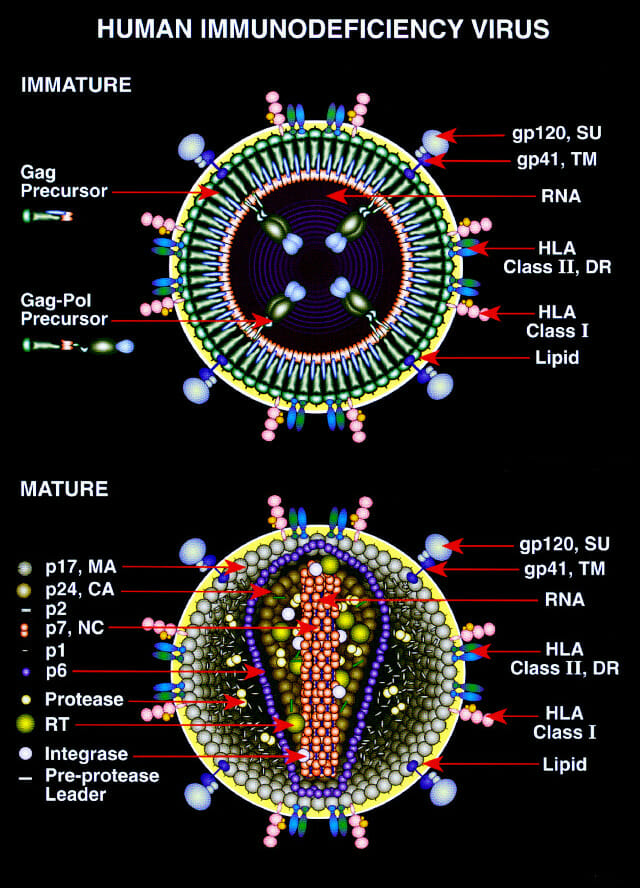


The life cycle and morphology of Hepatitis B virus (HBV) represent a highly specialized biological process targeted entirely within human hepatocytes. Characterized by a distinctive, double-shelled Dane particle morphology and an RNA-mediated reverse transcription replication cycle, understanding this complex structural layout is vital for developing targeted antiviral therapies and chronic infection management.
📌 Key Takeaways: Hepatitis B Structure & Life Cycle
- Virion Structure: The complete infectious virus is a 42–47 nm double-shelled particle known as the Dane particle, containing an outer lipid envelope and an inner icosahedral core.
- Replication Novelty: HBV is a non-retroviral DNA virus that uniquely replicates its relaxed circular DNA (rcDNA) genome via an RNA-mediated reverse transcription pathway utilizing pregenomic RNA (pgRNA).
- Cellular Entry: The virus targets hepatocytes exclusively by binding its surface antigens (specifically the pre-S1 domain) to the host membrane receptor NTCP (Sodium taurocholate cotransporting polypeptide).
- Chronic Persistence: Inside the nucleus, viral DNA is repaired into cccDNA (covalently closed circular DNA), which acts as a permanent transcription template that underpins chronic infections and resists standard clearance.
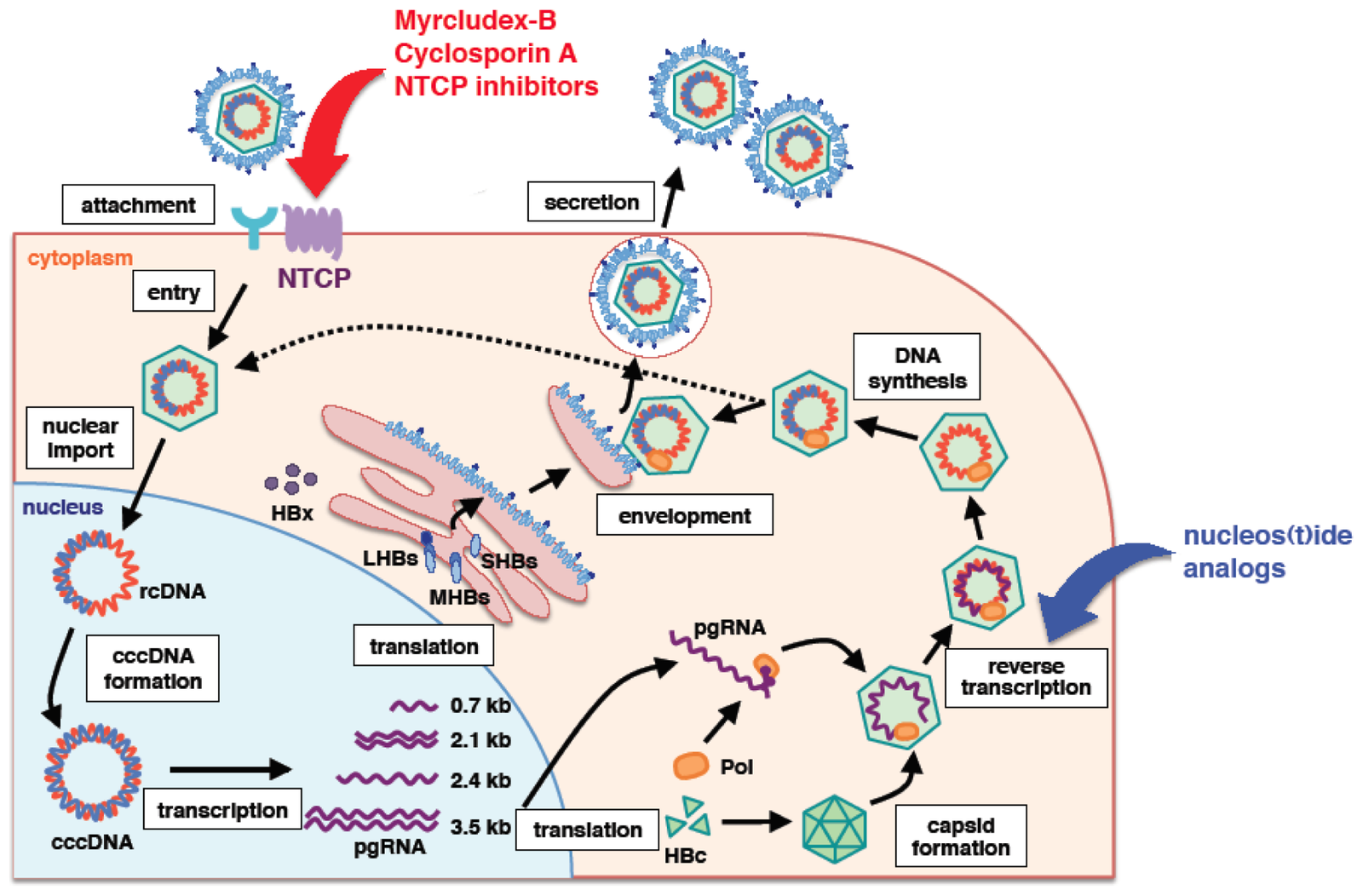
The hepatitis B virus (HBV) has a complex life cycle that mainly takes place inside liver cells (hepatocytes). It involves attachment and entry into the cell, formation of a stable “template” DNA, RNA-mediated replication using reverse transcription, assembly of new virus particles, and release from the cell.
What Is the Life Cycle of the Hepatitis B Virus?
Attachment and Entry
HBV first attaches to the surface of hepatocytes by binding via its envelope proteins (especially the pre-S1 domain) to the receptor NTCP on the liver-cell membrane. The virus is then taken into the cell by endocytosis; the envelope fuses with a membrane inside the cell, releasing the viral nucleocapsid into the cytoplasm.
Transport to Nucleus and cccDNA Formation
The viral partially double-stranded relaxed circular DNA (rcDNA) is transported along microtubules to the nucleus. Inside the nucleus, the rcDNA is repaired and converted into covalently closed circular DNA (cccDNA), which serves as a stable transcriptional template for viral RNAs.
RNA Transcription and Translation
From the cccDNA, the host’s RNA polymerase produces several viral RNAs, including a longer “pregenomic RNA” (pgRNA) and mRNAs for surface (HBsAg), core (HBcAg), polymerase, and HBx proteins. These mRNAs are exported to the cytoplasm, where ribosomes translate them into viral proteins.
Genome Replication Inside Capsids
The pgRNA is packaged together with the viral polymerase into newly formed capsids. Inside the capsid, the polymerase reverse-transcribes the pgRNA into a new partially double-stranded rcDNA genome, a step that makes HBV one of the few non-retroviral DNA viruses that uses reverse transcription.
Assembly and Envelopment
Capsids containing the rcDNA either move back to the nucleus (to replenish the cccDNA pool) or interact with envelope proteins in the endoplasmic reticulum (ER) and post-ER compartments to acquire a lipid envelope. Fully assembled virions are then processed through the Golgi apparatus and secreted from the cell as infectious HBV particles; large amounts of non-infectious subviral particles (spheres and filaments made of HBsAg) are also released.
Persistence and Chronic Infection
The cccDNA can persist in the nucleus for long periods, allowing continuous low-level production of new virus and antigens, which underlines chronic HBV infection and makes a cure difficult. This persistent cccDNA pool is why current treatments usually suppress viral replication but often do not fully eliminate HBV.
What Is the Morphology and Structure of Hepatitis B?
The hepatitis B virus (HBV) has a distinctive, spherical, “double-shelled” morphology typical of an enveloped DNA virus.
What Is the Overall Virion Structure of HBV?
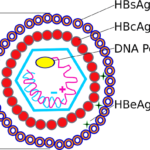
The complete infectious HBV particle, called the Dane particle, is about 42 to 47 nm in diameter and appears as a spherical or slightly pleomorphic enveloped virion under electron microscopy. It has an outer envelope surrounding an inner icosahedral nucleocapsid (core), forming a two-layered structure.
Outer Envelope and Surface Proteins
The outer envelope is a lipid bilayer derived from host cell membranes and is embedded with viral surface glycoproteins, collectively known as hepatitis B surface antigen (HBsAg). These surface proteins exist in the forms of large (L), middle (M), and small (S) HBsAg, which form disulfide-linked dimers and trimers and are responsible for receptor binding and antibody recognition.
Inner Nucleocapsid (Core)
The inner nucleocapsid is an icosahedral shell about 27 to 30 nm in diameter, composed of repeating units of the hepatitis B core antigen (HBsAg) protein. This capsid encloses the viral genome, a partially double-stranded, relaxed-circular DNA (rcDNA) molecule covalently linked at its 5’ end to the viral DNA polymerase (which has reverse-transcriptase activity).
Pleomorphic Subviral Particles
In addition to the 42 nm Dane particles, infected serum contains large numbers of non-infectious pleomorphic forms.
Roughly 20 to 22 nm spherical particles and
Filamentous particles up to several hundred nanometers long.
These are made only of HBsAg and host-derived lipid, without a nucleocapsid or DNA, and they are antigenic but not infectious.
Key Comparison Table
| Type | Transmission | Chronic | Vaccine |
|---|---|---|---|
| Hepatitis A | Fecal-oral, food/water | No | Yes |
| Hepatitis B | Blood, Fluids, Birth | Yes | Yes |
| Hepatitis C | Blood to blood | Yes (80%) | No |
| Hepatitis D | Blood, Fluids (need B) | Yes | Yes (via B vaccine) |
| Hepatitis E | Fecal-oral, Contaminated water | Rare | Only in China |