



Causative Organism and Vector Details
- In mainland India, Wuchereria bancrofti is the causative organism for filaria, transmitted by the ubiquitous vector, Culex quinquefasciatus.
- W. bancrofti is the most predominant infection, contributing to 99% of the problem in the country.
- The vector species Culex quinquefasciatus preferably breeds in dirty and polluted water. However, it can also breed in clear water if polluted water is absent.
- W. bancrofti infection is prevalent in both urban and rural areas.
- Brugia malayi infection is mainly restricted to rural areas due to the peculiar breeding habits of its vectors.
- Mansonia annulifera is the primary vector, and Mansonia uniformis is the secondary vector for the transmission of Brugia malayi infection.
- The breeding of these Mansonia vectors is associated with aquatic plants like Pistia stratiotes. The vectors cannot breed in the absence of these plants.
- The transmission of filariasis by the vector Mansonia indiana is very limited due to its low density.
- Mansonia indiana is found in several countries in South and Southeast Asia, including India, Sri Lanka, Myanmar, Thailand, Malaysia, Singapore, Sumatra, and Java. It is a vector of Brugia malayi.
Periodicity of Microfilaria (MF)
- Both Wuchereria bancrofti and Brugia malayi infections in mainland India exhibit nocturnal periodicity.
- Nocturnal periodicity occurs because vectors like Culex quinquefasciatus have a nocturnal biting pattern, peaking around midnight.
- Due to this midnight biting habit, the microfilaria (MF) are found in the peripheral blood at night.
- In the Andaman and Nicobar Islands, microfilariae are found in the peripheral blood smear during the daytime.
- This is because the vector there is Aedes nivenus, which has mostly daytime biting habits.
- Diurnal periodicity occurs because vectors like Aedes exhibit a diurnal biting pattern.
- Due to this daytime biting habit, the microfilaria (MF) are found in the peripheral blood during the day.
Human Filarial Species, Disease Type, and Vectors
Lymphatic filariasis is reported from 20 states and 5 union territories in India.
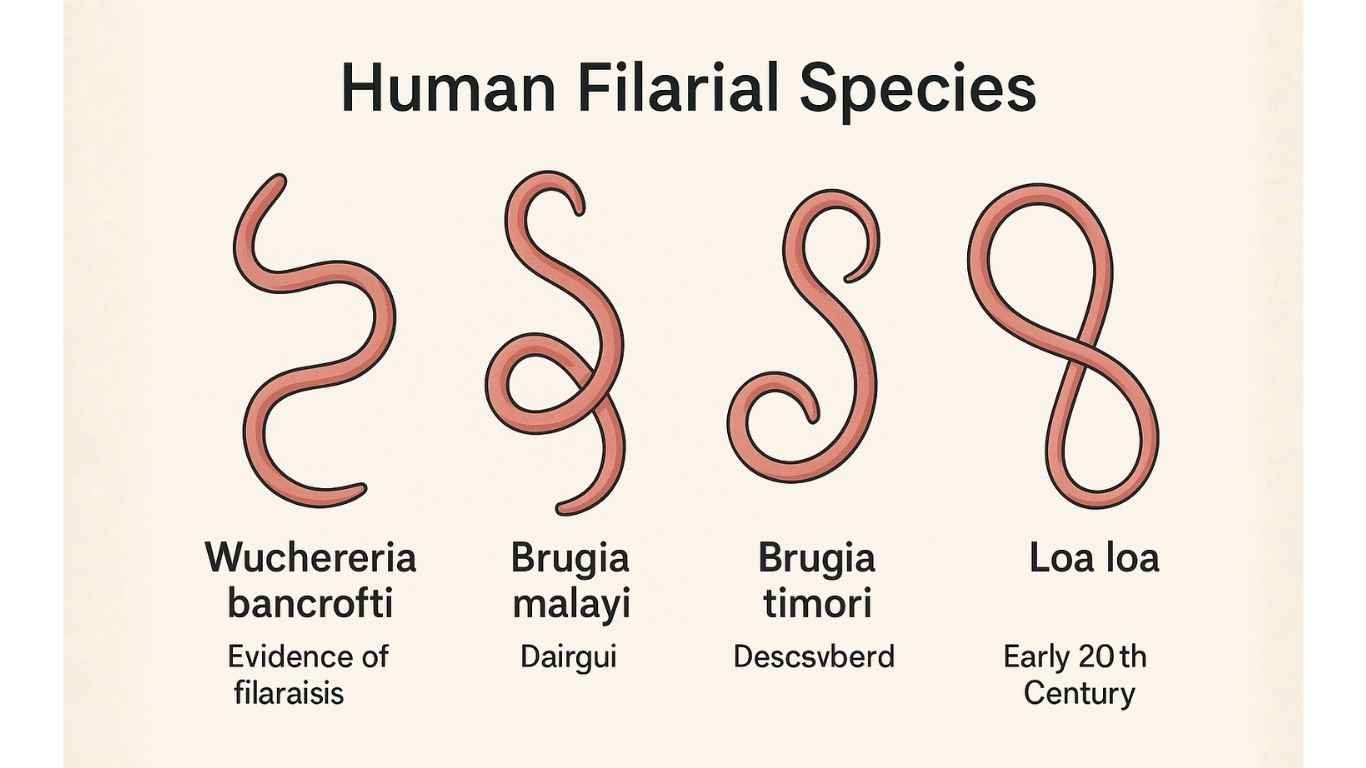
The main species of filaria that cause human filariasis and their vectors are listed below
| Sr. No. | Species | Disease Type | Vectors | MF Periodicity |
| 1 | Wuchereria bancrofti | Lymphatic | Culex, Aedes, Anopheles, Mansonia, Coquillettidia | Nocturnal |
| 2 | Brugia malayi | Lymphatic | Mansonia, Aedes, Anopheles | Nocturnal |
| 3 | Brugia timori | Lymphatic | Mansonia, Anopheles | Non-periodic |
| 4 | Loa-Loa | Sub-cutaneous | Chrysops (deer flies) | Diurnal |
| 5 | Onchocerca volvulus | Sub-cutaneous | Simulium (black flies) | Non-periodic |
| 6 | Mansonella perstans | Body-cavity | Culicoides | Non-periodic |
| 7 | Mansonella Ozzardi | Body-cavity | Culicoides | Non-periodic |
| 8 | Mansonella Streptocarca | Body-cavity | Culicoides | Non-periodic |
| 9 | Dirofilaria (heartworm) | Body-cavity | Various mosquitoes | Non-periodic |
Vector Biting Schedules
Vector biting schedules generally follow distinct temporal patterns, such as diurnal (daytime), nocturnal (nighttime), crepuscular (dawn and dusk), and non-periodic rhythms. These patterns are closely dependent on the habits of both the vector and the pathogen they transmit.