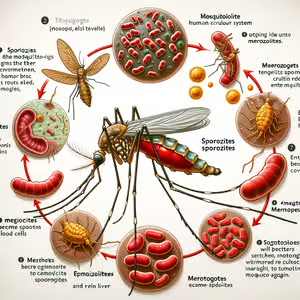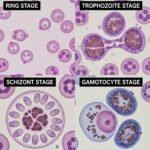
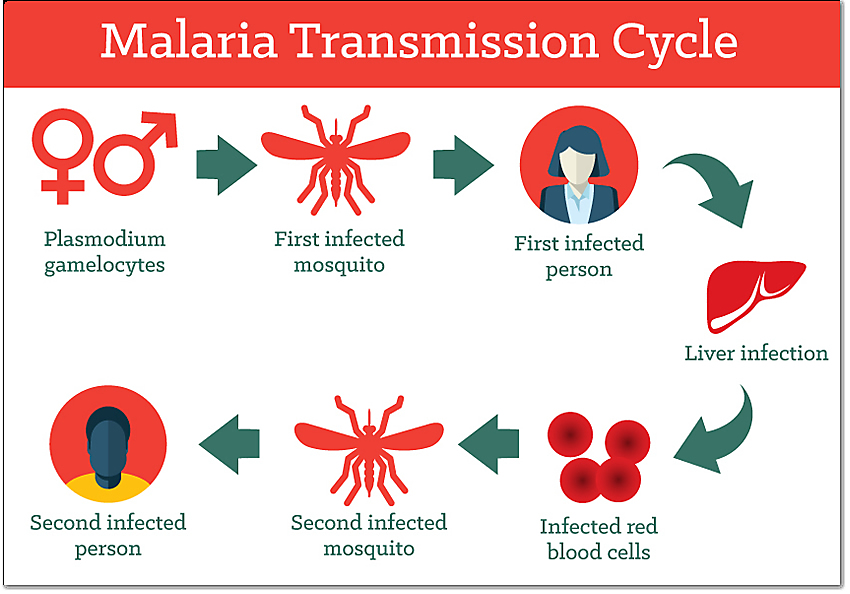



The sexual cycle of the malaria parasite begins when the Anopheles mosquito vector sucks the blood of an infected human (a gametocyte carrier). The mosquito takes in all stages of the malaria parasite during this blood meal. However, except for the gametocytes, all the remaining stages, including the ring stage, trophozoites, and schizonts, are digested in the mosquito’s stomach.

If there are favorable conditions, such as an optimum temperature around 25°C to 30°C and humidity more than 60%, maturation takes place.
- The male gametocyte develops into a microgamete, which then develops into 6 to 8 small, flagellate structures (spermatozoa).
- The female gametocyte develops into a macrogamete, which is flat, globular, and bigger than the male gamete.
Fusion occurs when one of the 6 to 8 flagellate structures (spermatozoa) fuses with the female gamete to form a zygote. The zygote then becomes motile and elongated in shape, at which point it is known as an ookinete or vermicule.
The ookinete penetrates the epithelial cell wall of the mosquito’s stomach and forms a cyst. This cyst develops further and is known as an oocyst.
Inside the oocyst, the nucleus and cytoplasm undergo further division, forming many spores (spermatocytes). Sporozoites are then formed from these spores. Due to the large number of sporozoites, the cell wall of the oocyst bursts, and the sporozoites enter the mosquito’s body cavity, avoiding the mosquito’s ovary. They then travel and enter the salivary gland of the mosquito’s proboscis. In this way, the mosquito becomes ready to transmit the malaria parasites to a new host.
The duration of this sexual life cycle is typically 10 to 14 days when the temperature is 25°C and the humidity is 60% to 70%.