
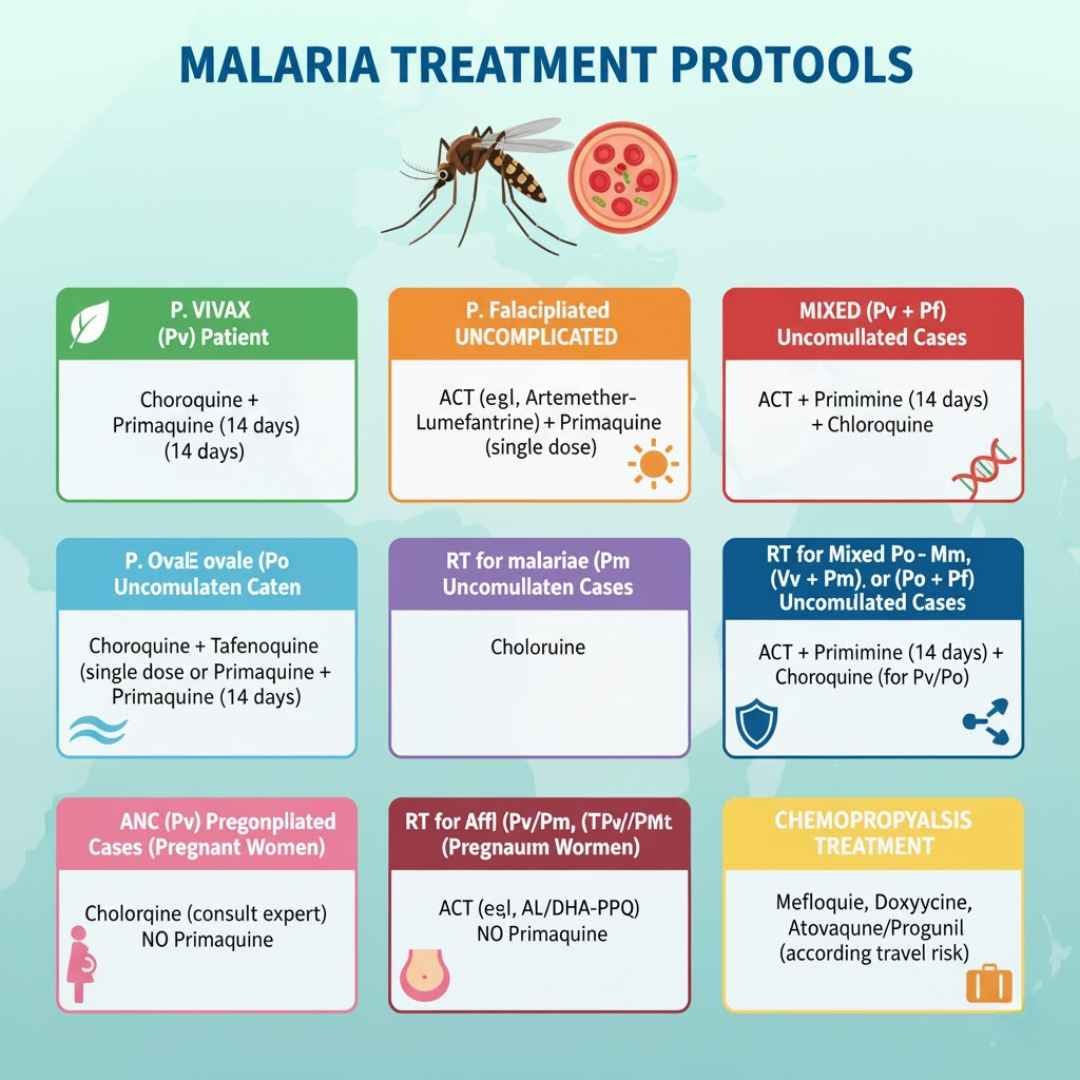
There are several types of treatment generally used in malarial cases.
1. Presumptive Treatment (Stopped)
The policy in 2013 stopped the practice of presumptive treatment for malaria, which previously involved giving all fever cases a single dose of chloroquine tablets, according to an age-wise schedule, at the time of blood smear (BS) collection.
2. Condensed Radical Treatment (CRT) or Full Radical Treatment (FRT)
- One-day CRT (or FRT): For an adult patient, the dose was 600 mg chloroquine with 45 mg primaquine.
- Three-day CRT (or FRT): For an adult patient, the dose was 600 mg chloroquine with 45 mg primaquine on the first day, 600 mg chloroquine alone on the second day, and 300 mg chloroquine on the third day.
- Current Policy (2013): As per the 2013 National Drug Policy on Malaria, full treatment with chloroquine for 3 days should be given in all cases of suspected malaria that cannot be immediately confirmed by tests.
3. Mass Radical Treatment (MRT) or Mass Chemotherapy (MCT) (Stopped)
Mass chemotherapy (mass drug administration) was previously recommended in highly endemic areas for interruption of transmission. This involved a single dose of 600 mg chloroquine with 45 mg primaquine without taking a blood sample. However, this treatment has been stopped as per the 2013 National Drug Policy on Malaria.
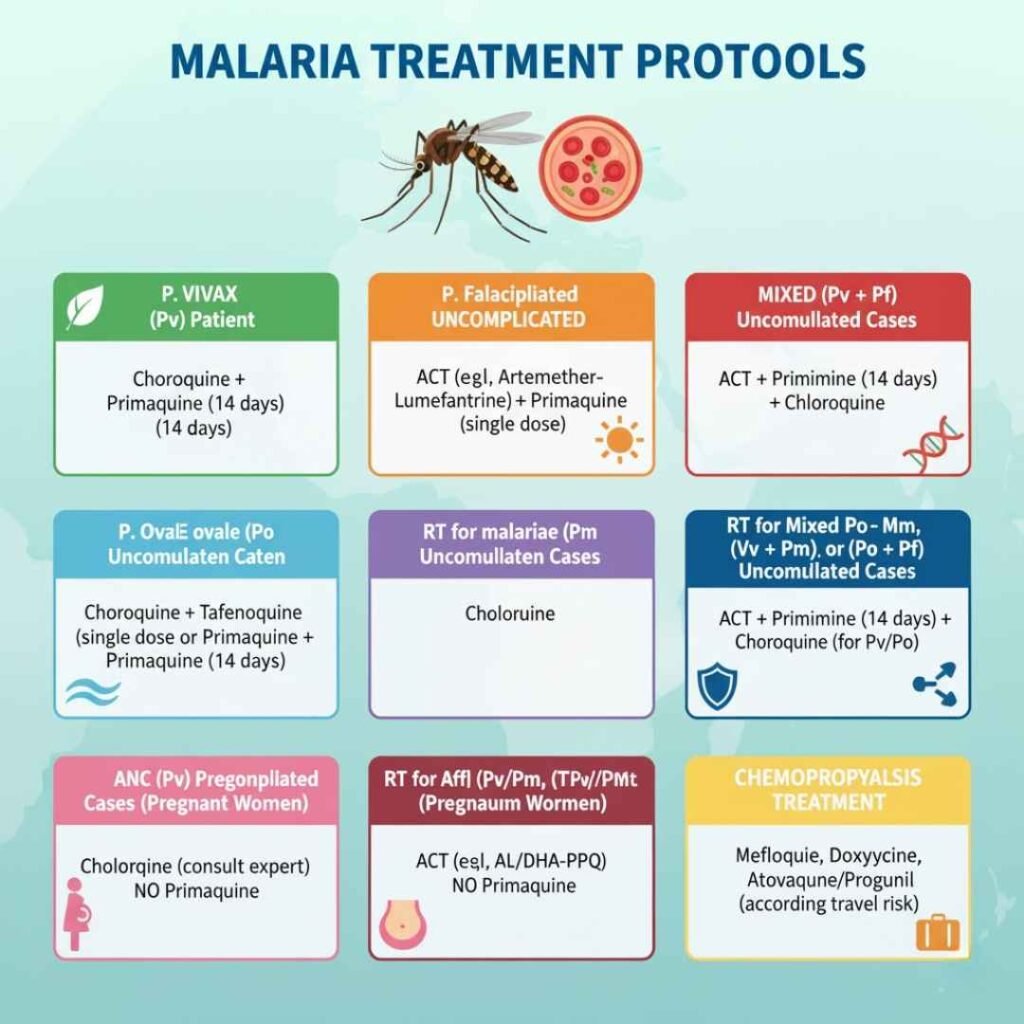
4. Radical Treatment (RT) for Uncomplicated Patients
Radical treatment is given for the complete cure of a disease, rather than just relieving symptoms. The treatment varies by species and age.
A) RT for P. vivax (Pv) Patient
Treatment is given upon confirmation of a Pv patient by RDT or microscopic examination.
| Day | Drug | Dosage (based on patient weight) |
| 1st & 2nd Day | Chloroquine | 10 mg/kg bw |
| 3rd Day | Chloroquine | 5 mg/kg bw |
| 1st to 14th Day | Primaquine | 0.25 mg/kg bw daily for 14 days under the supervision of a Medical Officer (MO). |
Age-wise/Drug-wise Dosage Chart for P. vivax
| Sr. No. | Age Groups | Chloroquine | Primaquine (for Pv) | Primaquine (for Pf) |
| 1 | 0–1 yrs | 75 mg | Nil | Nil |
| 2 | 1–4 yrs | 150 mg | 2.5 mg | 7.5 mg |
| 3 | 5–8 yrs | 300 mg | 5 mg | 15 mg |
| 4 | 9–14 yrs | 450 mg | 10 mg | 30 mg |
| 5 | 15 & Above | 600 mg | 15 mg | 45 mg |
| 6 | Pregnant Women | 600 mg | Nil | Nil |
- Based on the chart, the full dose of chloroquine should be given for two days, and half the dose should be given on the third day.
- Primaquine should then be given continuously for 14 days as per the chart.
Note on Primaquine: Primaquine is contraindicated in infants, pregnant women, and individuals with G6PD deficiency.
B) RT for Uncomplicated P. falciparum (Pf) Patient
Treatment is given upon diagnosis of a Pf patient by RDT (monovalent or bivalent) or microscopic examination.
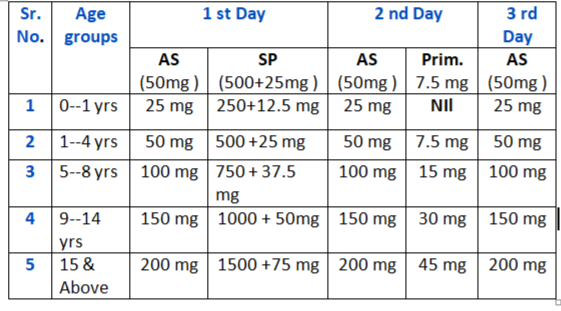
- The full dose of AS (Artesunate) should be given for three days.
- A full single dose of SP (sulphadoxine-pyrimethamine) should be given on the first day only.
- A full single dose of primaquine should be given on either the 2nd or 3rd day only.
- Primaquine is not given with SP due to contraindication.
C) RT for Mixed (Pv + Pf) Uncomplicated Cases
. As per above chart
- The full dose of AS should be given for three days, and the full single dose of SP should be given on the first day only.
- Primaquine should be given continuously for 14 days as per the Pv treatment chart.
- Primaquine should be started on the second day because it should not be given with SP due to contraindication.
D) RT for P. ovale (Po) Uncomplicated Cases
P. ovale should be treated the same as P. vivax (Pv).
E) RT for P. malariae (Pm) Uncomplicated Cases
P. malariae should be treated the same as P. falciparum (Pf).
F) RT for Mixed (Po + Pm), (Pv + Pm), or (Po + Pf) Uncomplicated Cases
- All cases of mixed infection are to be treated as P. falciparum (Pf), as per the Pf drug chart applicable in the area, plus primaquine for 14 days, as per the Pv treatment chart.
G) RT for ANC (Pv) Uncomplicated Cases (Pregnant Women)
- 600 mg chloroquine for the 1st and 2nd days.
- 300 mg chloroquine for the 3rd day.
- Primaquine is not given.
H) RT for ANC (Pf) Uncomplicated Cases (Pregnant Women)
- 1st Trimester:
- Quinine salt 10 mg/kgbw, 3 times daily (TDS) for 7 days.
- ACT (Artemisinin-based Combination Therapy) is not given for the 1st trimester.
- 2nd & 3rd Trimester:
- 200 mg artesunate (AS) plus 1500 mg sulfadoxine plus 75 mg pyrimethamine for the first day only.
- 200 mg artesunate (AS) on the 2nd and 3rd days.
- Primaquine is not given in pregnancy.
Precautions for Treatment
- Drugs/medication should not be given on an empty stomach.
- Medicine should be administered under direct supervision or in front of health workers.
- The artemisinin group of drugs is not recommended in pregnancy.
- Primaquine should not be given with an ACT combination (like artesunate), as artesunate reduces gametocyte carriers.
I) Chemoprophylaxis Treatment
Chemoprophylaxis should only be administered in endemic areas with high P. falciparum.
1. Short-term Chemoprophylaxis (Up to 6 Weeks)
- Doxycycline:
- Adults: 100 mg once daily.
- Children above 8 years: 1.5 mg/kgbw once daily (i.e., 100 mg/day).
- Doxycycline is contraindicated in children below 8 years and is not recommended for pregnant women.
- The drug should be started 2 days before travel and continued for 4 weeks after leaving the malarious areas.
2. Long-term Chemoprophylaxis (More than 6 Weeks)
- Mefloquine:
- Adults: 250 mg per week.
- Children: 5 mg/kgbw once a week.
- It should be administered two weeks before, during, and four weeks after exposure.
- Note: Mefloquine is contraindicated in individuals with a history of convulsions, neuropsychiatric problems, and cardiac conditions. Therefore, necessary precautions should be taken before prescribing the drugs.