

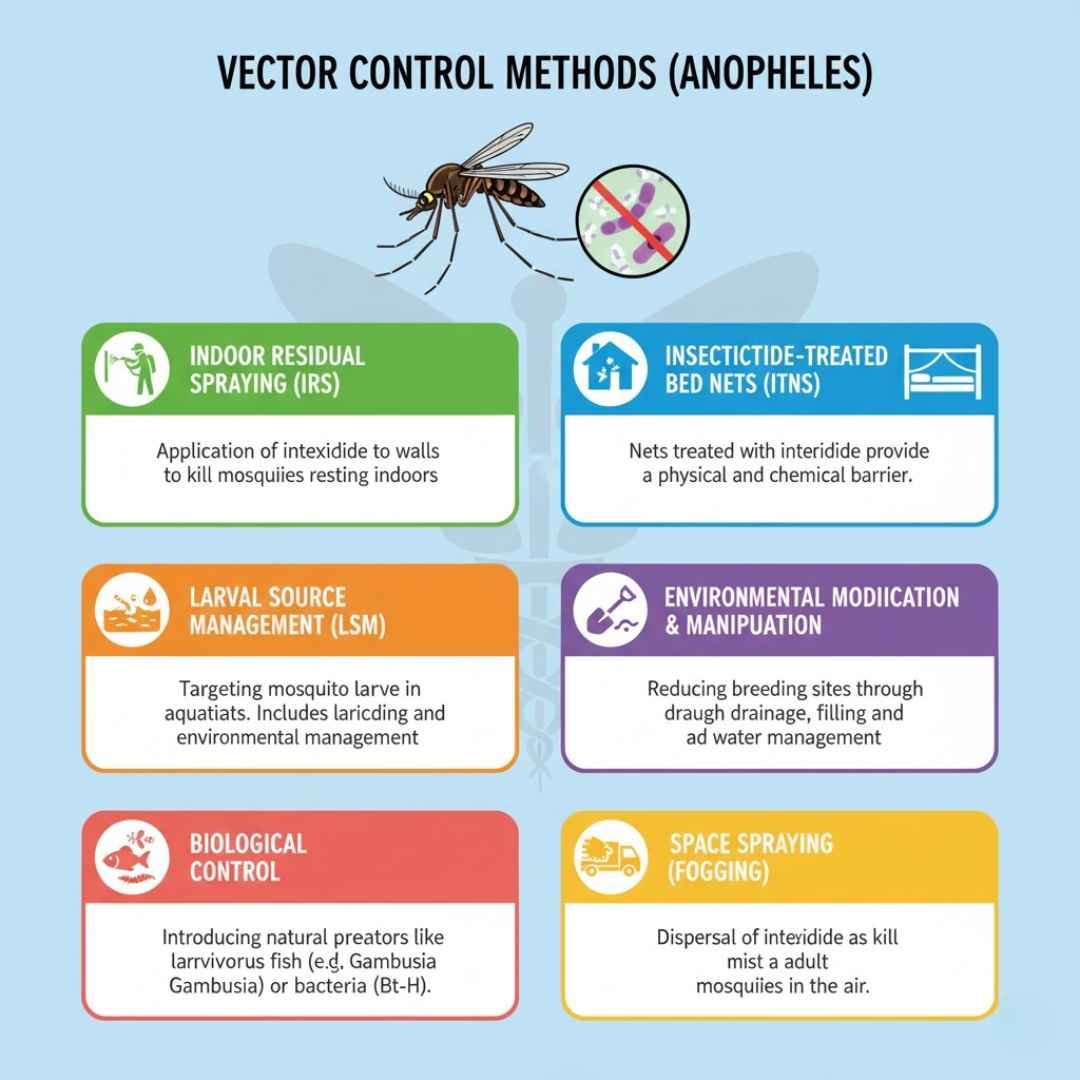
Vector Control Methods (Anopheles)
Anopheles Larval Control Methods
Anopheles larval control measures involve four major approaches
A) Chemical Control
In malaria programs, Anopheles larval control is carried out using larvicides, e.g., Temephos, Baytek, etc.
B) Biological Control
- Bacillus thuringiensis israelensis (BTI) powder and Bacillus sphaericus are used for killing larvae in water.
- Larvivorous fish (e.g., guppy fish and Gambusia) are used in ponds, tanks, and other water bodies. To use guppy fish effectively, breeding sites must be listed, and fortnightly follow-ups conducted to monitor fish growth.
C) Minor Engineering Measures
- Source reduction—Elimination or modification of breeding sites by filling burrow pits, ditches, unused wells, and irrigation channels.
- Habitat disruption—Covering water containers tightly, cleaning them regularly, drying them once a week, and destroying unused containers.
D) Personal Protection
Communities should be made aware of how to protect themselves from mosquito bites. This includes the use of repellents, bed nets, protective clothing, and window/door mesh.
For effective surveillance, larval control is monitored using a standard dipper (500 ml capacity). Insert the dipper gently, just below the water surface, to collect larvae without disturbance. Take 10–20 dips per site. Only Anopheles larvae should be counted (not culicine).
- Larval Density = Total larvae obtained / Total dips taken
Significance of larval density:
- Low = 0 to 2
- Medium = 2 to 5
- High = > 5
Pupal density is calculated similarly:
- Pupal Density = Total pupae obtained / Total dips taken
Significance of pupal density:
- Low = 0 to 0.5
- Medium = 0.5 to 1.5
- High = > 1.5
2) Anopheles Adult Control Methods
Adult mosquito vectors are mainly controlled by the following methods:
- Chemical methods
- Physical methods
- Personal protection
- Community awareness (IEC/BCC)
- Mosquito collection, identification, and dissection for surveillance
A) Chemical Methods
- Residual spraying:
- Indoor residual spraying (IRS), e.g., human dwellings.
- Outdoor residual spraying (ORS), e.g., cattle sheds (using malathion, synthetic pyrethroids).
- Space spraying: Aerosols (0.1–5 microns).
- Insecticide-treated nets (ITNs).
B) Physical Methods
Use of window and door screens, bed nets, protective clothing, repellents, clean surroundings, elimination of stagnant water, and reduction of breeding places.
C) Personal Protection
Wearing full-sleeved shirts, long pants, and socks to minimize exposed skin (especially at dusk and dawn). Repellents (creams, coils, vaporizers, and sprays) also help.
D) Community Awareness
Educating communities about mosquito habitats and involving them in sanitation and breeding site elimination.