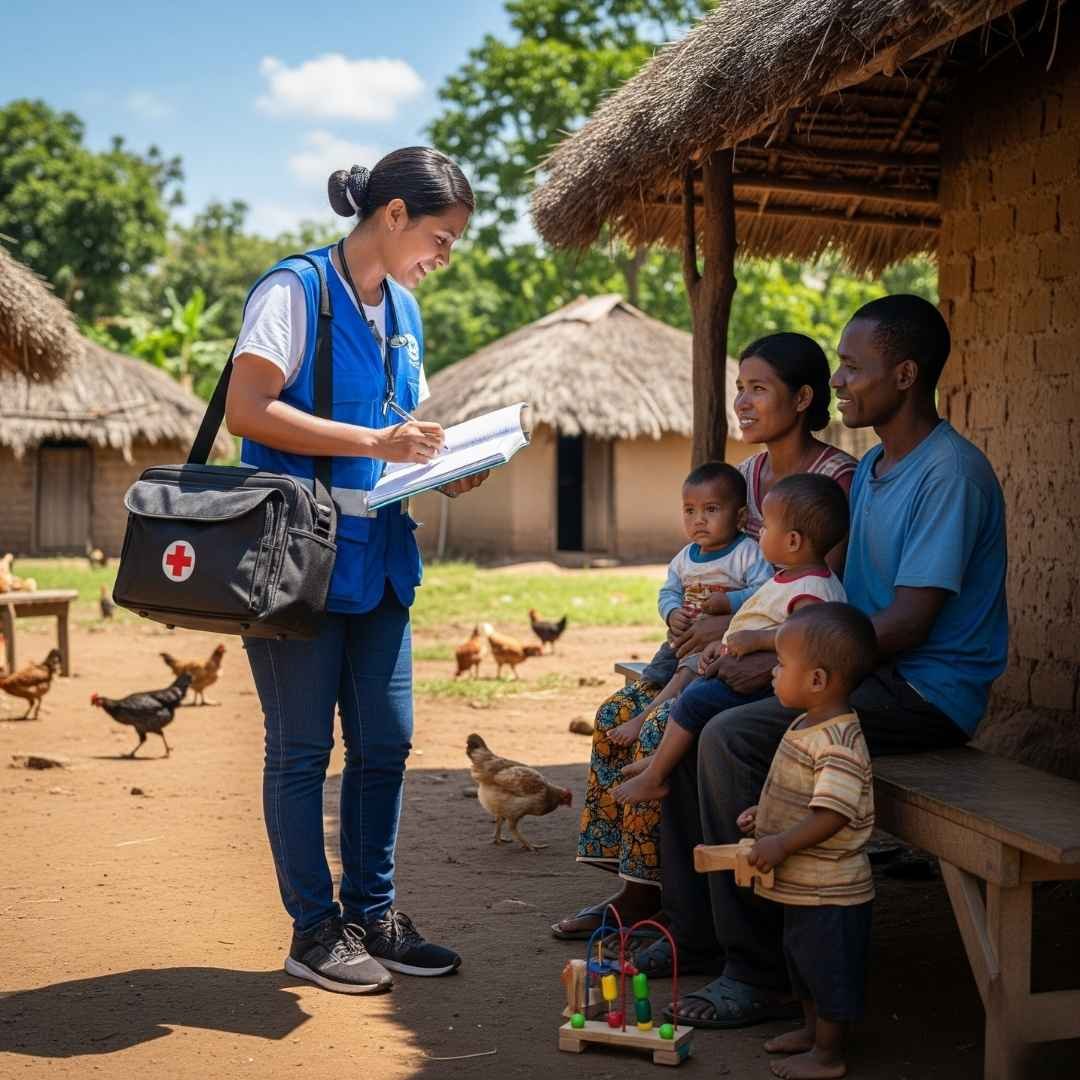


The role of community health workers is crucial for early case detection and complete treatment (EDCT) of malaria cases. CHWs are the frontline health workers who collected BS from house-to-house visits or performed RDT on fever cases and gave timely radical treatment. They maintain records of all blood smear collections and RDT results, which help him for data collection and reporting.
CHWs used the following register for VBD surveillance.
Case detection and management forms are M-1, M-2, M-3, and M-4.
1) M-1: Family health register, i.e., report of surveillance by CHW/MPW/ANM/ASHA. It is actually a list of all fever cases. This form is to be filled by any health worker who is directly involved in case detection and treatment.
2) M-2: Laboratory request form for slide examination. It is filled in duplicate copies by CHW, MPW, ANM, and ASHA whenever blood slides need to be sent to the laboratory for blood sample examination. If two B.S. are collected by health workers in a day and are needed to be examined, they are entered into M-2 and sent to the PHC lab within two days, due to avoiding time lag or EDCT.
3) M-3: Record of slide examination in PHC Laboratory.
4) M-4: Fortnightly reporting form from subcenter,Phc , district, and state. It is a village-wise, subcenter-wise, agency-wise, fortnightly, and monthly consolidation of all M-1 forms, including CHW, ANM, and ASHA (all total active, passive, contact, and mass blood smear collection) and a positive case details report. This report is made in triplicate, and two copies are forwarded to PHC on the 25th of the month for the second fortnight and the 10th of the following month for the first fortnight.
5) M-7: Details of malaria-positive cases register.
6) M-8: Blood smear receipt/entry register.
7) M-9: Epidemiological evaluation register or master file.
8) M-11: Weekly/monthly savingram.
The other important register should be kept with oneself by the CHW.
- Container survey register
- Guppy fish hatchery register
- Guppy fish distribution logbook
- Village-wise breeding places register
- Villagewise linelist of private practitioners and private lab register.
- Ten days working programme register (daily diary, month-wise)
- Positive-case details register for malaria, filaria, dengue, chikungunya, JE, CHK, Zika virus, and others.
- Migratory population survey register.
- MMDP register.
- Form A, hydrocele patient register.
- Form B, elephantiasis patient register.
- MF-6: Monthly report of the malaria program of PHC spraying.
Integrated vector control forms
- VC: Primary record of IRS
- VC-1S: Wall Stencil
- VC-2: District IRS output form
- VC-3: Primary record of bednet delivery and impregnation
- VC-4: Bednet delivery and impregnation form.
Health workers will take all precautions to use properly sterilized needles and clean slides while collecting blood smears.
He will put a stencil on the wall of each household with the date and signature at the time of the fortnightly domiciliary visits.
He will have a ten-day domiciliary house-to-house visit schedule given by the M.O./DHO.
Role of CHW (Female), i.e., ANM.
- ANM will be responsible for collecting blood smears from all antenatal and postnatal cases under her care, as well as from infants.
- During her visits, if a pregnant woman has a history of fever or has a fever, she will collect from her a thick and thin blood smear and keep records in the M-2 register.
- It should be kept in mind that malaria is a very serious complication in pregnancy and the postpartum period, leading to high mortality.
- She will take the blood smears to the nearest malaria clinic/PHC laboratory on priority within 24 to 48 hours.
- She will obtain the result of blood smears and give radical treatment to malaria-positive patients as per the species-wise drug schedule/guidelines.