

Life History
Life History: Sandflies have an ancient evolutionary history, with fossil evidence dating back to the Mesozoic era, over 100 million years ago. Sandflies belong to the family Psychodidae, which likely originated during the Triassic or Jurassic periods. Phlebotomine sandflies, the subfamily involved in disease transmission, are thought to have emerged in the lower Cretaceous period roughly 100 million years ago.
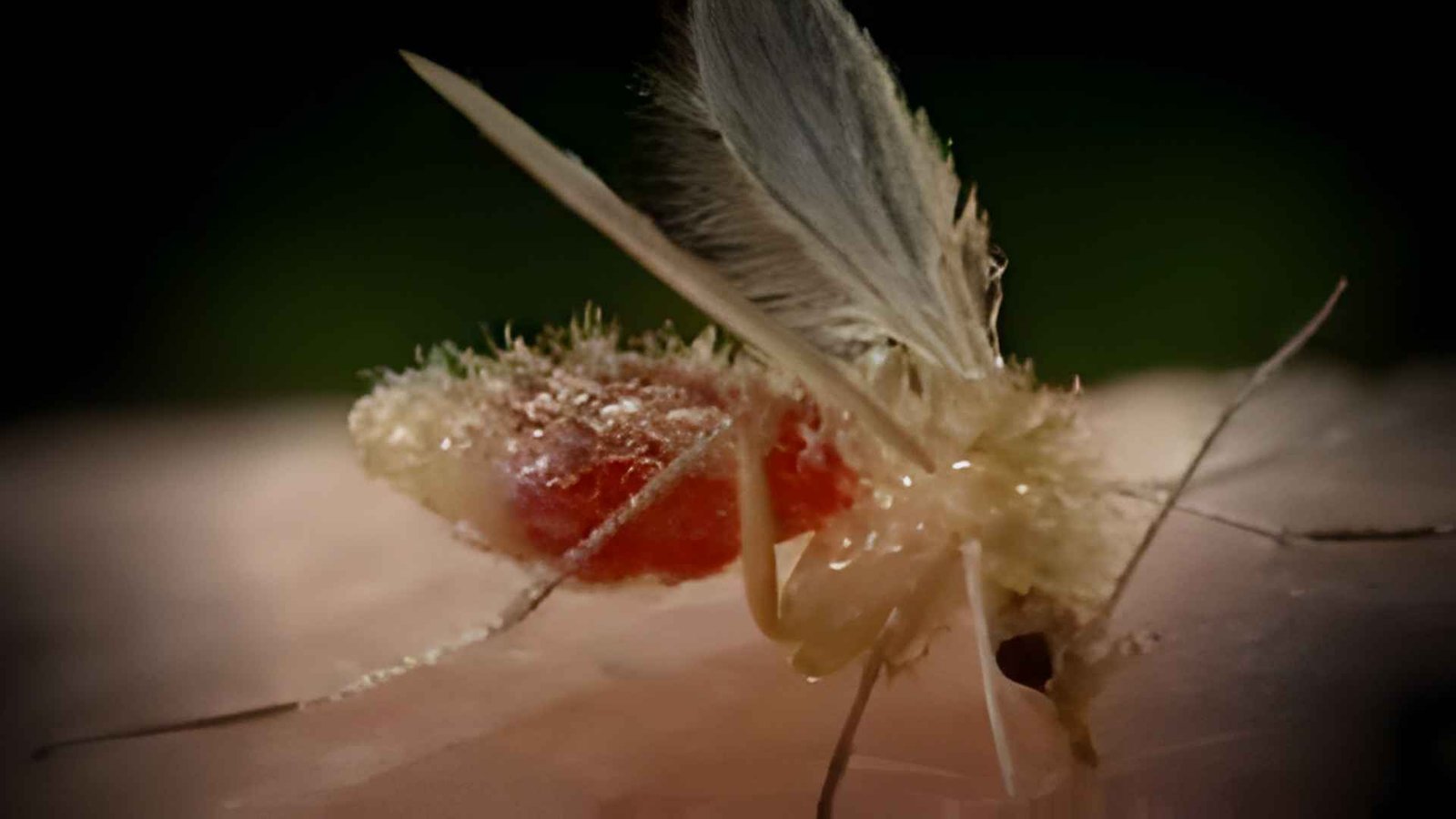
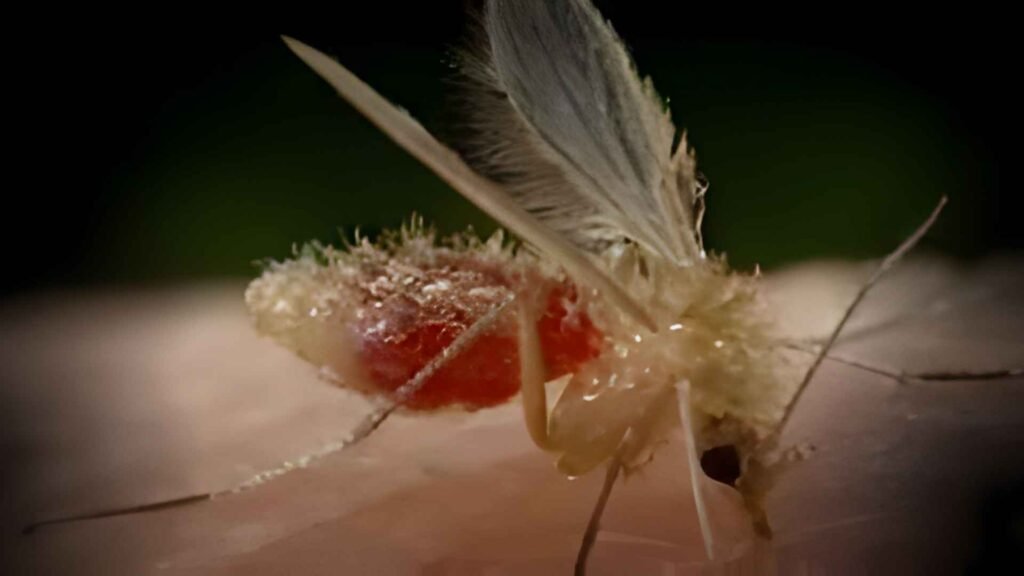
Sandflies are small insects, light or dark brown in colour. They are smaller than mosquitoes. They are 1.5 to 2.5 mm in length, with their bodies and wings densely clothed with hair.
General Characteristics of Vectors
General characteristics of vectors:
The body of a sandfly is divided into head, thorax, and abdomen.
1) Head
Head: The head bears a pair of long, slender, and hairy antennae; palpi; and a proboscis. Only the females bite; the males live on vegetable juices.
2) Thorax
Thorax: The thorax bears a pair of wings and three pairs of legs. The wings are upright, lanceolate in shape, and densely hairy. The second longitudinal vein on the wings branches twice; the first branching takes place in the middle of the wing. This is a characteristic feature of the genus Phlebotomus. The legs are long and slender and out of proportion to the size of the body.
3) Abdomen
Abdomen: The abdomen has 10 segments and is covered with hair. In the female, the tip of the abdomen is rounded; in the male, there are claspers, which are conspicuous and attached to the last abdominal segment.
Distinguishing Features of Sandflies from Mosquitoes
Sandflies may be distinguished from mosquitoes by the following characteristic:
Size: sandflies are smaller than mosquitoes.
Wings: The wings of the sandfly are upright and lanceolate in shape; the second longitudinal vein branches twice, the first branching taking place in the middle of the wings.
Legs: The legs of the sandfly are longer compared with the size of the body.
Hopping: Sandflies hop about and do not fly by choice.
Habits of Sandflies
Habits:
Sandflies are troublesome nocturnal pests. Their bite is irritating and painful, while their presence is scarcely observed. They infest dwellings during the night and take shelter during the day in holes and crevices in walls, holes in trees, dark rooms, stables, and store rooms.
The females alone bite, as they require a blood meal every third or fourth day for oviposition. Sandflies are incapable of flying over long distances; they merely hop about from one place to another place. Sandflies are generally confined to within 50 yards of their breeding places.
In summer, sandfly eggs typically hatch/develop within about 30 days, but under winter or cool conditions, the eggs can remain viable and hatch after a much longer duration, up to approximately 710 days (almost two years). Thus, sandfly eggs have the ability to remain viable for up to 710 days in cool or winter conditions.
Sandflies hop, covering distances less than 0.5 meters at a time. Most sandflies disperse within 100 to 150 meters from their breeding and resting sites. During their lifetime, Phlebotomus ariasi flying about 2.2 km.
Here brief notes on sandfly habits:
Biting Habits
Biting Habits: Only female sandflies bite, as they require blood meals for egg production/development. They bite mainly during dusk and nighttime, feeding on various hosts, including humans, domestic animals, and wild mammals. The bite causes a painful, itchy welt due to pharmacologically active saliva injected during feeding. Females use their piercing-sucking mouthparts to create a pool of blood from which they feed.
Resting Habits
Resting Habits: – Sandflies rest in cool, dark, and humid environments such as cracks in walls, animal burrows, tree holes, hollow logs, palm tree crowns, and inside houses, especially shaded or darkened areas. They often rest during daylight hours, becoming active at night for feeding and mating.
Flying Habits
Flying Habits: Sandflies have weak flight capacity with characteristic short hops rather than long continuous flights. They typically fly low to the ground with limited range, mostly 50 to 150 meters from breeding/resting sites. Flight activity peaks at dusk and night, influenced by temperature, humidity, and wind conditions.
Breeding Habits
Breeding Habits: – Females lay 30 to 70 eggs per gonotrophic cycle in moist sites with organic matter like soil cracks, leaf litter, animal burrows, and tree roots. Eggs hatch within 4 to 20 days depending on temperature. Larvae feed on decaying organic matter before pupating. Larval and pupal stages occur in protected humid microhabitats, with development times influenced by environmental conditions.
Epidemiological Importance
These ecological and behavioral traits make sandflies effective vectors of pathogens while presenting challenges for control measures due to their cryptic resting and breeding habits.
Life Cycle of Sandflies
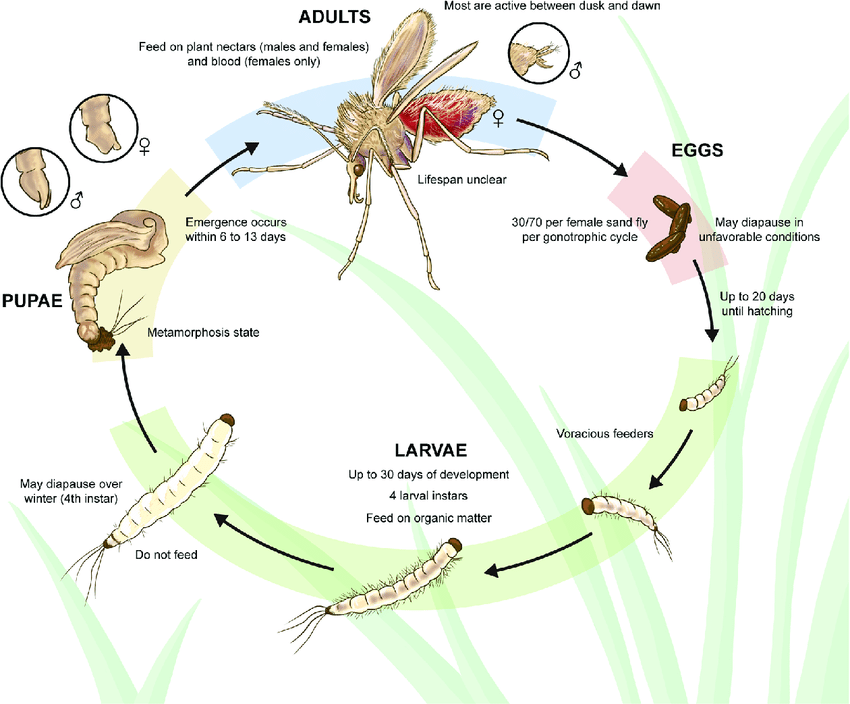
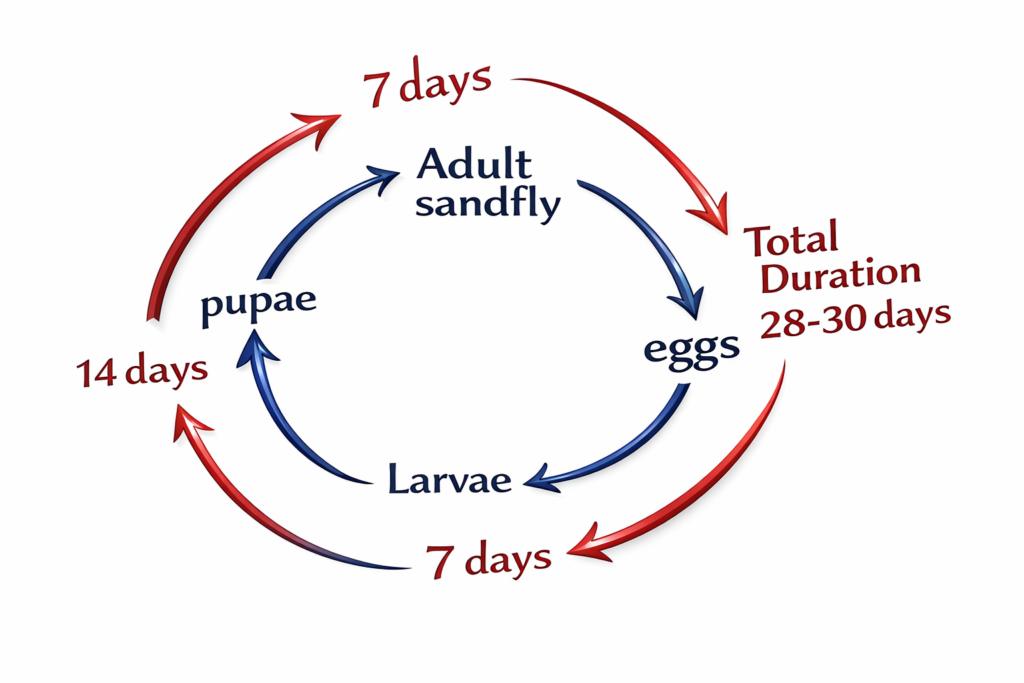
Life Cycle Of Sandflies.
The life cycle of the sandfly consists of four major stages: egg, larva, pupa, & adult.
Egg Stage
Egg: A female sandfly lays approximately 30 to 70 eggs in protected, humid environments rich in organic matter like cracks, animal burrows, termite mounds, damp dark places in the vicinity of cattle sheds and poultry, or leaf litter. The eggs are comparatively large and torpedo-shaped with longitudinal wavy lines on the outside. The eggs hatch within 7 days. Hatching is delayed in cool or unfavorable conditions.
Larval Stage
Larvae: There are four larval instars (developmental stages). The larvae are hairy maggots with a distinct head, thorax & abdomen. The last abdominal segment carries two pairs of long, stout hairs; one pair is remarkably long. The larva feeds on decaying organic matter, such as leaf mold, insect bodies & animal feces, and becomes a pupa in about 2 weeks.
Pupal Stage
Pupa: The pupal stage is sensitive to desiccation. The pupal stage lasts for about 1 week. Adult sandflies usually emerge during darkness, often just before dawn. Males typically emerge before females.
Adult Stage
Adults: Adults have a relatively short life span, with males living about a week and females potentially living longer to undergo multiple gonotrophic cycles. The average life span of female sandflies is about 2 weeks.
Duration of Life Cycle
Egg → Larvae → Pupa → Adult sandfly
← 7 days → 14 days ← 7 days ← = 28 to 30 days of cycle.