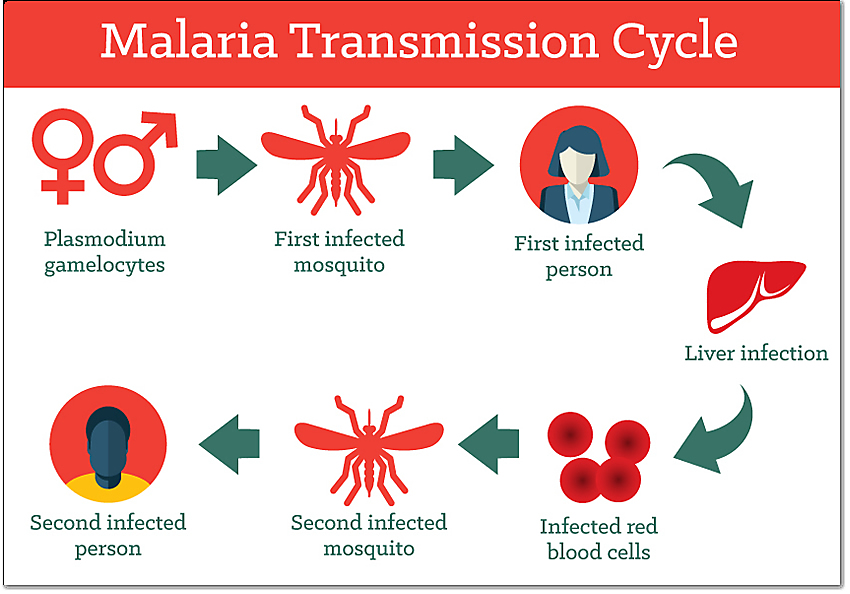


Life cycle of malaria parasites involving three living things.
- Mankind, a secondary vertebrate, is an intermediate host.
- Mosquito, primary invertebrate, definite host.
- Plasmodium parasites is a gest or guest.
The malaria parasite completes its asexual cycle in mankind and sexual cycle in mosquitoes.
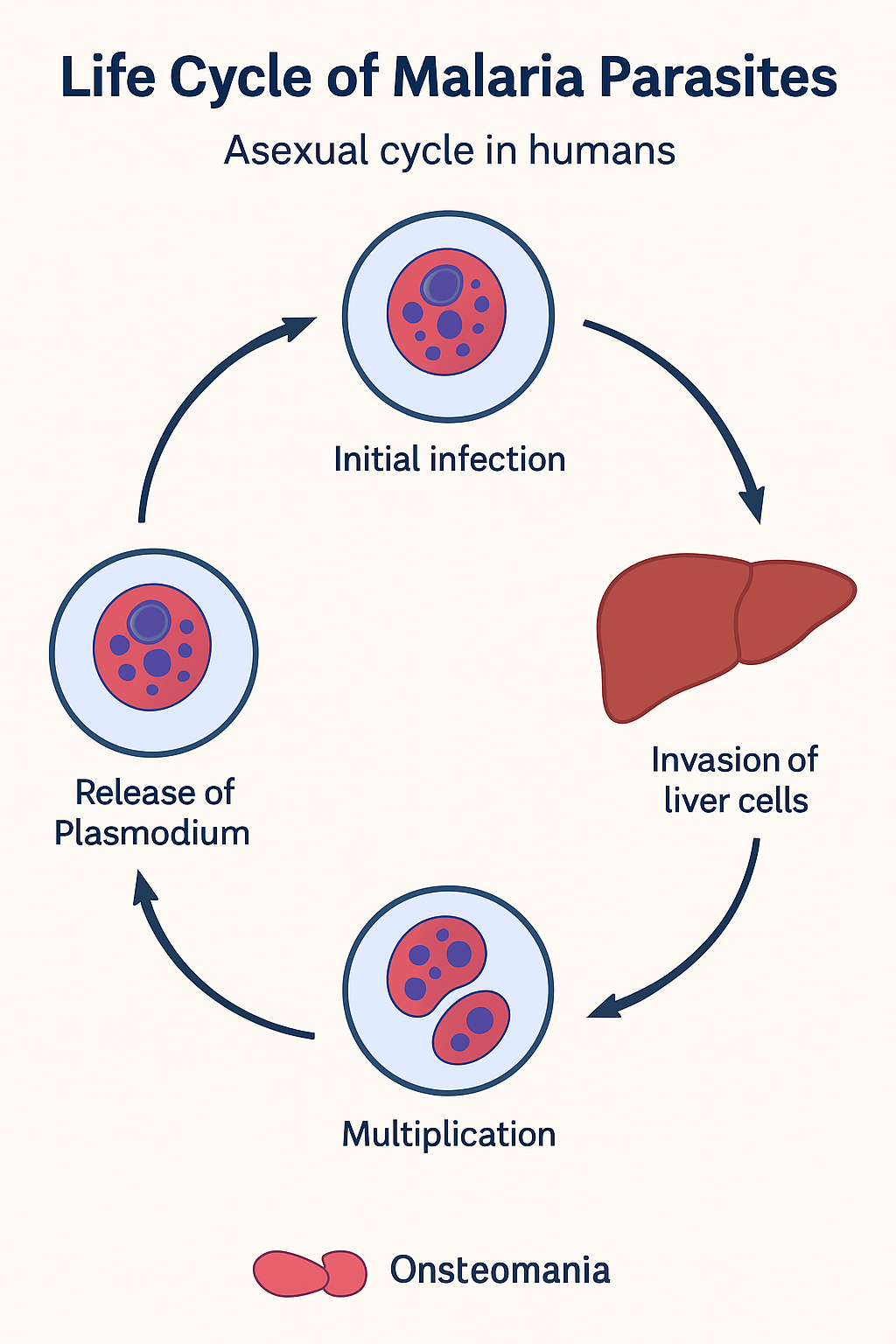
Asexual Cycle in Humans
The asexual life cycle takes place in the human body & it is divided into two stages.
- Pre-erythrocytic stage
- Erythrocytic stage
A) Pre-erythrocytic or Exo-erythrocytic or Liver Stage Tissue Phase Cycle:
(These cycles have the above three names):- When an infective female Anopheles mosquito bites a human body (a healthy individual), many sporozoites enter the human body through the saliva of the mosquito, where saliva acts as an anti-coagulation agent.
Sporozoites: Sporozoites are spindle-shaped, and they are very motile. They get adjusted (circulated) within 30 minutes, and then they enter the parenchymal cells of the liver. After entering the liver cell, sporozoites become round bodies; again, they develop and form a globular mass having a nucleus (chromatin). Further, this nucleus divided into a number of nuclei. Each nucleus gets cytoplasm and makes an individual structure. This is called ‘cryptozoites’ (i.e., hepatic schizonts).
These cryptozoites develop, so pressure comes on the outer cell, and the parenchymal cell bursts, and cryptozoites get released out.
In the case of Pv, 10,000 cryptozoites form.
In the case of Pf, 40,000 cryptozoites form.
In case of Pm,2000 cryptozoite forms,
during the tissue phase cycle.
In the case of Pv and Po, some sporozoites do not develop, and they take rest or sleep (dormant stage) and are called ‘hypnozoites.’ They develop after 3 to 6 months to develop into cryptozoites, which enter erythrocytes of peripheral blood circulation. These hypnozoites are responsible for ‘relapse’ (re-attack), recurrences.
This pre-erythrocytic cycle, or tissue-phase cycle, requires 8 to 10 days in Pv, 5 1/2 to 6 days in Pf, and 11 to 12 days in Pm.
B)Erythrocytic Cycle
Cryptozoites attack new RBCs in human blood and form a ‘signet’ ring structure.
1)Ring stage
When cryptozoites attack red blood cells (RBCs), they develop, and the cytoplasm forms a vacuole with a chromatin dot (nucleus). This is called the ring stage.
2)Trophozoites stage
After the ring stage, the chromatin expands in size, and the cytoplasm has vegetative growth with ameboid movement.
3)Early Schizont
In this vacuole, the cytoplasm gets diminished and fused, and the chromatin divides into 8 to 32 small chromatin dots. Each chromatin dots is surrounded by the same cytoplasm.
4)Mature Schizont
Each chromatin dot is surrounded by cytoplasm and forms merozoites. These merozoites (erythrocytic schizonts) are formed in RBC. Pressure is created on the wall of the RBC, and merozoites come out through the breaking of the RBC. At this stage, busting of RBC allergic reaction takes place because this dead RBC acts as an antigen, and fever comes to the patient.
Then the same merozoites again come to the cycle and re-attack fresh RBCs and repeat this cycle for 2 to 3 times (or for many months, not exactly known), and the remaining merozoites develop into male and female gametocytes, which are required for further development by the sexual cycle in mosquitoes.
This cycle takes variable time period in various species, or this cycle follow a ‘ cyclic pattern ‘ depending on the kind of species
Development Time of Malaria Parasites
- Plasmodium vivax (Pv): Completes its cycle in 48 hours (2 days).
- Plasmodium falciparum (Pf): Completes its cycle in 36 hours (1½ days).
- Plasmodium malariae (Pm): Completes its cycle in 72 hours (3 days).
- Plasmodium ovale (Po): Completes its cycle in 48 hours (2 days).
- Plasmodium knowlesi (Pk): Completes its cycle in 24 hours (1 day).
Incubation Period
The incubation period (time from infection until symptoms appear) usually takes 8 to 14 days to complete, depending on the species:
- Plasmodium vivax (Pv): 10 to 12 days (8 + 2 = 10 days to 10 + 2 = 12 days).
- Plasmodium falciparum (Pf): 7 to 8 days (5½ + 1½ = 7 days to 6 + 1½ = 8 days).
- Plasmodium malariae (Pm): 14 to 15 days (11 + 3 = 14 days to 12 + 3 = 15 days).
- Plasmodium ovale (Po): 10 to 12 days (8 + 2 = 10 days to 10 + 2 = 12 days).
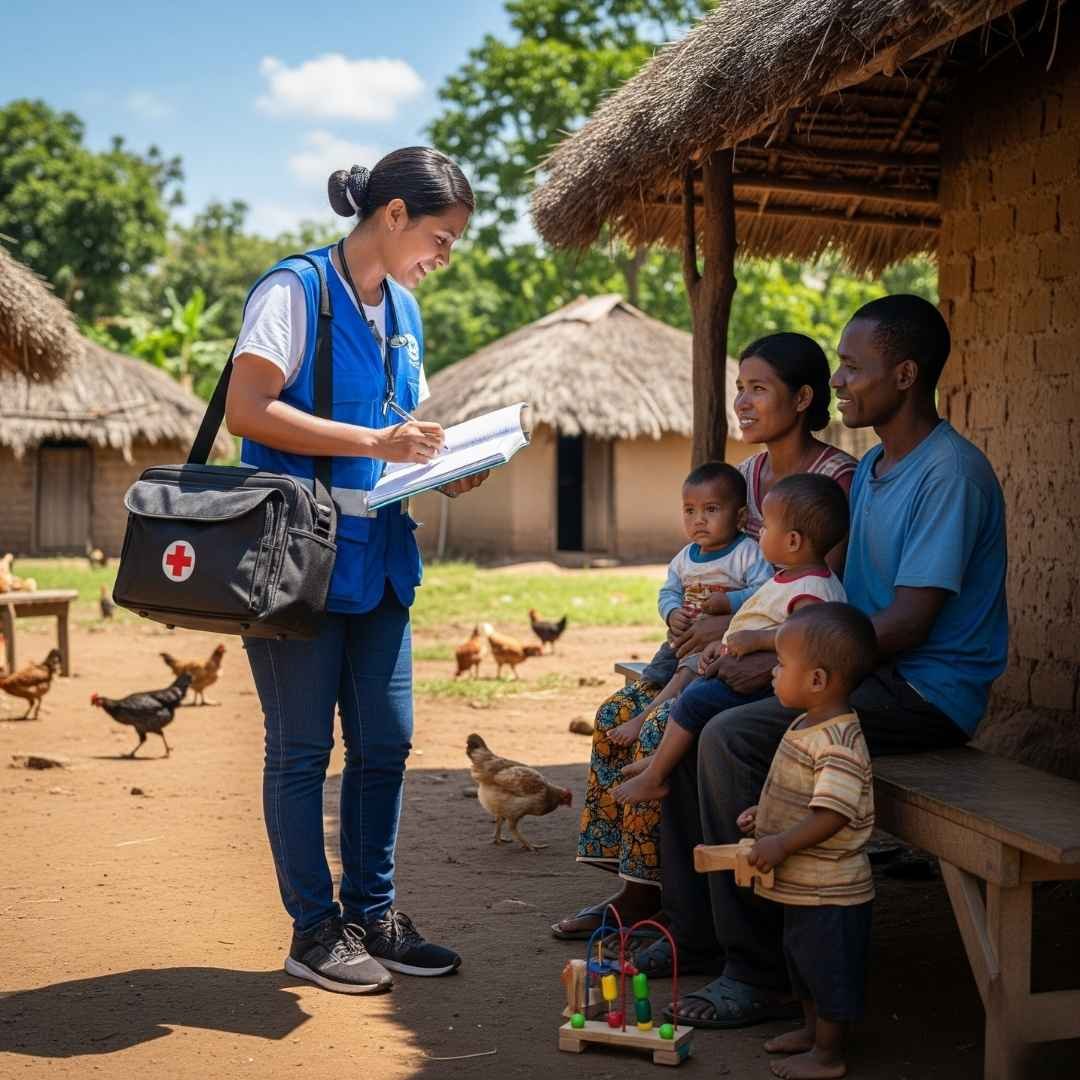
Thus fever comes to the patient in the above-mentioned period. So at this time health workers need to make home visits and take blood samples for early detection and support to stop timely transmission.
Thus, the time it takes for merozoites to form gametocytes is
In Pv = 55 hours, in Pf = 110 hours, and in Pm = 100 hours. In Po = 55 hrs
Hence, the total duration of the asexual life cycle takes 12 to 18 days for completion.
In Pv = 10 + 2.5 = 13 day’s
In Pf = 7 + 5 = 12 days
In Pm = 14 + 4 = 18 days.
In Po = 10 + 2.5 = 13 day’s