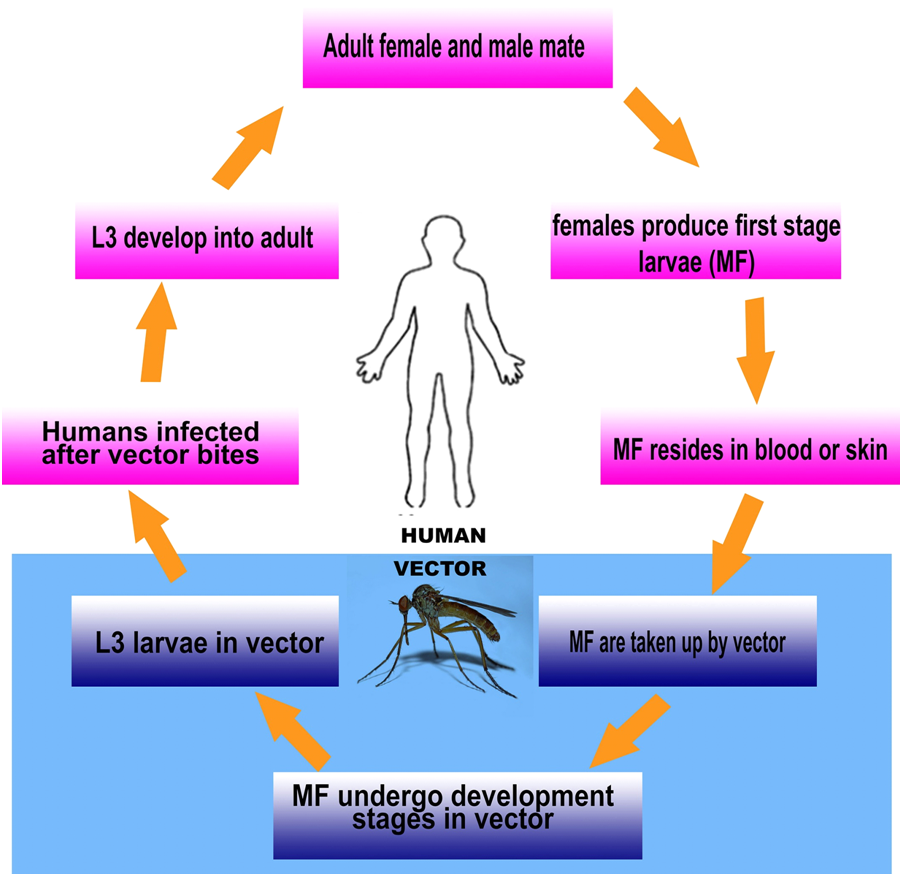



The life cycle of filaria parasites involves three things, e.g.,
1) Mankind –> Primary vertebrate definitive host.
2) Mosquito –> Secondary invertebrate intermediate host
3) Nematode Parasites –> gest
The life cycle of filaria parasites completed into two stages
1) Sexual life cycle of the filaria parasite —> In mankind.
2) Asexual life cycle of filaria parasite —> In Mosquito
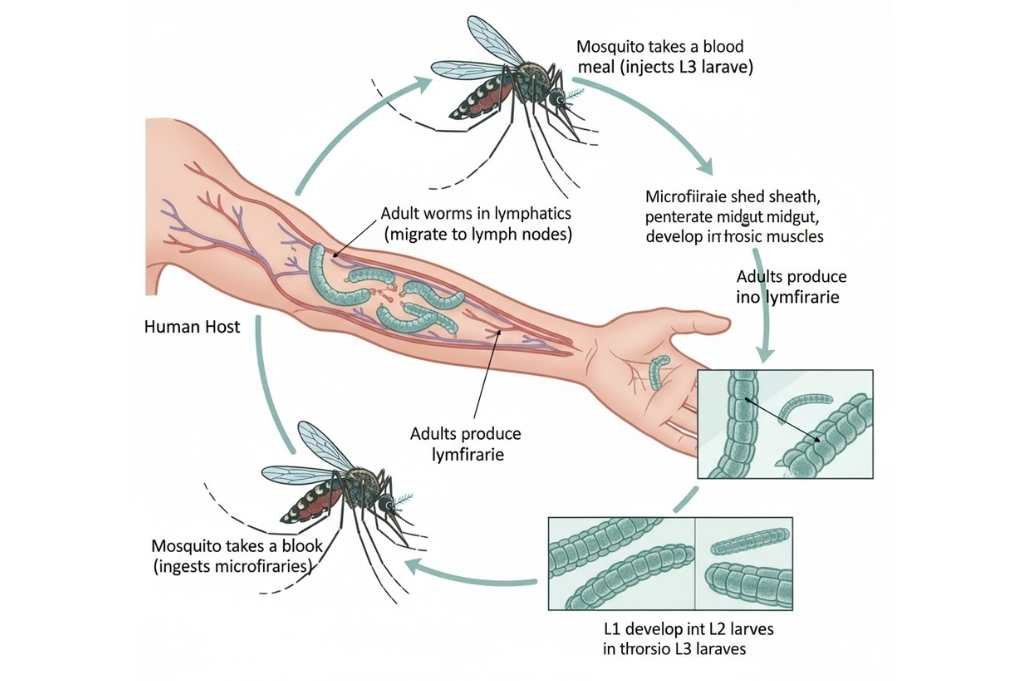
Sexual life cycle of filaria parasite
When an infected female Culex quinquefasciatus mosquito bites healthy mankind, then they deposit the infective larvae (L-3 stages) on the surface of the skin at the site of the mosquito bite, from where they make their way through the capillaries to reach some part of the lymphatic system. Here, they develop into adult worms. The adult parasites are usually found in the lymphatic system of mammals. The female parasites become fertilized by males, and female broods of microfilariae later reach the bloodstream. They give birth to as many as 50,000 microfilariae per day. The female produces microfilariae during the first five years. The life span of microfilariae is not exactly known, but they survive up to three to twelve months. Microfilariae appear in the peripheral bloodstream during midnight; this is called nocturnal periodicity. The adult worms are coiled together in the human lymphatic system. The lifespan of adult worms is 15 to 20 years. The length of the male parasite is 40 micrometers, while the length of the female parasite is 50 to 100 micrometers.
The asexual life cycle of filaria parasite
When female Culex quinquefasciatus mosquitoes suck the blood of healthy mankind, then they pick up microfilariae from the infected person (Mf-carrier) during their blood meal. Within a few hours, mf lose their sheath in the mosquito stomach, become motile, and then they enter (penetrate) into thoracic muscles for further development.
L-1 → After entering the thorax, the L-1 stage develops in two days. The length of L-1 is 120 to 250 microns. The width is 10 to 14 microns. It has a saucer shape with a small tail. It does not have movement.
L-2 → The L-2 is the second larval stage and develops in 3 to 7 days. Its length is 225 to 330 microns and its width 15 microns. It is elongated in the anterior-posterior direction and has slight movement. This stage is called the ‘pre-infective stage.’
L-3 → The L-3 is the third larval stage and develops in 5 days. Its length is 1500 to 2000 microns and its width 18 to 23 microns. It is longer than L-2 and looks like a snake. Its movement is very active. This stage is called the ‘infective stage.’ It is not definitely known how long it takes for the infective larvae (L-3) to develop into adult parasites and produce mf in the man, but the period is estimated to be from a few months to one year (5 months to 18 months, i.e., the incubation period in man).
After developing into L-3 larvae in the thorax, it immediately moves to the mosquito proboscis and remains in the salivary glands. Thus, the mosquito becomes ready for transmission.
Total duration of the cycle is
L-1 —-> 2 days —— 2-day
L-2 —-> 3 days ——-7 days
L-3 —-> 5 day——-5-day
Total → 10 days – 14 days, but when the required temperature is 25 to 30 degrees centigrade and 60% to 70% humidity. (The extensive incubation period is about 10–14 days).
Reservoir of Infection
The reservoir of infection is a person or healthy individuals carrying mf in the peripheral bloodstreams. Such individuals are without any recognizable symptoms of illness. The individuals with advanced disease often turn out to be negative for MF. Man is the natural host. All ages are susceptible to infection. In endemic areas, filarial infection has been recorded even in infants aged 6 months, but infection has been found to rise with age up to 20–30 years of age. Filarial disease cases (i.e., elephantiasis) occur in a small percentage of infected individuals, commonly in the age group over 10 years.