

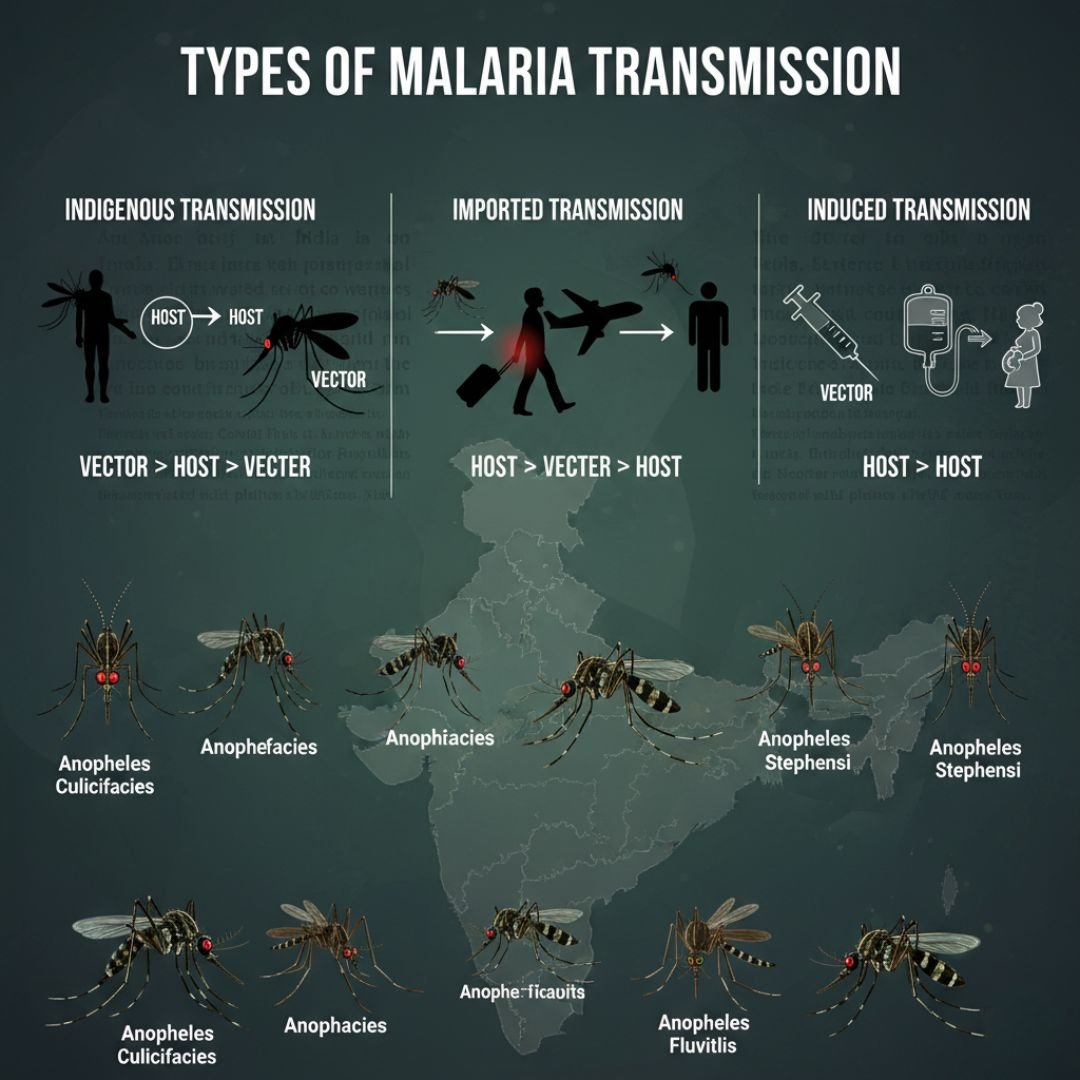
There are three types of transmission of malaria
1) Indigenous transmission of malaria
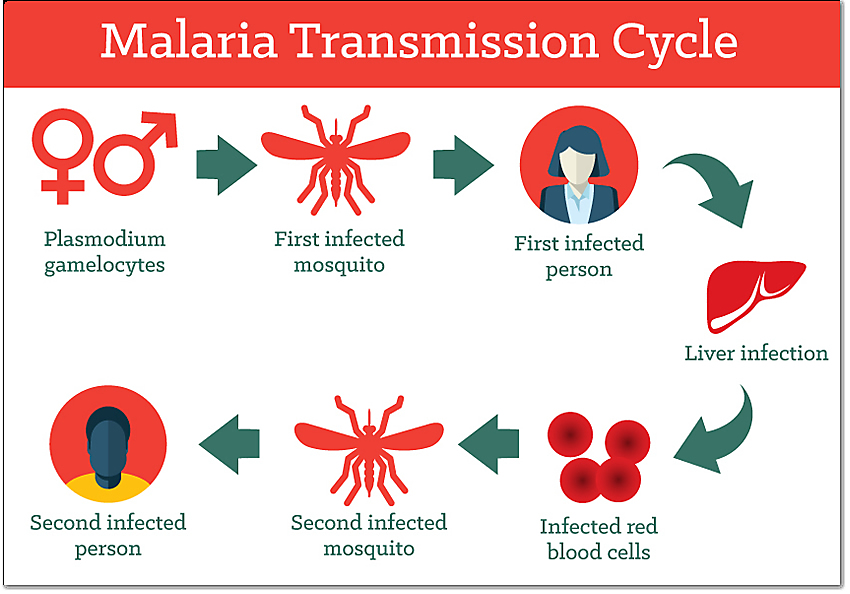
It is a natural cycle of malaria transmission, i.e., Vector —> Host —-> Vector —>It is known as the Indigenous type of malarial transmission. It refers to the local spread of malaria in a specific area. The transmission occurs within the region, not brought in from outside.
2) Imported transmission of malaria
The host (i.e., human) comes from another village, district, or state in an infected area, having already been infected. (i.e., the cycle is Host —> Vector —-> Host). This person having gametocytes comes in contact with another person, and he is a carrier of malaria. Such phenomena are known as imported types of malaria. Outside the area or country, an infected person travels to a non-endemic or malaria-free area, where they spread the transmission.
3) Induced transmission of malaria
Refer to malaria infection that occurs through artificial means rather than through mosquito bites. (e.g., HOST —> HOST). It means
- Blood transfusion: when the host is in the pre-patent period and if he/she donates the blood.
- Needle: In the case of a hypodermic needle, malaria gets transmitted. It is very common in drug addicts.
- Organ or tissue transplants and congenital malaria: This is spread from an infected mother to the newborn.
Vectors’ role in malaria
In the world, there are more than 4000 species of mosquitoes, of which about 424 belong to the Anopheline group and about 70 are the main vectors of malaria. In India there are about 58 species of Anopheline mosquitoes and of these, 11 are vectors of malaria
In India, at least eleven species of Anopheline mosquitoes transmit malaria, with nine species officially recognized by NCVBDC-Delhi.
The vector species play their role in different regions of India. There are six primary vectors, and five are secondary vectors. Primary and secondary roles depend on their regional prevalence, species complex & ecological condition.
Primary Vectors
The important malaria vectors in India are
1) Anopheles Culicifacies: It is a major rural and peri-urban vector in India. It is the most common vector in India except in the Northeast. It has five sibling species with varying transmission efficiency. It has not been reported in the Andaman & Nicobar Islands and Lakshadweep.
2) Anopheles Fluvitilis: Important vector in foothill and forested areas. It is generally a rural vector.
3) Anopheles stephensi: It is a major urban vector and semi-urban vector in a large part of the country except for the Northeast part of India.
4) Anopheles Sundicus or Epiroticus: It is found in coastal areas of the Andaman & Nicobar Islands only.
5) Anopheles Minimus: It is in the northeastern region, in the West Bengal foothill streams.
6) Anopheles Baimaii or Dirus: It occurs in forest-fringe areas in the Northeast. It is highly anthropophilic (human-biting).
Secondary Vectors:-
1) Anopheles Philippinensis (or Nivipes): It breeds in paddy fields. The northeast region of the country (Assam, Bengal).
2) Anopheles annularis: It is found in central India and Orissa, U.P.
3) Anopheles Varuna: It is found in Andhra Pradesh, Jharkhand, Bihar, and Kerala.
4) Anopheles Jeyporiensis: It is often found in forested or rural areas with suitable breeding sites, such as rice fields and slow-flowing streams.
5) Anopheles Subpictus: It is especially found in coastal and certain urban regions where it sustains local transmission. It is found in part of Orissa, coastal South India, and urban areas like Goa.