


Zika Virus Structure
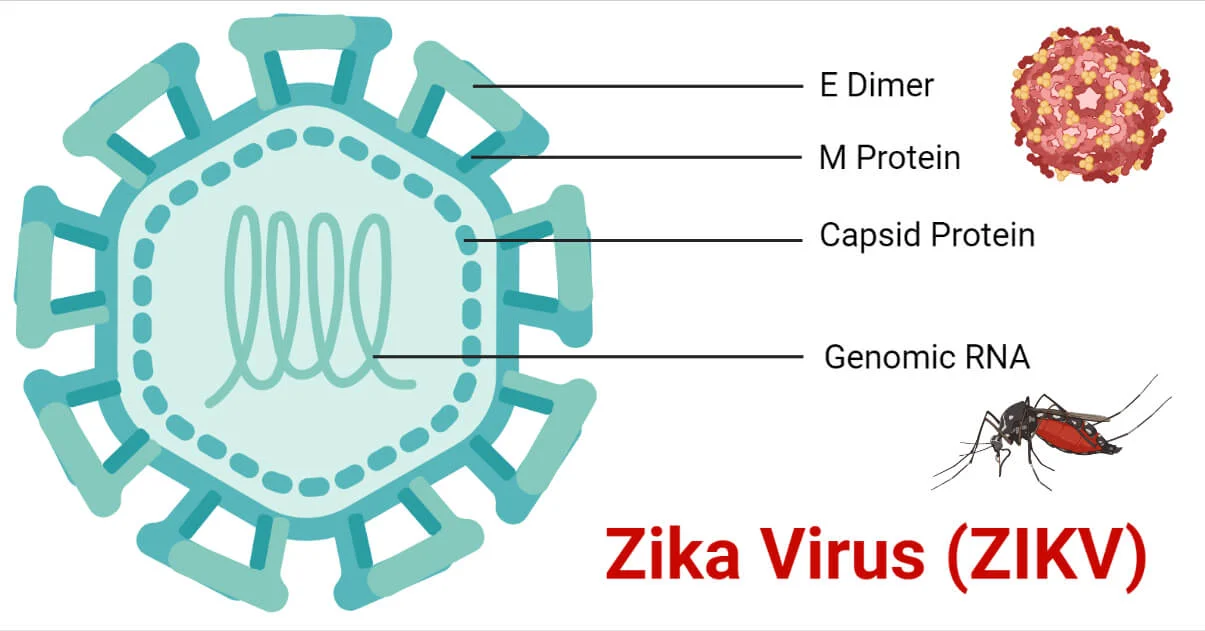
Zika virus is a mosquito-borne flavivirus that primarily spreads through bites from infected Aedes mosquitoes, such as Aedes aegypti and Aedes albopictus. It belongs to the Flaviviridae family and the Flavivirus genus. The Zika virus structure consists of a single-stranded positive-sense RNA genome enclosed in an icosahedral nucleocapsid, surrounded by a lipid envelope with glycoproteins.
Zika virus has three main structural proteins: capsid (C), precursor membrane (prM/M), and envelope (E). Plus seven nonstructural proteins (NS1—NS5). The C protein forms an icosahedral nucleocapsid core (~30 nm diameter).
Structural Proteins of Zika Virus
Capsid (C) Protein
Capsid (C) Protein: The C protein packages the viral RNA genome into a nucleocapsid core, interacting with genomic RNA via positively charged residues. It directs nuclear localization in infected cells and aids virion assembly by binding lipid droplets.
Precursor Membrane (prM/M) Protein
Precursor Membrane (prM/M) Protein: prM protects the envelope protein during virion maturation in the secretory pathway. Shielding the fusion loop until low pH triggers cleavage into mature M. Immature prM-E complexes on virions can enhance infection in some cell types via antibody-dependent enhancement.
Envelope (E) Protein
Envelope (E) Protein: E protein mediates receptor binding membrane fusion via its fusion loop in domain II and virion attachment, arranged as 180 dimers in icosahedral symmetry on the lipid envelope. Domain III facilitates host cell recognition, serving as a key vaccine and antibody target.
Virion Morphology
Virion Morphology: The mature virion measures ~50 nm in diameter with icosahedral symmetry, featuring a lipid envelope studded with 180 copies each of E and M proteins forming a smooth surface. An asymmetric cryo-EM structure reveals a prominent glycosylation site at E protein Asn154, aiding immune evasion unlike some flaviviruses.
Genome Organization
Genome Organization:- A single-stranded positive-sense RNA genome (~ 10.8 kb) encodes a polyprotein cleaved into three structural proteins (C, prM/M, E) and seven nonstructural proteins (NS1 to NS5). Unique stem-loop structures in 5’ and 3’ UTRs regulate replication and packaging.
Transmission Traits
Transmission Traits: Persistent infection in mosquitoes with lifelong viremia, sexual transmission capability, and mother-to-fetus vertical spread distinguish Zika from other flaviviruses. High placental tropism links to microcephaly via NS proteins disrupting neurogenesis.
Magnitude of Zika Virus
Magnitude Of Zika Virus:-
Zika virus magnitude refers to the scale of its global epidemics, peaking dramatically in 2015-2016. The 2015-2016 Americas outbreak saw over 900,000 suspected cases across 65+ countries, with Brazil reporting ~1.5 million cases and more than 4,000 microcephaly cases linked to congenital Zika syndrome. Global age-standardized incidence rates peaked at 174 per 100,000 in 2016.
Geographic Spread of Zika Virus
Geographic Spread Of Zika Virus:
Transmission evidence exists in 92 countries/territories, primarily Latin America/Caribbean (Brazil, Colombia, Ecuador, and Peru) and parts of Asia-Pacific, with ongoing low-level activity into 2025. India reported autochthonous cases in Maharashtra (2021) and Uttar Pradesh (2024), signaling potential emergence in South Asia.
Public Health Impact
Public Health Impact: WHO declared a Public Health Emergency of International Concern in 2016 due to birth defects and neurological risks; over 8,600 malformed births were estimated in Brazil alone. Sexual, perinatal, and transfusion transmission amplified spread beyond mosquitoes.
Trends
Trends: Global cases declined post-2017 due to immunity buildup and surveillance, yet vulnerable regions with Ae. Aegypti vectors face resurgence risk amid climate change.