


Chikungunya Virus Structure
The ‘Chikungunya virus (CHIKV)’ is an enveloped, positive-sense, single-stranded RNA virus belonging to the genus Alphavirus and the family ‘Togavirus.’ Its virion size ranges from 60 nm to 70 nm in diameter, and it has an icosahedral capsid structure surrounded by a lipid envelope.
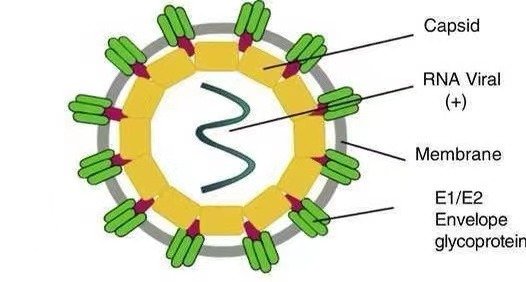
Key Structure Component
1) Genome
Approximately 11.6 kb long RNA genome encoding two major open reading frames, providing nonstructural proteins (nsP1 to nsP4) involved in viral replication and structural proteins for virion assembly.
2) Non-Structural Proteins (nsPs)
nsP1—> methyltransferase for RNA capping
nsP2—> helicase and protease, interferes with host immune response.
nsP3 —> regulates the replication complex.
nsP4—> RNA-dependent RNA polymerase.
3) Structural Proteins
Capsid protein (C): forms the nucleocapsid, protecting the viral RNA.
Envelope glycoproteins E1 & E2 : form heterodimeric spikes critical for virus attachment and entry into host cells. E2 binds to host receptors, while E1 mediates membrane fusion during entry.
E1 Protein: is a class-2 viral fusion glycoprotein that mediates membrane fusion between the viral envelope and host endosomal membrane during the entry process.
E2 Protein: Serves as the main attachment protein, binding to host cell surface receptors and attachment factors such as glycosaminoglycans (GAGs) and entry receptors including MXRA8, CD147 protein complex, DC-SIGN, L-SIGN, prohibitin, and others.
E3 Protein: stabilizes and activates E1
6K Protein: involved in viral budding and assembly.
Virus Entry and Assembly
Chikungunya virus uses E2 glycoprotein to bind cellular receptors, enters cells via receptor-mediated endocytosis, and the acidic endosome triggers conformational changes, exposing E1 for membrane fusion, allowing release of viral RNA into the host cytoplasm. The virus assembles a nucleocapsid with capsid protein and RNA.
This structural organization facilitates CHIKV infection, replication, immune evasion, and transmission by mosquito vectors.
Thus, CHIKV features an icosahedral capsid surrounded by a lipid envelope with key structural proteins (capsid, E1, E2, E3, and 6K) essential for viral entry, assembly, and budding, while non-structural proteins orchestrate replication and immune evasion.