


1) Clinical Diagnosis: Once malaria is suspected on clinical grounds, laboratory confirmation is mandatory.
2) Laboratory Diagnosis: Laboratory diagnosis methods for detecting Plasmodium parasites in whole blood are crucial. There are two methods; use depends upon ecological condition.
Direct evidence
Direct evidence of the presence of the malaria parasite in the whole blood
MICROSCOPY (Gold Standard):- By surveillance, taking a blood smear for the patient through active and passive surveys is the primary and most common method, and the thick & thin smears are examined microscopically and identified not only by species but also by their stages.
A) Thick smear: used for detecting the presence of parasites and their density (parasitemia) in less time
B) Thin Smear: It is used for confirmation of parasite species & observing morphological characteristics of species.
Indirect evidence
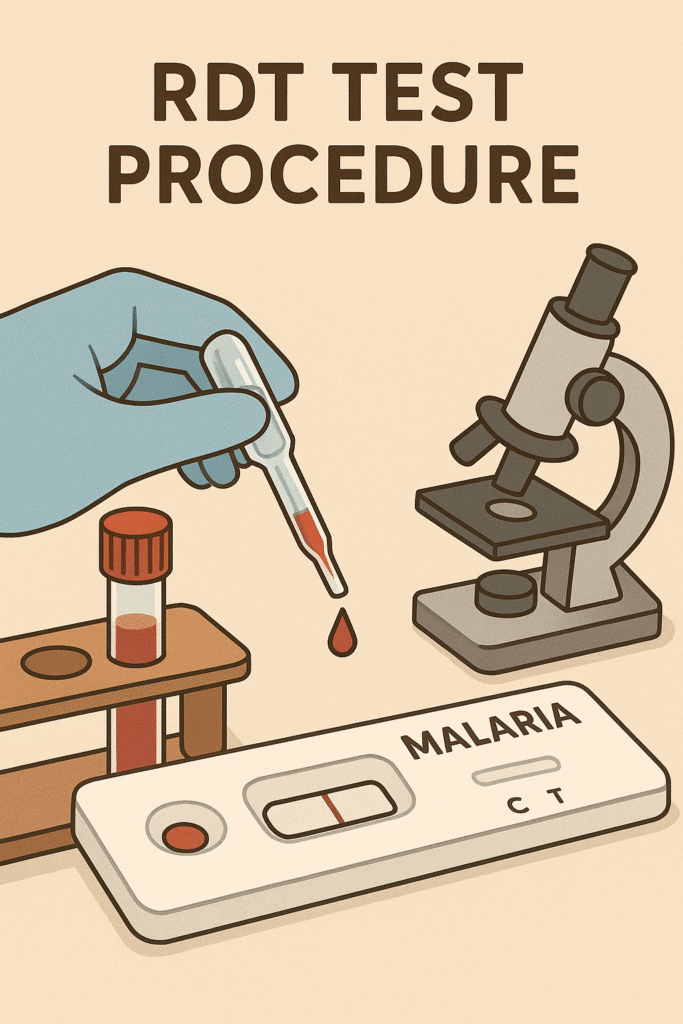
Indirect evidence tests for malaria involve detecting antibodies or antigens in the blood. But nowadays, only the antigen RDK is mostly preferred for the identification of malaria. e.g., RDK or RDT: – These are immuno-chromatographic test (ICT) assays that detect malaria antigens in the blood. RDK targets specific antigens produced by different malaria species, such as P. falciparum & P. vivax.
The most common antigens detected are HRP2 (histidine-rich protein-2) for P. falciparum and pLDH (parasite lactate dehydrogenase) for P. vivax species.
pLDH: Found in all four human Plasmodium species, with some RDTs detecting species-specific pLDH.
Aldolase: A pan-material antigen found in all species.
Advantages of RDK/RDT
RDk is a valuable alternative to microscopy, especially where there is no laboratory, no laboratory technician available, or a remote area. Results are obtained within minutes and do not require special training or good handling.
Disadvantages of indirect evidence (i.e., RDK/RDT)
1) False Negative: When there is low parasite density, in the case of gene detection, sometimes RDT can produce a false negative result.
2) False-Positive: Areas with high malaria transmission RDK can result in false-positives.
3) RDK may have varying sensitivity and specificity for different malaria species.
Advantages of Direct Evidence (i.e., Microscopy)
The microscopy method allows accurate identification of species (one or more). To know parasite density. To know infected RBC & WBC. To know the morphological characteristic of parasites & blood content. Identified different developmental stages.
Disadvantages of Direct Evidence (i.e., Microscopy)
Well-trained microscopists are essential for accurate results, especially at low parasite densities or in mixed infections. Often mistaken for P. falciparum or P. malariae under a microscope. Blood smear quality, staining quality, DHB, and staining procedure affect the microscopic result.