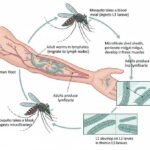



Filariasis is typically acquired during childhood through the bite of an infected female Quinquefasciatus mosquito. The parasite can remain and multiply undetected for up to 18 years inside the body. The disease usually manifests many years later, in adulthood.
The microfilariae (Mf) damage the lymphatic system, resulting in lymphedema of the arms, breasts, and legs.
- The most common manifestation of lymphatic filariasis (LF) among men is hydrocele.
- Damage to the lymph system leads to recurrent bouts of fever and skin infection, causing the skin to harden and thicken, which results in elephantiasis.
- Obstruction of the lymphatic system by adult worms and subsequent bacterial infection are the two most important factors in causing elephantiasis.
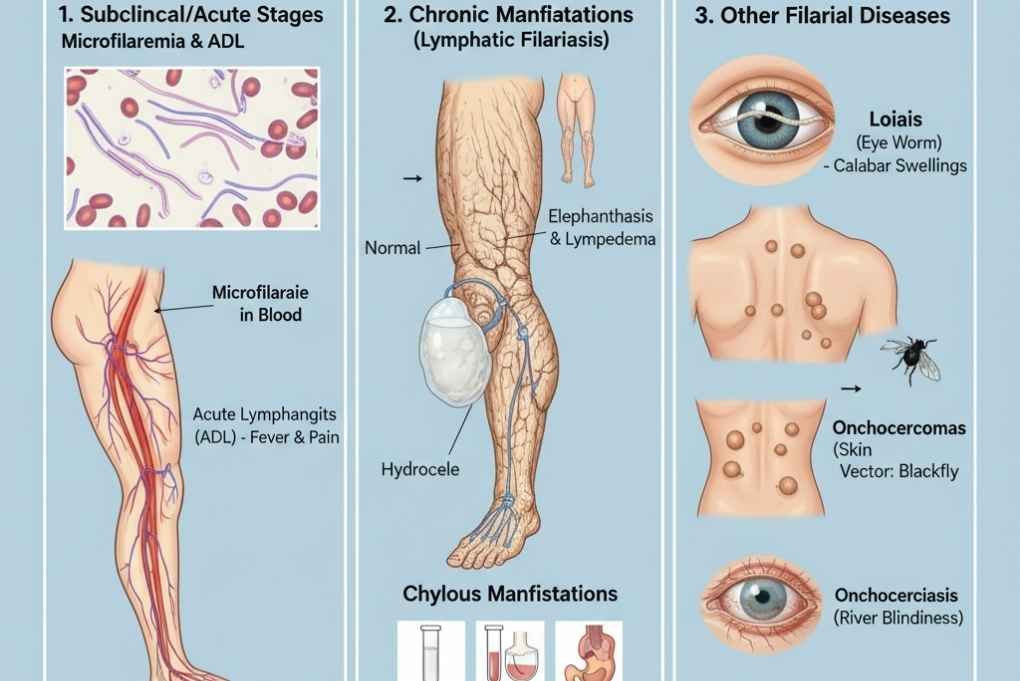
Stages of Filarial Infection
There are generally four stages in the filarial infection in the human host. The clinical manifestations depend upon the stage of infection and the load of adult parasites in the host.
A) Stage of Invasion
- The infective larvae enter the human host and begin further development in the lymph nodes and lymphatic system.
- Adult filarial parasites (male and female) develop in the lymphatic system.
- Microfilariae (Mf) are not produced by the adult female at this stage.
- The patient experiences symptoms such as fever, rigor (shivering), headache, and lymphadenopathy.
- At this stage, filariasis cannot be confirmed by a blood examination.
B) Asymptomatic Stage or Carrier Stage
- This stage usually has no clinical manifestation.
- The adult female produces Mf at this stage.
- The Mf are usually detected by a night blood examination.
- The patient considers themself healthy and disease-free but is a carrier of the disease.
- Diagnosis cannot be made based on signs and symptoms.
- This condition may persist for years.
- Not all patients progress to the advanced next stage.
- This condition can be completely cured with medicine and treatment.
C) Acute Stage or Acute Manifestations
- Acute manifestations include filarial fever, lymphangitis, lymphadenitis, lymphedema of various body parts, and epididymoorchitis in the male.
- Swelling also appears on the breast.
- These symptoms are mainly due to the infection of the lymphatic vessels by adult worms.
- Such attacks occur repeatedly.
- In elephantiasis, the urine can become whitish and milky (chyluria), and Mf may be found in the urine.
- The swelling subsides in a few days.
- This condition can be completely cured with proper medical treatment.
Associated Pathological Conditions (Acute)
- Acute manifestations include:
- Fever.
- Painful swelling of the lymph glands (lymphadenitis).
- Reddish streaks on the limbs (lymphangitis).
- These are often accompanied by painful, soft, and pitting swelling or edema of the extremity, which often subsides, leaving a persistent residual swelling.
- Filarial fever may occur at intervals of weeks, months, or years.
- The onset of fever is usually sudden, and the temperature may reach 39°C to 40°C, often accompanied by rigor (shivering) and sweating.
The temperature may return to normal within 24 hours or may last for two to three days.
D) Chronic Stage or Chronic Manifestations
- These chronic stages develop over years, often after repeated and intense exposures.
- Chronic filariasis most commonly leads to:
- Lymphedema of the limbs, breasts, genitalia, legs, or arms.
- Hydrocele.
- Chyluria (milky/whitish urine).
- Advanced cases progress to elephantiasis, which is the thickening and hardening of the skin and subcutaneous tissues.
- Chronic lymphedema may be complicated by acute attacks due to secondary bacterial infection, which worsens the skin changes.
- Persons in the chronic stage (disease cases) are usually found negative for Mf in their night blood sample.
While suffering from the disease, they are generally not important from a community point of view because they do not have the microfilaria circulating in their blood to infect mosquitoes.