



Biological control methods play a very important role in mosquito control activities. Two larva-eating fish are used
- Gambusia affinis (mosquito fish)
- Poecilia Reticulata (guppy or rainbow fish)
These two types of fish are known as larva-eating fish.
- These fish eat more larvae than adult mosquitoes.
- They survive easily in freshwater sources and are highly useful.
- Before releasing these fish into water collections, it is necessary to carefully estimate the number of eggs that will be laid there by mosquitoes.
- Fish can reduce mosquito breeding significantly in both malaria and filaria endemic areas.
1) Gambusia affinis (Mosquito fish)
- In 1928, Dr. B.A. Rao imported these fish from Italy and established a large-scale fish production center in the state of Mysore.
- Gambusia affinis is commonly known as the western mosquitofish.
- This fish is viviparous.
- Female fish are 6 to 621 cm long, olive green in color, and suited for surface feeding.
- Male fish are 2 to 321 cm long and smaller than females.
- Breeding Season: It varies in different provinces depending on the weather and environment, but it is usually from November to October.
- Females give birth at monthly intervals.
- They develop into mature fish within two months.
- One female gives birth to 250 to 300 young at a time.
- They eat all kinds of mosquito larvae.
- They especially prefer Anopheles larvae.
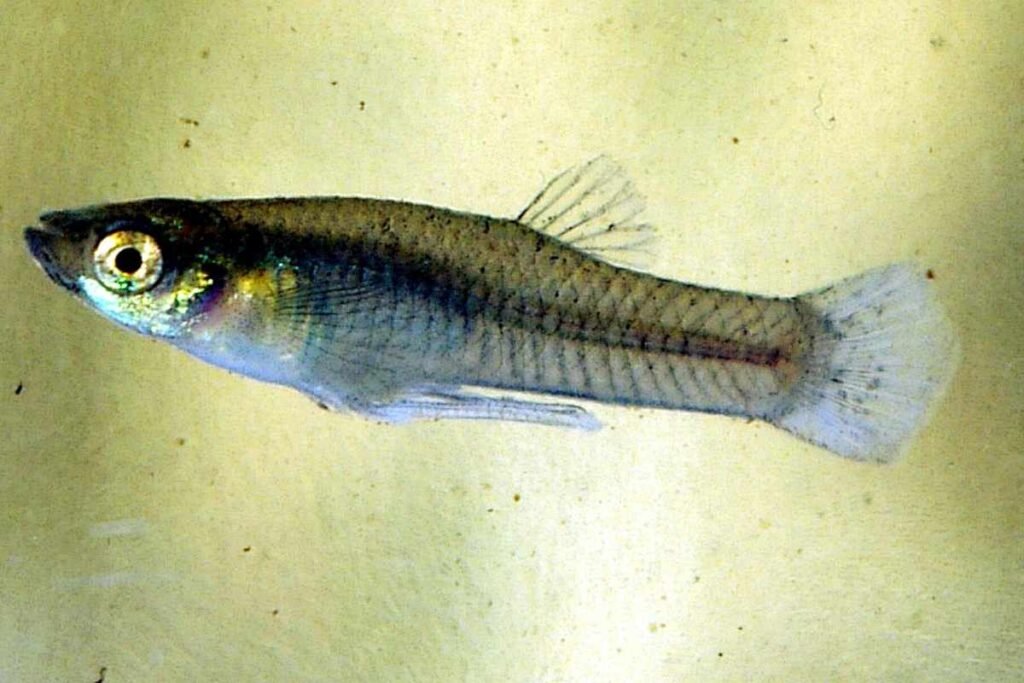
2) Poecilia Reticulata (Guppy fish)
- In 1910, India used it to reduce mosquito density under the malaria control program.
- In 1967, it was found in large quantities in the ‘Nag River’ in Nagpur, Maharashtra state, and since then it has been widely used everywhere in malaria and filaria control programs.
- The National Institute of Communicable Diseases, Delhi, started its work by bringing the above fish from Nagpur on a large scale as a larvae eater.
- Guppy fish are ovoviviparous, meaning embryos develop internally and young are released live and fully formed.
- Females can store sperm from multiple males, and brood sizes range from 20 to 40 fry every 4 to 6 weeks, enabling quick population growth.
- Guppy fish can survive even in dirty, polluted water.
- They cannot survive if the temperature drops below 10° to 11° Celsius.
- Similarly, it cannot tolerate temperatures above 42° Celsius.
Differences between Male and Female Guppy Fish
| Male Fish | Female Fish |
| 1) The stomach is flat. | 1) The stomach is big. |
| 2) It is small and thin in size. | 2) The female is larger and more aggressive. |
| 3) The pelvic fin is long and close to the anal fin. | 3) The pelvic fins are small; the anal fin does not reach the pelvic fin. |
| 4) The anal fin serves as the gonopodium (i.e., external genitalia). | 4) There is no gonopodium. |
| 5) Dorsal and pectoral fins are large and light. | 5) Dorsal and pectoral fins are normal. |
| 6) Colored spots are over the body. | 6) The brown colour is everywhere. |