



Definition:
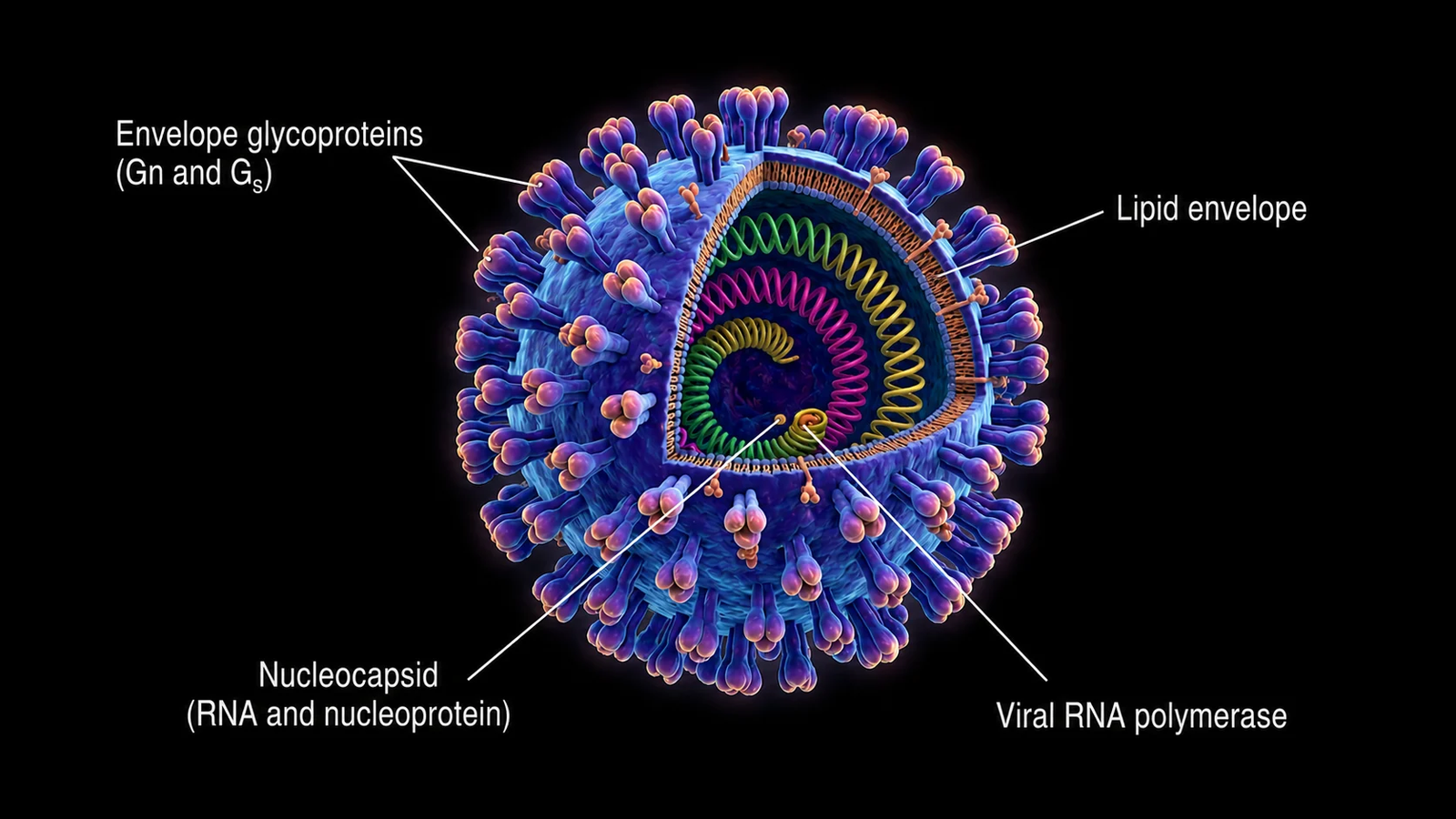
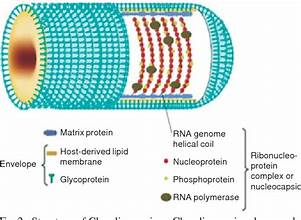
Chandipura virus is an enveloped, single-stranded, negative-sense RNA virus belonging to the family Rhabdoviridae and genus Vesiculovirus. Characterized by bullet-shaped particles, 150-160 nm long and 50-60 nm wide, showing distinct surface projections 9-11 nm in size and a stain-filled canal at the base of the virus particles.
Its key structure & genome features include:
1) Virion structure:
- Rod-shaped virion with a lipoprotein envelope derived from the host cell membrane.
- The envelope is embedded with glycoprotein. Spikes (G protein) are responsible for receptor recognition and membrane fusion during host cell entry.
- Inside the envelope, the matrix protein (M) lines the inner surface, connecting the nucleocapsid to the envelope and playing a role in virus assembly and budding.
2) Genome:
- The viral genome is approximately 11,120 nucleotides long.
- It has a single, non-segmented, negative-sense RNA coding for five major proteins in the order of 3′-Nucleoprotein (N), -Phosphoprotein (P), -Matrix protein (M), -Glycoprotein (G), and -Large protein (L). -5 ‘
- The three end has a non-coding 49-nucleotide leader sequence, and the five end contains a 46-nucleotide trailer sequence.
3) Proteins:
- Nucleoprotein (N): Encapsidates the RNA genome, protecting it from nucleases and facilitating RNA synthesis.
- Phosphoprotein (P): Cofactor for RNA-dependent RNA polymerase, important for transcription and replication.
- Matrix protein (M): Connects the nucleocapsid to the envelope, aids viral assembly, and inhibits host antiviral responses.
- Glycoprotein (G): Mediates attachment to host cell receptors and membrane fusion; major antigenic determinant.
- Large protein (L): The catalytic subunit of RNA polymerase with multiple enzymatic functions, including RNA synthesis, capping, and polyadenylation.
4) Viral Life Cycle (CHPV)
Occurs in the cytoplasm of host cells.
Transcription produces monocistronic mRNAs for each gene.
Replication produces full-length positive-sense antigenomes, which serve as templates for genome synthesis.
Chandipura virus particles assemble at the host membrane and bud off to infect new cells.
The glycoprotein G has been structurally studied, revealing conformational changes at low pH during fusion similar to other vesiculoviruses. The matrix protein also plays a critical role in viral pathogenicity by modulating host cell gene expression.
The structural and genomic organization underpins CHPV’s replication, transmission, and pathogenicity, making it a distinct member of the Rhabdoviridae family implicated in acute encephalitis outbreaks primarily in India.