



Fogging guidelines for dengue fever vector (Aedes egypti) control focus on timely, targeted application of insecticides to reduce Aedes mosquito populations and interrupt virus transmission. Details of operational principles commonly recommended in dengue fever outbreaks are given below.
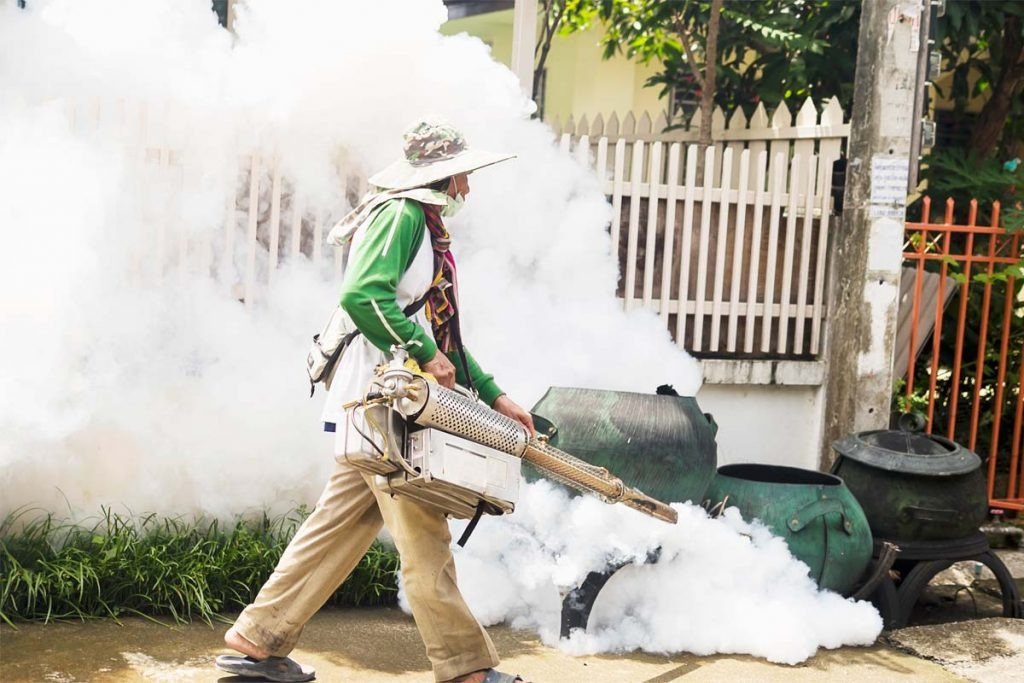
Method for Door-to-Door Fogging in the Village:
Indoor fogging should be conducted to kill Aedes aegypti mosquitoes and achieve effective vector control.
- First, remove all food items, drinking water, children, pets, and other living beings from the room.
- Next, close all the windows of the room tightly to ensure no fog escapes outside. After sealing the room, carry out fogging and immediately close the door. Keep the room sealed and closed for two hours.
- After two hours of sealing, all mosquitoes and other living creatures inside the room will be killed. Therefore, ensure that no living beings, people, or food and drink items remain inside the room during fogging.
- Repeat the fogging process throughout the entire village.
- Fogging should be done early after dengue case notification, ideally within 2 days of confirmed cases or clusters and repeated as needed
- Priority given to areas within at least 200-meter radius around reported dengue cases or clusters to cover Aedes mosquito flight range
- Fogging is done as a part of an integrated program including larval source reduction and community education, not as a standalone measure.
Best timing for Fogging , environmental conditions, and Methods
- Perform fogging during times when Aedes mosquitoes are most active and seeking hosts, i.e., typically early morning or evening. Either 6:00 to 11:00 AM or 5:00 to 7:00 PM
- Optimal environmental conditions include wind speeds less than 10 km per hour and temperatures below 28°C. And humidity below 85% to ensure effective insecticide dispersal and mosquito activity.
- Avoid fogging during or immediately after rainfall, as droplets may settle and reduce insecticide contact.
- Use a combination of vehicle-mounted and handheld fogging machines to cover streets and areas difficult to access by vehicle.
- Vehicle speed should be maintained at 5 to 8 km/hour. For even distribution of insecticide.
- Fogging should be applied downwind first, progressing systematically upwind.
- Residents are advised to keep doors and windows open to allow insecticide fog inside houses for indoor mosquito control.
- Operators must use protective gear like masks and avoid prolonged exposure.
- Notify communities in advance about fogging schedules and safety precautions.
Limitations of Fogging
- Fogging primarily knocks down adult mosquitoes but does not affect eggs, larvae, or pupae.
- Fogging alone is insufficient for long-term control but useful only for rapid adult population suppression during outbreaks.
- Fogging should be avoided during windy conditions, rainfall, or extreme heat, as they reduce the effectiveness of the insecticide dispersion and mosquito activity.
- Overuse of insecticides should be avoided.
- Insecticides should not be used continuously for more than three years.
- The same insecticide should not be used for both larval control and mosquito control.
- Spraying/fogging should be carried out with high-quality standards.
- Priority should be given to biological control methods.
Recommended insecticides for fogging
The recommended insecticides and their concentrations for fogging, i.e., space-spraying, to control adult mosquito vectors like Aedes spp. responsible for dengue transmission, mainly include pyrethroids such as cyfluthrin, deltamethrin, bifenthrin, synthetic pyrethrins, etc.
Indoor fogging for dengue vector control
Pyrethrum extract is commonly used for fogging as an insecticide to control the dengue vector mosquitoes, Aedes aegypti. The general formulation involves diluting 1 liter of 2% pyrethrum extract with 19 liters of kerosene or diesel to prepare a 0.1% pyrethrum formulation, which is the ready-to-spray solution.
Two main methods of fogging are applied
Thermal fogging
The pyrethrum formulation is sprayed using thermal fogging machines, which produce a dense fog by vaporizing the insecticide formulation at high temperature. This is typically applied at an insecticide rate of about 30 to 60 ml/1000 cubic feet.
ULV (Ultra-Low-Volume) fogging
In this method a very fine aerosol of the pyrethrum formulation is sprayed using specialized ULV fogging, enabling better coverage and penetration into mosquito resting places.
The pyrethrum fogging is usually done using hand-operated fogging machines or pump-operated devices fitted with micro-discharge nozzles for effective dispersal indoors or outdoors. Indoor pyrethrum fogging is often carried out on a fortnightly basis, with up to three rounds recommended for maximum effectiveness in dengue control.
Some insecticide formulations are summarized below
| Sr. No. | Insecticide | Formulation Concentration | Solvent | Method | Doses/Volume | Use |
| 1 | Pyrethrum Extract | (2%) 1:19 | kerosene | Thermal fogging | 30-60 ml/1000 cubic feet | Indoor |
| 2 | Malathion | 96% technical diluted to 5% | Diesel/kerosene | Thermal fogging | 30-60 ml/1000 cubic feet | Outdoor |
| 3 | Deltamethrin | 2.5% or 5% EC | Water/Oil | ULV fogging | 0.5-1 g ai per hectare | Indoor/Outdoor |
| 4 | Cyfluthrin | 5% EC | Water/Oil | ULV fogging | 0.5-1 g ai per hectare | Indoor/Outdoor |
Here,
0.5-1 g means 0.5 to 1 gram of the active ingredient (ai) of the insecticide is applied over an area of one hectare, i.e., 10,000 square meters.
“G” stands for grams, and “ai” means active ingredient.
Primarily uses insecticides like pyrethrum extract formulations and cyphenothrin 5% EC.
- Pyrethrum is diluted in kerosene to make a 0.1% ready-to-spray formulation, applied using a Flit pump or hand-operated fogging machine with micro discharge nozzles at approximately 30 to 60 ml per 1000 cubic feet.
- Cyphenothrin 5% EC is also recommended for indoor fogging.
- Malathion is mainly used for outdoor fogging and not typically indoors.
Fogging techniques used indoors include thermal fogging and space spraying. Thermal fogging vaporizes the insecticide using heat, commonly with diesel as a carrier, which condenses into a fine mist or cloud, providing rapid knockdown of adult mosquitoes. For indoor fogging, the dose of insecticide is about 0.5 mg of active ingredient. Per square meter, typically prepared as 20 ml of insecticide in one liter of kerosene oil.
Indoor fogging is done to target adult Aedes aegypti mosquitoes resting or flying indoors, with fog disseminated through rooms where mosquitoes are likely to be found. It is advised to prepare rooms by removing food, covering drinking water storage, and sealing windows to maximize efficacy. Thermal fogging indoors creates a dense insecticidal fog that kills adult mosquitoes on contact.