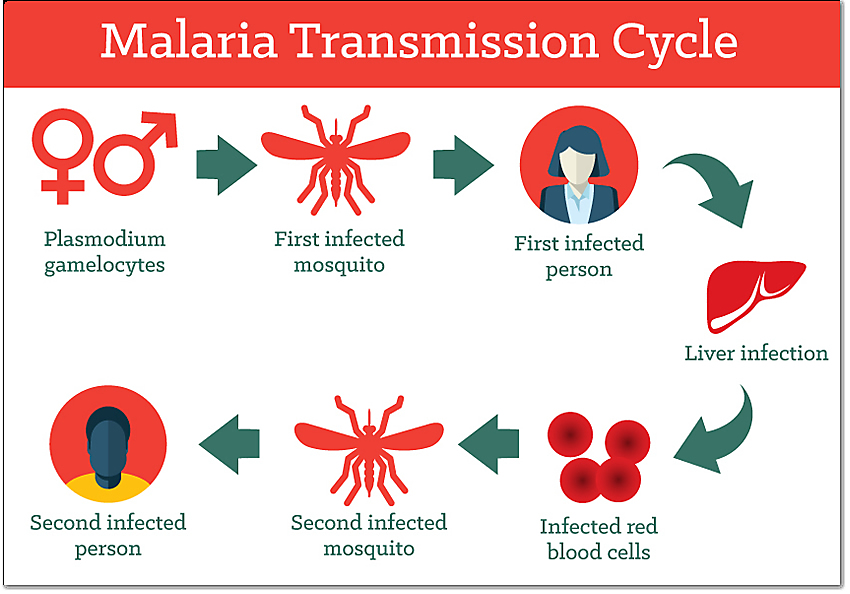


The transmission cycle of dengue fever involves a human–mosquito–human cycle transmitted by infected female Aedes mosquitoes.
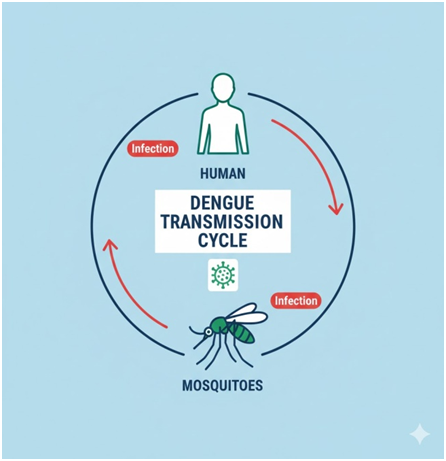
Transmission Cycle Steps
The cycle begins when a female Aedes mosquito bites an infected human and then transmits the virus to a new human.
1. Mosquito Bites an Infected Human
A female Aedes mosquito feeds on a person infected with the dengue virus during the viremic phase. when the virus is present in the blood. This includes symptomatic, pre-symptomatic, and asymptomatic individuals.
2. Virus Replicates in Mosquito
Inside the mosquito’s midgut, the virus multiplies and spreads to secondary tissues. including the salivary glands. This period, known as the Extrinsic Incubation Period (EIP), lasts about 8–12 days at typical tropical temperatures (25°C–30°C).
3. Mosquito Transmits Virus to New Human
Once the virus reaches the salivary glands, the mosquito becomes infectious. It can then infect other humans by injecting virus-containing saliva into the skin when biting them. The mosquito remains infectious for the rest of its life, generally about 3–4 weeks.
4. Human Incubation Period
After infection, the human goes through an intrinsic incubation period of 3–14 days before symptoms appear.
5. Infected Human Can Infect Mosquitoes
The human becomes viremic (virus in blood), making them infectious to mosquitoes for about 4–5 days. which can be longer. thus continuing the transmission cycle.
Factors Influencing the Extrinsic Incubation Period (EIP)
The EIP is defined as the time from when a mosquito ingests infected blood to when it becomes infectious. It is primarily influenced by temperature.
Factors That Shorten EIP
Higher Temperature
Warmer ambient temperatures (between 25°C and 30°C) accelerate viral replication and dissemination within the mosquito. This can reduce the EIP from about 12 days at lower temperatures (nearly 20°C) to as few as 7 days or less. The ideal range for dengue virus transmission by Aedes aegypti is roughly 22°C–32°C.
Adequate Nutritional Status
Well-nourished mosquitoes develop the infection faster, which may shorten the EIP.
Optimal Temperature Range
The ideal range for dengue virus transmission by Aedes aegypti is roughly 22-32°C. Within this range, viral replication is efficient, and mosquitoes remain healthy enough to live long enough to transmit.
Vector Genetic Variability
Some mosquito populations are genetically predisposed to transmit the virus faster, potentially shortening the EIP.
Factors That Lengthen EIP
Lower Temperatures
Cooler temperatures, such as below 22°C, slow viral replication and dissemination, lengthening the EIP and reducing transmission potential.
Temperature Fluctuation
Large temperature variations, especially when the average temperature is below 18°C, can prolong the EIP and weaken viral replication.
Mosquito Mortality and Fitness
Infection itself can shorten a mosquito’s lifespan. Stressed or unhealthy mosquitoes may have an extended or aborted EIP, as the virus may not reach the salivary glands before the mosquito dies.
Genetic Constraints and Immune Responses
Mosquito antiviral pathways (RNAi, Toll, and IMD) and heat shock proteins, which are regulated by temperature, can suppress viral replication and prolong the EIP.
Additional Notes on Transmission
Mosquito Infectiousness
The mosquito remains infectious for life after getting infected, generally about 3–4 weeks.
Rare Transmission Routes
Rare routes of transmission include vertical transmission from infected female mosquitoes to their offspring and sporadic infection through blood transfusions, organ transplants, or possibly breast milk and sexual contact.
Summary table for dengue transmission cycle steps:
1) Infectious human Viremic for 4—5 days, virus in blood
2) Mosquito bites infectious human: A female Aedes mosquito ingests virus blood
3) Virus Incubation In mosquitoes, an extrinsic incubation period of 8—12 days
4) The mosquito becomes infectious; the virus reaches the salivary glands and is infectious for the mosquito’s lifespan.
5) Mosquito bites: The new Humanà virus is transmitted via saliva injection during a bite.
6) The human intrinsic incubation period is 3-14 days (average 4-7) before symptoms appear.