

Overview of Dengue Virus
The dengue virus (DENV) is an enveloped, positive-sense, single-stranded RNA virus belonging to the Flavivirus genus. Its genome is approximately 10,700 nucleotides long, coding for three structural and seven non-structural proteins.
Structural Proteins
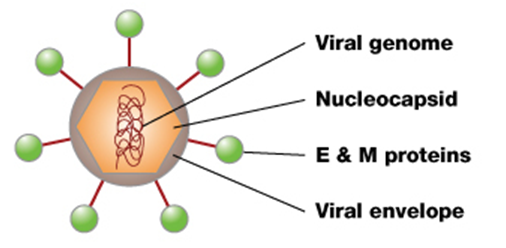
The DENV structural proteins are
1. Capsid (C)
A small protein (around 100 amino acids) that forms the nucleocapsid shell enclosing the RNA genome.
2. Membrane (M) / Pre-Membrane (prM)
Initially produced as prM, which protects the envelope protein (E) during assembly. During maturation, prM is cleaved to M.
3. Envelope (E)
The major surface protein (around 495 amino acids). It is arranged as 90 dimers in the mature virion. The E protein is responsible for receptor binding, membrane fusion, and antigenicity. It has three domains and lies flat on the viral surface, contributing to the smooth appearance of the mature virion.
4. Maturation Process
Immature virions have spiky surfaces formed by prM-E heterodimers. This changes to a smooth surface as prM is cleaved during transit through the Golgi apparatus under acidic conditions.
Kinds of Dengue Fever (Clinical Classification)
Dengue fever is clinically classified based on severity.
1. Classic or Simple Dengue Fever (DF): Usually a self-limiting febrile illness.
Symptoms: Fever, headache, muscle and joint pain, rash, and mild bleeding.
WHO 2009 Classification: Dengue without warning signs.
2. Dengue Hemorrhagic Fever (DHF): A more severe form characterized by increased vascular permeability.
Symptoms/Features:
Plasma leakage, thrombocytopenia (<50,000 platelets/mm$^3$), hemorrhagic manifestations, and sometimes shock.
WHO 2009 Classification: Dengue with warning signs.
3. Dengue Shock Syndrome (DSS): The most severe form.
Features: Circulatory failure, shock, and organ dysfunction due to severe plasma leakage.
WHO 2009 Classification: Severe Dengue.
Dengue Virus Serotypes
The virus itself has four serotypes. There are four antigenically distinct serotypes: DEN-1, DEN-2, DEN-3, and DEN-4.
- Infection with one serotype generally gives lifelong immunity to that specific serotype but only short-term cross-immunity to others.
- All serotypes can cause any clinical type of dengue, though some are linked to higher severity.
- Severe dengue cases are more frequent in secondary heterologous infections (involving a different serotype than the first) due to antibody-dependent enhancement.
Clinical Impact Differences of Serotypes
| Serotype | Clinical Severity / Notes |
| DENV-1 | Typically causes milder infections. Can still cause severe disease, especially in secondary infections. |
| DENV-2 | Associated with the highest severity of disease and accounts for a large proportion of severe dengue cases (DHF and DSS). |
| DENV-3 | Can cause severe illness, often in secondary infections. Tends to cause milder disease on average. |
| DENV-4 | Often linked to hepatic involvement (e.g., liver enzyme elevation, hypoalbuminemia). Sometimes it has severity comparable to DENV-2. |
Note: Coinfections with multiple serotypes can also lead to more severe liver dysfunction and clinical outcomes. Laboratory profiles show all serotypes cause thrombocytopenia and leukopenia but differ slightly in mean lymphocyte and neutrophil percentages.
Summary Table
| Sr. no. | Dengue Type | Clinical Feature | WHO 2009 classification |
| 1 | Classic Dengue fever (DF) | Fever, headache, myalgia, rash, and mild bleeding. | Dengue without warning signs |
| 2 | DHF | Plasma leakage, thrombocytopenia, hemorrhage. | Dengue with warning signs |
| 3 | DSS | Circular shock, Organ failure | Severe Dengue. |
| Sr. no. | Serotypes | Clinical Severity | |
| 1 | DENV-1 | Typically milder infections. | |
| 2 | DENV-2 | Higher risk of severe dengue, including DHS & DSS. | |
| 3 | DENV-3 | Can cause severe illness, often secondary infection | |
| 4 | DENV-4 | Often linked to hepatic involvement and severity. | |